
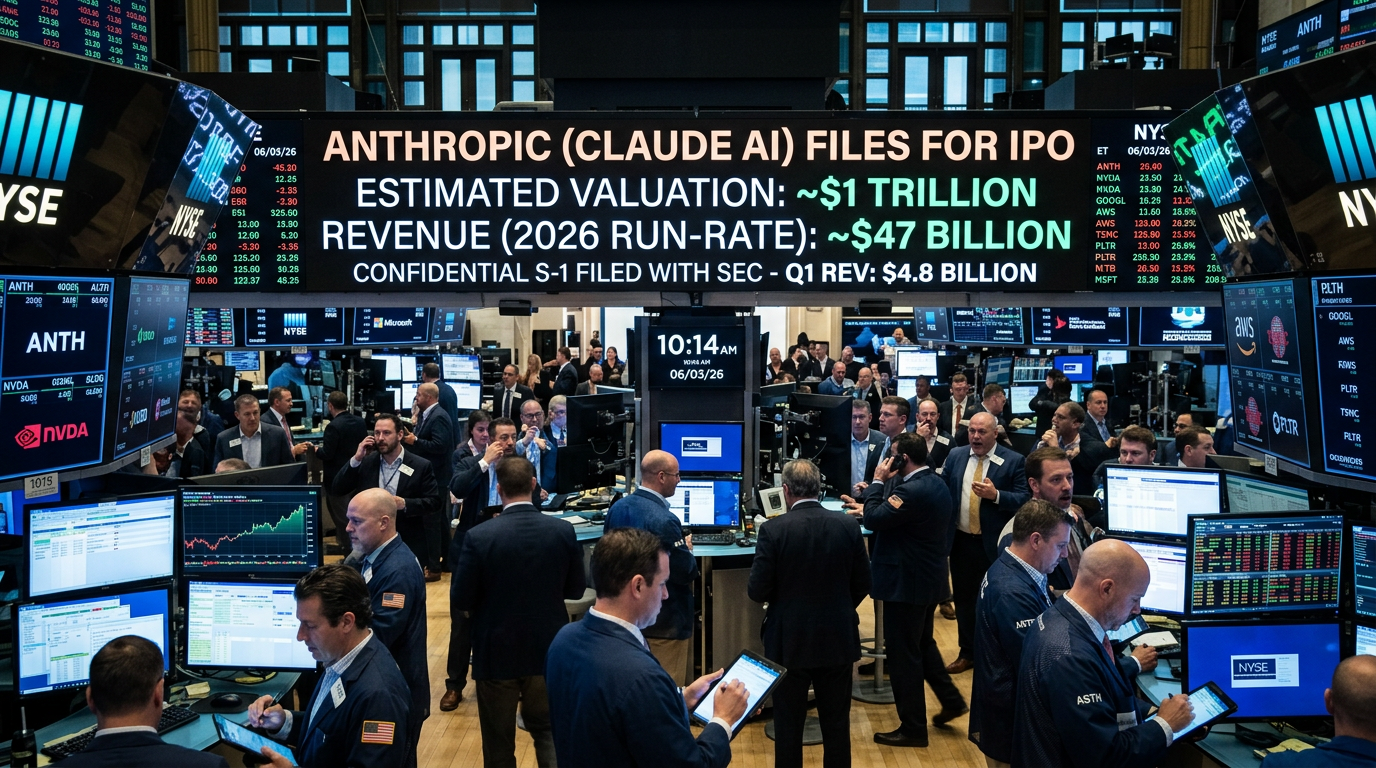
Anthropic filed a confidential S-1 with the SEC on June 1, 2026. No pricing date. No share count. Just the opening bell of what Wedbush analysts called “the opening of the floodgates for the IPO market.”
The numbers behind the filing are striking. Revenue run-rate hit approximately $47 billion in May 2026, up from roughly $10 billion the prior year. In Q1, the company reported $4.8 billion in revenue — and then told investors it was on track to more than double sequentially in Q2 to $10.9 billion, alongside an operating profit of $559 million. That’s not a money-losing AI lab burning toward bankruptcy. That’s a company approaching breakeven at near-trillion-dollar scale.
The most recent funding round — a $65 billion Series H — lifted the valuation to roughly $965 billion. A debut above $1 trillion is now the market base case if conditions cooperate.
Before the IPO Even Happens
Here’s what most coverage misses. Anthropic has already committed to spending more than $100 billion with Amazon Web Services over the next decade, securing up to 5 gigawatts of compute capacity. Separate agreements with Google lock in another 5 gigawatts. That is 10 gigawatts of contracted AI compute demand from a single company — before a single share trades publicly.
This isn’t a filing story. It’s an infrastructure spending story. And the infrastructure spending story already has public market tickers attached to it.
The Names Getting Institutional Attention
Marvell Technology (MRVL) was the loudest signal in June. At Computex on June 2, Nvidia CEO Jensen Huang called Marvell a potential trillion-dollar company. The market responded: Marvell shares surged 33% in a single session — the largest one-day gain in the company’s history — adding approximately $56 billion to its market cap and lifting total value above $250 billion. Marvell is one of the primary architects of custom silicon for hyperscalers, with 18 confirmed XPU sockets in its pipeline. When Amazon scales Trainium to honor its Anthropic commitments, Marvell’s design wins convert to revenue directly.
Celestica (CLS) integrates GPUs, custom silicon, and networking gear into finished, tested racks that hyperscalers actually deploy. In April 2026, the company made its DS6000-series 1.6 terabit Ethernet switches — hardware designed to handle the cluster density that Anthropic’s training runs demand — available to order. Someone has to assemble and ship the physical infrastructure that a 10-gigawatt compute commitment requires. Celestica does that for the largest hyperscalers on the planet.
Credo Technology (CRDO) supplies the Active Electrical Cables that connect GPUs inside AI clusters. Anthropic’s $100 billion AWS compute commitment will translate into physical servers that need Credo’s cables. The company’s three confirmed hyperscaler customers all have direct Anthropic relationships. The connection is indirect but structurally load-bearing.
Astera Labs (ALAB) designs the semiconductor connectivity silicon living inside the AI rack — PCIe retimers, CXL memory controllers, and Ethernet fabric switches. In May 2026, the company launched the Scorpio X-Series 320 Lane AI Fabric Switch, described as the largest open memory-semantic fabric switch available, now shipping to leading cloud customers. Astera’s technology manages signal integrity between chips inside a cluster — a critical layer in the infrastructure Anthropic needs at scale.
Amazon and Alphabet — The Cleaner Play
Amazon and Alphabet are the two largest direct equity stakeholders in Anthropic. Investors in both companies enjoy leveraged exposure to Anthropic’s post-IPO progress through direct appreciation of equity stakes and recurring cloud revenue growth — without taking on the execution risk of a standalone AI model developer at a near-trillion-dollar valuation.
Alphabet’s cloud business grew 63% in Q1 2026. AWS is Anthropic’s primary compute provider. Both companies benefit whether Anthropic wins or just keeps burning infrastructure spend at scale. That’s a structurally different risk profile than holding the IPO itself on day one.
The Macro Overlay
There’s a wrinkle. May nonfarm payrolls printed 172,000 — more than double the 80,000 consensus — sending yields sharply higher and reinforcing the higher-for-longer rate narrative. The 10-year Treasury yield moved back above 4.53%. Futures markets now price roughly 70% odds of a rate hike by year-end 2026. Fed Chair Kevin Warsh faces a June 16-17 meeting with essentially no room to cut.
That macro backdrop matters for IPO timing. A rate hike environment compresses growth multiples. Anthropic debuting near $1 trillion in a rising-rate world introduces real valuation volatility risk — which is exactly why the infrastructure plays may offer a more favorable risk/reward than the primary listing itself.
Scenario Framework
Bull Case: Anthropic IPO debuts above $1 trillion, validating the AI monetization narrative and triggering a fresh round of hyperscaler infrastructure commitments. Infrastructure plays like MRVL, CLS, CRDO, and ALAB accelerate on incremental order flow visibility.
Base Case: Anthropic lists in late 2026 at or near the $965 billion private mark. Uncertainty around pricing creates a choppy post-IPO drift. Indirect beneficiaries — Amazon, Alphabet — outperform the primary listing in the months that follow, as the equity stakes reprice and cloud revenue confirms the infrastructure demand thesis.
Bear Case: Macro deterioration or Fed rate hike delays the Anthropic listing, reducing near-term infrastructure spending commitments. Infrastructure names that ran hard into the filing — particularly after the Marvell Computex surge — face a technical reset. The AI capex fatigue narrative, already seeded by the Meta and Broadcom earnings reactions, gains traction.
Active Trader Framework
The infrastructure plays offer something the Anthropic IPO itself cannot: current price, current liquidity, and defined technical levels to work against. Marvell after a 33% single-session surge needs time to consolidate — watch for volume patterns and moving average support as the setup develops post-spike. For the IPO itself, the disciplined approach is to plan around the day-one open, the post-IPO drift, and the 180-day lock-up window rather than treating the listing as a single event.
Wedbush characterized this as a trio of mega-listings — SpaceX, Anthropic, OpenAI — all converging on public markets in compressed time. That’s a structural shift in how AI capital formation works. Whether you trade the primary listings or the infrastructure supply chain, the signal is the same: the AI buildout is accelerating, not plateauing. Position accordingly — with defined risk.
For informational and educational purposes only. Not investment advice. Trading involves risk, including loss of principal.