
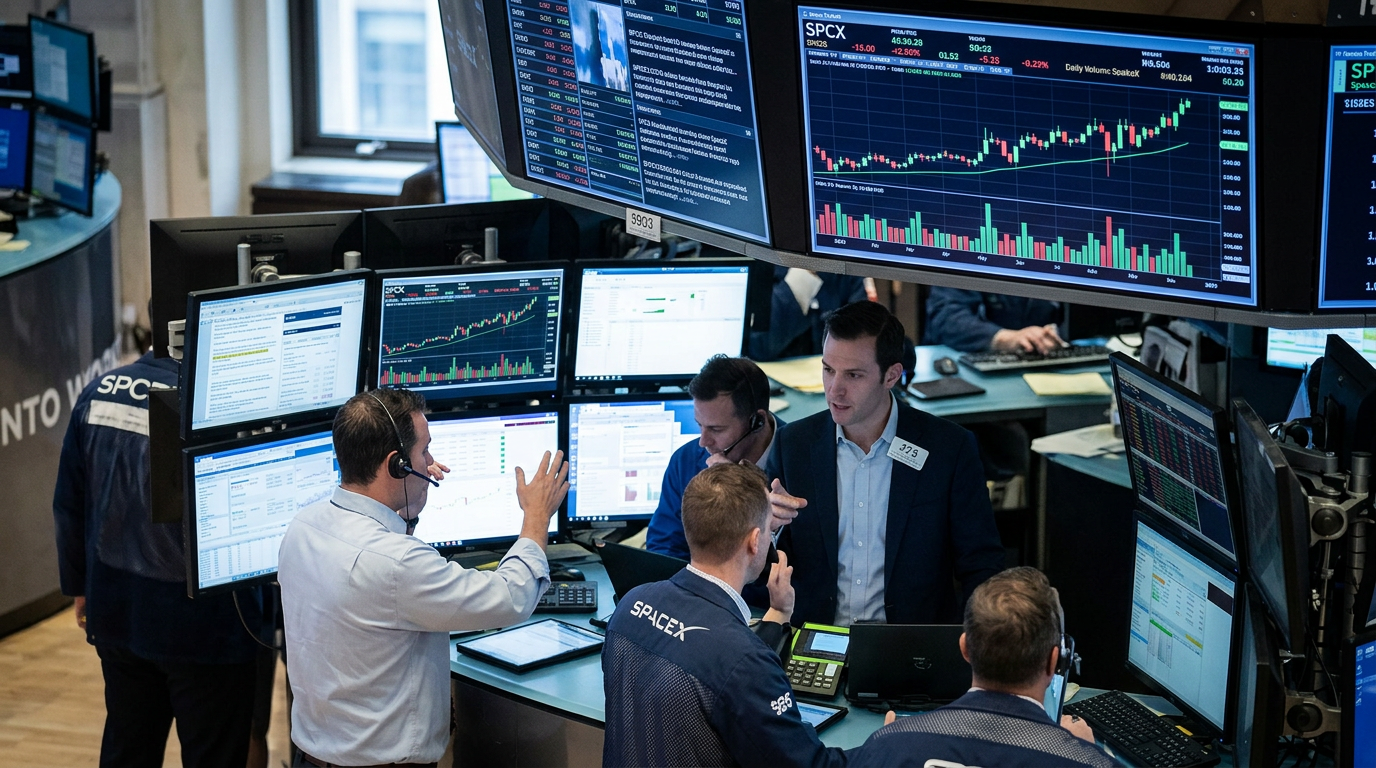
Five trading days. That’s all it took for SpaceX — the most anticipated public listing in a generation — to become the most talked-about position on every institutional desk from New York to London. SPCX debuted June 12 on the Nasdaq at $135 per share, raised $75 billion in the largest IPO in U.S. market history, and within days had crossed a $2 trillion market cap. The question traders are actually asking isn’t whether this thing moves — it clearly does. The question is whether you’re playing it intelligently or just chasing narrative.
Here’s where the numbers get complicated.
SpaceX reported fiscal year 2025 total revenue of $18.7 billion — a 33% expansion year-over-year. But the company also posted a net loss of approximately $4.9 billion. The internal math is stark: Starlink generated $11.4 billion in revenue in 2025, representing 61% of total company revenue and a 48% increase from 2024, while simultaneously producing $4.4 billion in operating profit — effectively acting as the internal cash engine subsidizing billions in Starship R&D and AI infrastructure buildout. The space launch segment contributed $4.1 billion in 2025, up just 8% year-over-year, primarily from Pentagon and NASA contracts.
So Starlink carries the valuation. And at a $2+ trillion market cap with analysts projecting $25 billion in 2026 revenue, you’re looking at roughly a 73x to 115x price-to-sales multiple — well above the 67x Palantir currently carries as the highest in the S&P 500, and more than what Facebook demanded at its 2012 IPO growing at 88% annually. That multiple compression risk is real and it’s the part most retail participation is glossing over right now.
What the Tape Is Showing
The stock surged approximately 19% on its first trading day, closing at $161. By June 16, SPCX hit an intraday all-time high of $225.64 before pulling back. The 52-week range now spans from the $135 IPO price to that $225.64 high — a range established in less than a week of trading. Low float dynamics matter here. The IPO structure was engineered to expand the public float gradually to maximize Nasdaq 100 inclusion weighting and drive forced passive buying from index funds. That mechanism creates early price support, but it also concentrates supply pressure into the second half of 2026 as lockups roll off.
Analyst price targets reflect the division: bullish targets reach $227 per share at the street high, while bears flag correction potential to the $75 range. The average 12-month consensus sits around $164 — which is actually below where the stock is trading right now.
Slight tangent, but it matters: SpaceX announced it’s acquiring the AI coding startup behind Cursor in an all-stock deal reportedly valued near $60 billion. That xAI integration thesis is starting to inflate the narrative beyond Starlink’s proven fundamentals — and narrative-driven moves at $2 trillion market caps have a way of snapping back hard.
Key Levels to Monitor
Technical analysts are watching the $150–$160 zone as the primary structural support — the range where the stock closed on its first trading day. That level represents the IPO pop settlement area and is where most of the initial institutional allocation sits. Below $150, you’re talking about a test of the actual IPO price, which would constitute a post-deal failure signal. On the upside, $225 is the proven resistance print. A clean hold above $200 with volume confirmation opens the path toward that $227 street-high target.
Scenario Framework
Bull Case ($230–$310): Starlink hits 15 million subscribers by year-end, 2026 revenue reaches or exceeds the $25 billion analyst projection, Nasdaq 100 inclusion triggers forced institutional buying, and Starship commercial contracts begin to generate disclosed revenue in Q3 or Q4.
Base Case ($150–$200): Stock consolidates in the post-IPO range, Starlink subscriber metrics confirm the growth trajectory but ARPU compression persists, and the first earnings report in November 2026 provides the next fundamental catalyst for directional resolution.
Bear Case ($75–$130): Lockup expiration supply pressure arrives earlier than expected, a broader tech multiple compression event coincides with rate repricing from the Fed, net losses widen on accelerated Starship spending, and the stock re-tests the IPO price as the structural floor.
Active Trader Positioning Considerations
Volatility is the feature, not the bug here. Intraday ranges in SPCX have exceeded 15% within single sessions in the first week of trading. Position sizing needs to reflect that reality — not the average true range of a seasoned large-cap. Key catalysts to monitor include: the June 30 lockup expiration window, any Nasdaq 100 index inclusion announcement, the first post-IPO earnings release in November 2026, and Starship testing milestones that could validate the non-Starlink segments of the bull thesis. Risk management frameworks should anchor on the $150–$160 structural support zone as the key invalidation level for any long thesis built above that range.
The largest IPO in history is now a live trading instrument. That doesn’t make it automatically investable at current levels. Preparation over conviction — know the levels, know the catalysts, and let the tape confirm before adding size.
For informational and educational purposes only. Not investment advice. Trading involves risk, including loss of principal.