
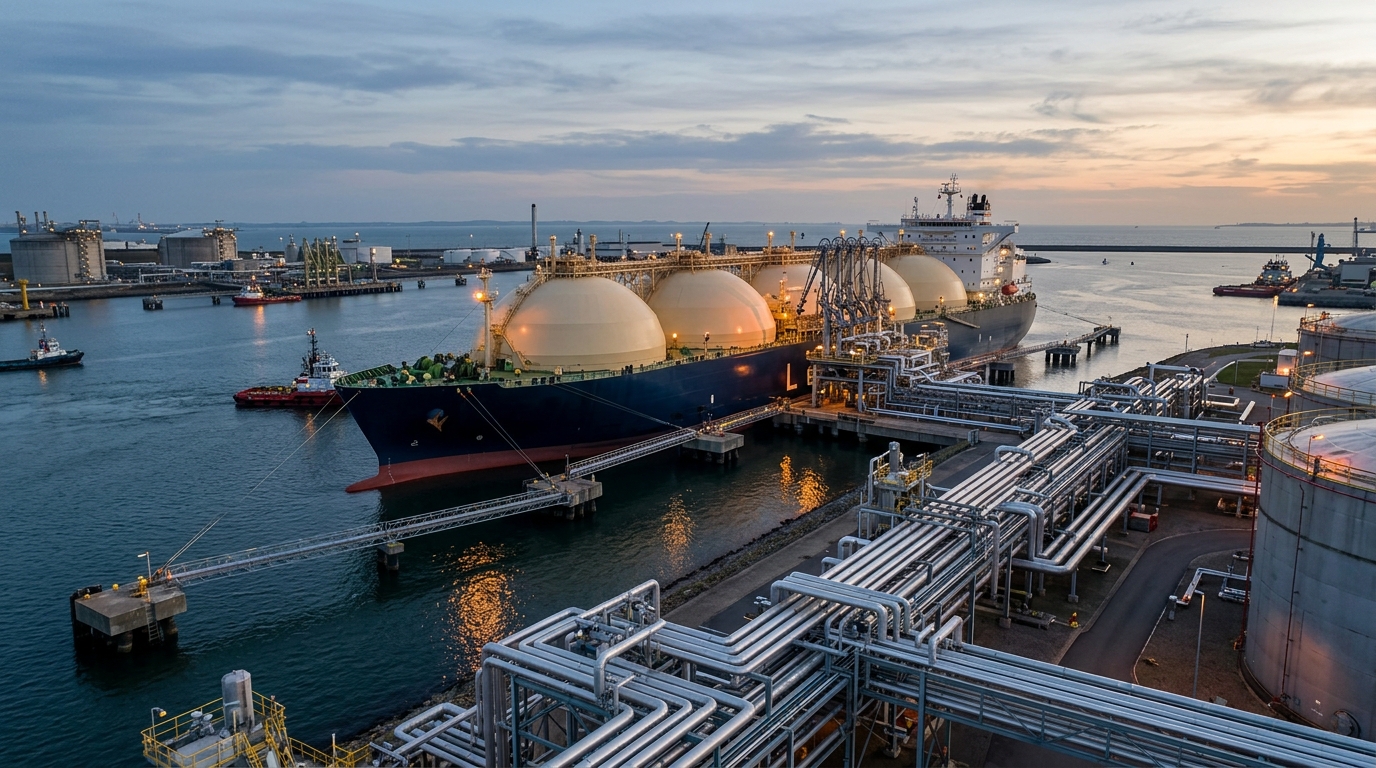
The world’s biggest LNG exporter is shopping for gas it used to produce itself. That sentence, which would have read as fantasy twelve months ago, is now the defining trade in global energy.
Iranian strikes in March damaged two of Ras Laffan’s 14 LNG trains along with a gas-to-liquids facility. QatarEnergy CEO Saad al-Kaabi said in March that the repairs would sideline 12.8 million tons per year of LNG capacity for three to five years. The delay is not primarily about money. Replacement gas turbines needed to power refrigeration compressors face global delivery delays of two to four years, and only three global manufacturers produce the large-frame turbines required for LNG operations. Those suppliers entered 2026 with order books already stretched by demand linked to data center expansion and the global shift away from coal. Ras Laffan will not be back quickly.
Reuters reported Thursday that QatarEnergy Trading, the trading arm that managed 10 million tons of the company’s LNG portfolio, is now seeking 2-3 million metric tons per annum through to 2031. The discussions mark a shift from purchases of dozens of US spot LNG cargoes toward longer-term solutions to cover the shortfall. That shift matters enormously for investors in American LNG infrastructure.
US projects under construction have a total of 25 million metric tons of LNG available for purchase, according to Rapidan Energy. Venture Global has the most with 10 mtpa uncontracted, while both Cheniere and Woodside each have 6 mtpa available for sale. QatarEnergy is negotiating with all three. The seller’s position here is strong. As Saul Kavonic, head of energy research at MST Marquee, noted, Qatar’s pursuit of long-term volumes indicates it now sees genuine risk to its ability to export LNG for several years. A buyer with that kind of urgency does not negotiate aggressively on price.
The geographic logic compounds the commercial one. At the Gastech conference in Bangkok today, Oman’s energy minister called for alternative routes to allow LNG flows to bypass the Strait of Hormuz entirely. The IEA says there is currently no alternative route capable of delivering Qatar’s or the UAE’s LNG volumes to the global market outside their existing liquefaction and shipping systems. That physical constraint means Gulf producers cannot simply reroute their output. The Atlantic basin can.
This is the investment question worth holding: if QatarEnergy signs multi-year contracts with Cheniere, Venture Global and Woodside through 2031, those are not temporary arrangements. The customer relationships, the credit history, the infrastructure investment decisions that follow long-term SPAs, all of these tend to persist well beyond the original contract term. A five-year deal signed under duress often becomes the foundation for the next ten-year deal signed by habit and preference. The closure of the Strait of Hormuz reduced global LNG supply by approximately 18 million tonnes in the second quarter of 2026, according to Cheniere’s Q2 2026 earnings call. Europe is entering winter with storage deficits. Asian buyers are competing for every available cargo.
The risk is not that these contracts get signed. The risk is that peace returns to the Gulf faster than anyone expects, Ras Laffan restarts ahead of schedule, and Qatar competes again from a position of low-cost, massive-scale production. That outcome looks unlikely before 2029 at the earliest, given the turbine supply chain alone. QatarEnergy first declared force majeure in March 2026 and has renewed it month by month, most recently extending LNG cancellations into November.
The map of global gas supply is being redrawn in real time. The companies holding permitted, contracted, and operating liquefaction capacity in the Atlantic basin did not engineer this moment. But the ones that move quickly to lock in QatarEnergy’s volumes through 2031 will find themselves with a structural advantage that outlasts the crisis that created it.