
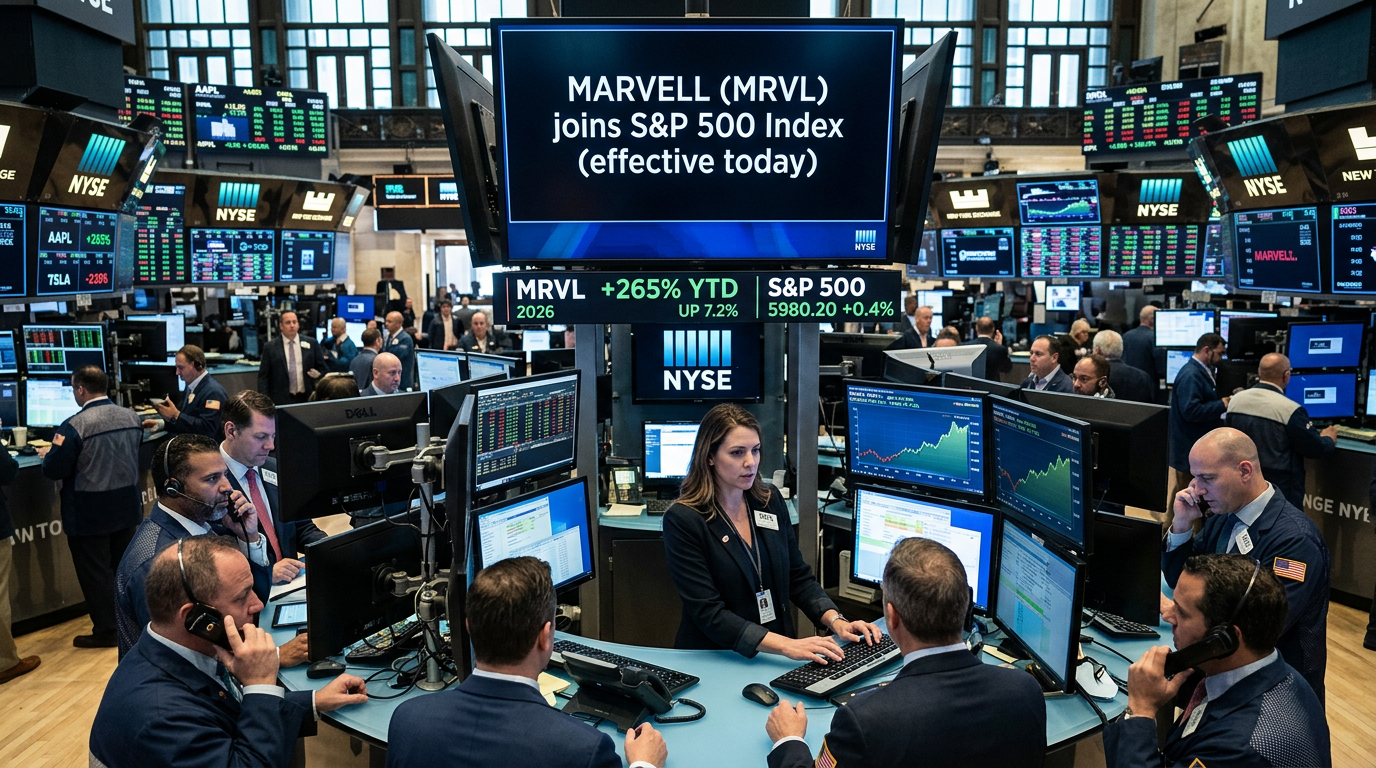
Today is the day. Before markets opened this Monday morning, Marvell Technology (MRVL) officially replaced Pool Corp in the S&P 500 — triggering mandatory mechanical buying from every index fund and ETF that tracks the benchmark. The forced demand was baked in. What happens after the dust settles is a much harder question.
The stock is up roughly 265% in 2026.
That number needs a moment to sit.
Three catalysts stacked inside three weeks drove this move. At COMPUTEX on June 2, Nvidia CEO Jensen Huang appeared onstage alongside Marvell CEO Matt Murphy and declared Marvell the candidate to be the “next trillion-dollar company.” Shares hit a record close of $316.43 days later. Then S&P Dow Jones Indices confirmed the index inclusion, effective today, June 22. Then KeyBanc raised its price target to a Street-high $385 — up from $260 — on June 18, and shares surged another 7.27% that day alone, touching an intraday high of $329.88 before closing at $310.58.
Three separate catalysts. Each one individually would have moved this stock. Together, they created something closer to a supernova.
What Marvell Actually Does
Marvell is a fabless semiconductor company headquartered in Santa Clara. The core business is data infrastructure chips — ethernet controllers, custom ASICs, silicon photonics, and the interconnect technology that allows thousands of processors to communicate inside a data center at high speed. That last part is what Jensen Huang was talking about.
As AI clusters scale from hundreds of chips to hundreds of thousands, the bottleneck shifts. It’s no longer just about raw compute. It’s about moving data between chips fast enough that the cluster doesn’t choke on its own size. Marvell sits directly inside that problem.
- Data center revenue (FY2026): $6.1 billion — a record
- Custom silicon annual run rate: Removed (not verified)
- Data center revenue growth (Q1 FY2027): +27% year-over-year
- Interconnect product revenue guidance (FY2027): +70% growth
- Total FY2026 revenue: $8.195 billion
- Next earnings date: August 27, 2026 (estimated)
Microsoft’s North American data centers reportedly source 100% of their optical chips from Marvell. Amazon Web Services is reportedly expanding its custom Trainium chip program externally — a move that would flow directly through Marvell’s design and networking pipeline.
The Nvidia Partnership Is Bigger Than People Realize
This wasn’t just a conference compliment. In March 2026, Nvidia and Marvell formalized a strategic partnership through Nvidia’s NVLink Fusion platform — a rack-scale platform for semi-custom AI infrastructure. The deal included a $2 billion investment by Nvidia into Marvell and a commitment to collaborate on silicon photonics. Huang’s June 2 comment wasn’t random hype. It was a statement about architecture. When Nvidia disaggregates compute across enormous clusters, the connectivity layer — Marvell’s lane — becomes load-bearing.
Slight tangent here, but worth noting: silicon photonics, which uses light instead of electricity to transmit data between chips, is a technology Marvell is actively developing with Tower Semiconductor. Tower Semiconductor and Marvell have said they’ve shipped over 5 million coherent photonic integrated circuits in that partnership. That’s a number that hasn’t gotten nearly enough attention given what it implies for data center efficiency at scale.
Analyst Targets
- KeyBanc: Buy/Overweight, $385 (Street high, raised June 18, 2026)
- Consensus (28 analysts): Removed (count/consensus not verified)
- 52-week range: $61.44 – $329.88
- Current market cap: ~$282 billion (as of June 18, 2026)
- Forward P/E: Removed (not verified)
The Valuation Problem Nobody Wants to Say Out Loud
Here is where it gets uncomfortable. Specific valuation multiple comparisons removed (not verified).
That premium is only rational if Marvell out-executes from a smaller base at a pace that closes the gap faster than the market expects. Specific FY2027/FY2028 revenue forecasts and CAGR removed (not verified). If there’s any stumble — a hyperscaler capex pullback, a program delay, or a slowdown in the custom ramp — the stock is exposed at these levels.
There’s also the CFO transition. On June 11, Marvell named Dan Durn as incoming CFO, effective June 15. Outgoing CFO Willem Meintjes filed to sell approximately 207,329 shares (about $60 million at the time of filing) around the same period. The company reaffirmed its Q2 outlook alongside the leadership change. But the timing is the kind of thing that earns a raised eyebrow even from bulls.
Bull / Base / Bear
Bull: Index inclusion demand clears, and the August 27 earnings report confirms data center revenue growth accelerating toward 55% with the $16.5 billion FY2028 target reaffirmed. Street targets get pulled up sharply. Silicon photonics optionality begins to be priced in separately. Stock approaches $385.
Base: Forced buying creates short-term volatility. Fundamentals hold but don’t dramatically accelerate. Stock consolidates in the $280–$330 range through summer. August earnings become the next real catalyst.
Bear: Post-inclusion selling pressure hits a stock with minimal margin for error at 70x forward earnings. Any hint of hyperscaler spending moderation, or a delay in the Amazon Trainium ramp, hands sellers their narrative and exposes a gap fill toward the $240–$260 range.
Technical Overlay
MRVL closed at $310.58 on June 18. The 52-week high is $329.88, hit intraday on that same day. Specific support, trend-channel, and volatility statistics removed (not verified). Watch the $300 level as near-term support; a close below that on heavy volume would signal the post-inclusion euphoria is fading faster than bulls expected.
What Investors Should Watch
- August 27, 2026: Q2 FY2027 earnings (estimated) — the data center growth rate is the number that matters most
- Amazon Trainium expansion: Any confirmed broadening of external chip sales would be a direct Marvell catalyst
- Street target revisions: Generalized — further upward revisions would reaffirm the premium
- Silicon photonics milestones: Optical chip volume and margin contribution in Q2 guidance
Bottom Line
Today’s S&P 500 inclusion is real. The Jensen Huang endorsement is real. The revenue growth trajectory is real. What isn’t real — not yet — is a trillion-dollar market cap. The stock has already run 265% this year. The next move depends entirely on whether the August earnings report confirms the acceleration, or reveals that the stock has been pricing in a future that’s still a few quarters away from showing up in the numbers.
Watch August 27. Not today.
For informational purposes only.