
Hey there, bargain hunter.
New home sales just hit a four-month low. The headline number is bad. The inventory number underneath it is worse.
The Census Bureau reported that sales of new single-family homes in May 2026 came in at a seasonally adjusted annual rate of 580,000 units — down 7.3% from April’s revised rate of 626,000 and 6.8% below the May 2025 pace of 622,000. Wall Street was looking for something closer to 632,000. The miss was not a rounding error.
But here’s what most of the coverage skipped.
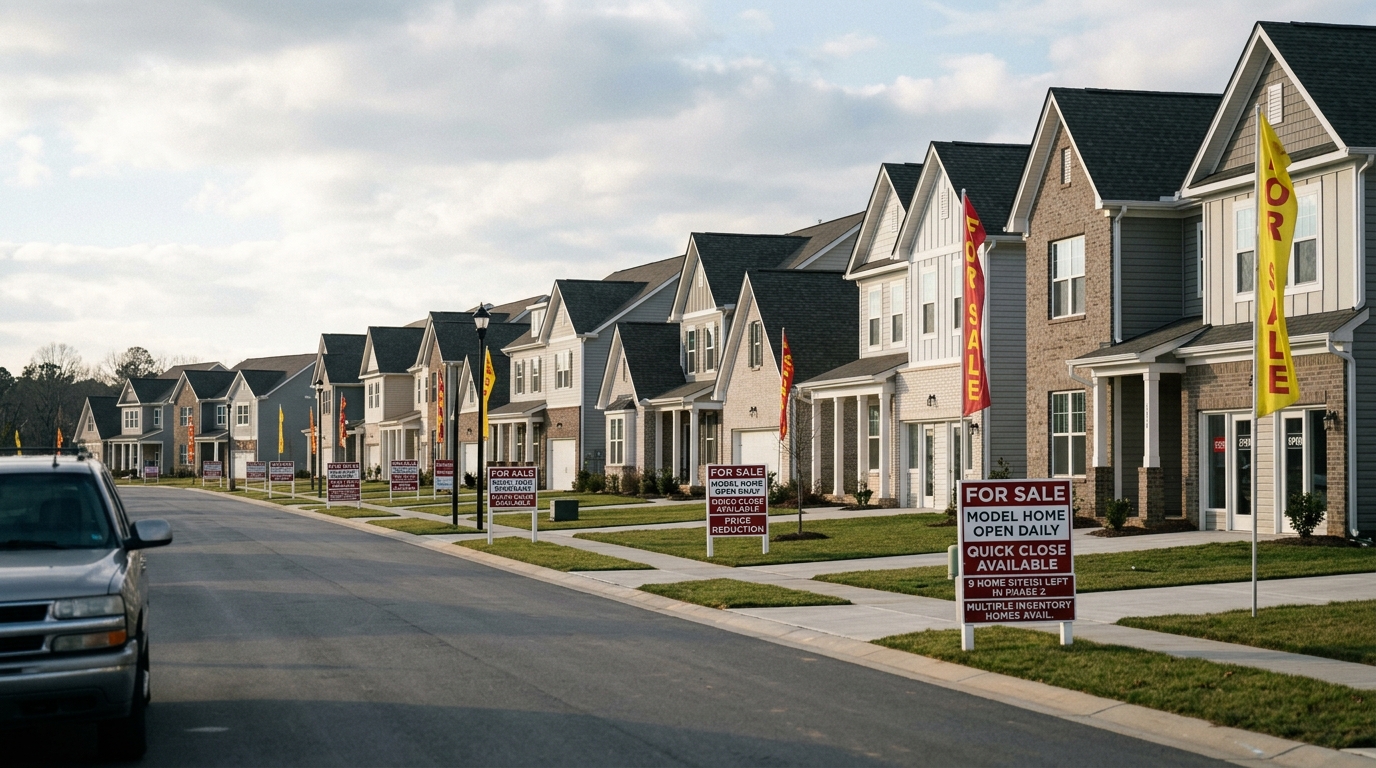
The seasonally adjusted estimate of new homes for sale at the end of May rose to 496,000 — a 2.3% increase from April and the highest level since July 2025. At the current sales pace, that represents 10.3 months of supply. In April it was 9.3 months. That single-month jump in supply is the kind of data point that shows up quietly in a government release and then matters a lot three to six months later when builders start pulling back on starts.
For context: a healthy new home market typically runs at 5-6 months of supply. Readings above 9 months have historically been associated with meaningful builder margin compression, incentive escalation, and eventually permit pullbacks that ripple into construction employment.
The West Is the Story Nobody Is Watching
Regionally, the breakdown was striking. Sales in the West plummeted 26.9% month-over-month in May to 117,000 — a seven-month low. The South, which accounts for roughly 60% of all U.S. new home sales, fell 4.1% to 350,000, the lowest level since January. The Midwest recovered 16.2%, and the Northeast was essentially flat.
The West is where affordability math breaks down first and most visibly. Average selling prices for new homes jumped to $540,600 in May — up 7.8% from April and 5% above year-ago levels. Combine that with mortgage rates still running between 6.3% and 6.5%, and first-time buyers in California, Arizona, and Colorado are essentially priced out at the entry level. New home prices at the lower end actually fell 2.7% year-over-year to around $318,000 according to separate industry tracking — which means builders are slashing prices at the bottom of the market just to move product.
That’s not strength. That’s desperation with better staging.
What the Builders Are Actually Doing
This is where it gets interesting. Roughly half of builders surveyed indicated that incentives and price cuts were higher in May than at the same point a year ago. Builders have been using margin compression as a demand lever — buying down mortgage rates at their own expense — for the better part of two years. That strategy worked when rates were expected to fall. With rates now expected to stay elevated through most of 2026 and into early 2027, the math gets harder every quarter.
The median number of months a new home stayed on the market increased to 3.7 months in May — the highest since July 2021. That’s slow. That’s a market where buyers have time, and builders don’t.
Existing home sales told a slightly different story for May — up 3.2% with a median price of $429,300 and 4.5 months of inventory. That divergence between new and existing is worth noting. Existing home sellers, locked into low mortgage rates from 2020-2021, are still reluctant to list. But when they do list, those homes are moving faster than new construction right now — which is a reversal of the post-pandemic dynamic that drove builder revenues to record levels.
The Stocks That Feel This First
The public homebuilders are the most obvious pressure point. D.R. Horton, Lennar, PulteGroup, and NVR all have significant exposure to the exact price points and geographies where stress is most visible. Builder margins held up through 2024 and into 2025 because land costs were locked in at favorable levels and incentive spending was manageable. Both of those tailwinds are fading.
Mortgage REITs and title insurance companies — the less visible second derivative — feel this too. Slow sales mean slower origination volume, which compresses fee income at companies like Pennymac, Mr. Cooper, and Fidelity National Financial.
And then there’s the broader consumer angle. Housing construction employment is a significant piece of the U.S. labor market. If starts follow sales lower — which historical patterns suggest they will when supply crosses 9-10 months — the residential construction workforce starts to shrink. That’s a leading indicator for overall employment that tends to arrive quietly before it shows up in the headline numbers.
The market is not pricing any of this. Homebuilder stocks have had a complicated 2026 — Berkshire’s acquisition activity and Japanese buyer interest in the sector earlier this year created a halo effect on valuations. That halo may be wearing thin now that the underlying demand data is sending a different signal.
10.3 months of supply. Remember that number. It tends to matter.