
August 28, 2026
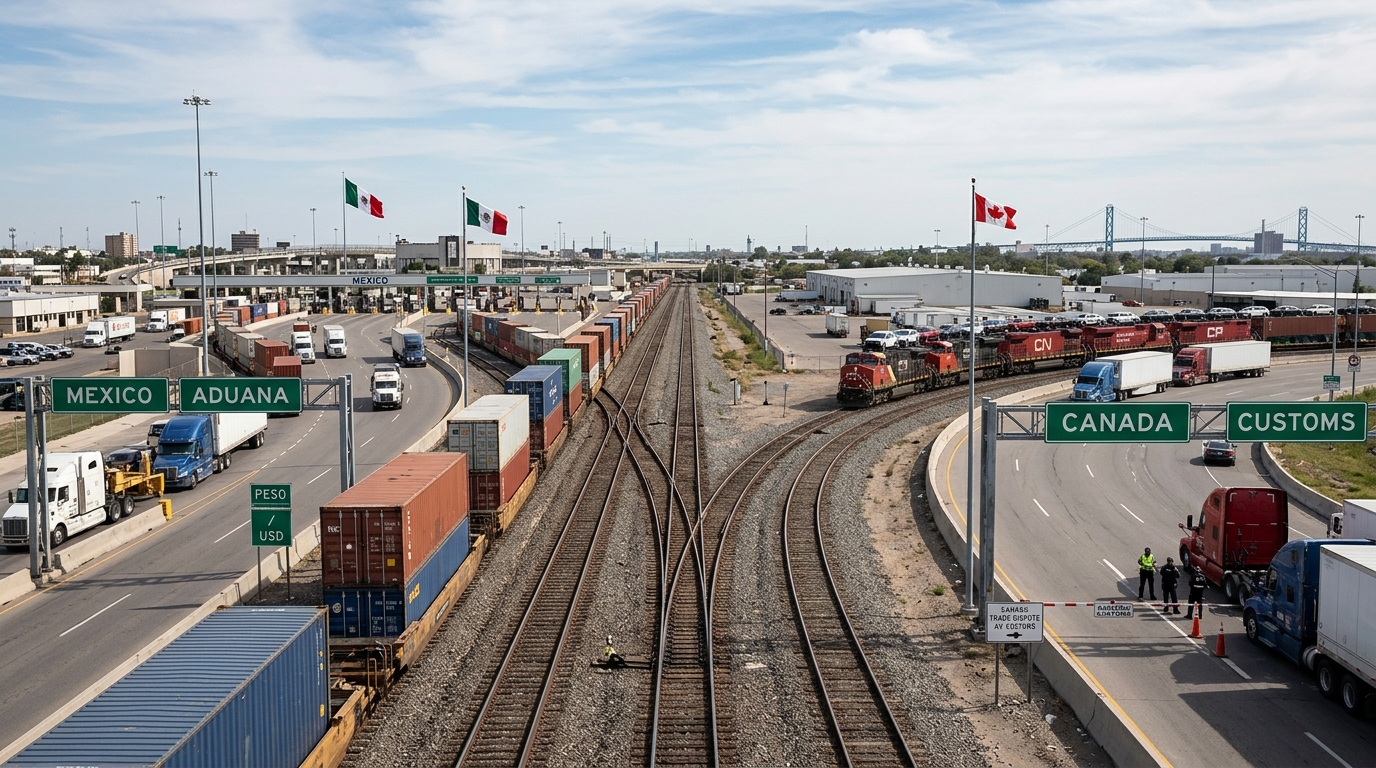
Mexico negotiates while Canada retaliates, and the split is showing up in autos, rails, and the peso.
The most important lesson from this week’s North American trade developments has nothing to do with any single tariff rate. It is about how markets price diverging policy risk across assets that used to move together. Mexico and Canada are now on opposite tracks, and the spread between those two tracks is widening fast.
What Happened
Mexican President Claudia Sheinbaum said she expects to reach a trade agreement with the United States, echoing recent comments made by President Donald Trump. That statement landed on August 24, the same week Washington escalated sharply against Ottawa. Canada announced retaliatory tariffs on C$27.6 billion worth of U.S. goods, matching dollar-for-dollar new duties imposed by Washington. Those counter-tariffs take effect September 8, covering 15%, 25%, and 50% rates across more than 700 products.
U.S.-Canada trade talks collapsed late on Friday, August 21. Hours later, at 12:01 a.m. Eastern on Saturday, August 22, 50% tariffs on $27.6 billion of Canadian goods took effect. Trump then said the U.S. will raise tariffs on Canadian vehicles, auto parts, and trucks to 50%, effective January 1, 2027. Mexico, meanwhile, has completed three bilateral negotiating rounds with USTR. Ambassador Greer met with President Sheinbaum during the third round in Mexico City, reviewing discussions on economic security, labor, agriculture, electronic payment services, steel and aluminum, and automobiles. Both sides directed their teams to convene for a fourth bilateral round in Washington in September 2026.
Why It Happened
The split traces back to a strategic choice made months ago. Following President Trump’s hardline rhetoric, Mexican President Sheinbaum opted for diplomacy over confrontation, voicing confidence that Mexico could negotiate better conditions and reach a deal to reduce tariffs. Canada took the opposite approach. Carney said the Americans wanted to destroy Canada’s major industries, including autos, steel, and aluminum, and Ottawa has matched every U.S. escalation in kind.
2026: The Year of the Robot
A revolutionary new robot is beginning to emerge.
Elon Musk says it will “change civilization as we know it.”
Microsoft’s Bill Gates said, “it will be as revolutionary as the PC.”
Nvidia’s Jensen Huang says it could be “the largest technology industry the world has ever seen.”
Creating a $24 trillion opportunity for investors.
And one $7 stock could be the biggest winner of all.
On July 1, the United States did not agree to extend the USMCA for a new 16-year term, triggering the annual review process. The Article 34.7.4 “at any time” extension mechanism remains available and could now run through annual reviews as far as 2036. That structure means every session between now and a final deal is a live catalyst for markets. Washington and Mexico City are building toward something. Washington and Ottawa, for now, are not.
How Professionals Might View It
Experienced traders are not treating this as a binary trade-deal outcome. They are mapping it sectorally. The clearest expression is in autos. If current tariffs double, automakers including GM, Stellantis, Ford, Toyota, and Honda face significant added costs on some of their most important models, and a higher levy on parts would inflict pain across the U.S. automotive supply chain.
The Mexico contrast matters here. Economy Minister Marcelo Ebrard is seeking to lower 50% U.S. tariffs on Mexican steel and aluminum, and 25% duties on automobiles. A deal that reduces those Mexico-specific sectoral tariffs, while Canada faces 50% rates, shifts relative competitive advantage for any automaker with manufacturing on both sides of both borders. GM is already repositioning: CEO Mary Barra said on the company’s July 21 call that GM is “onshoring significant manufacturing starting next year” in a move that will bring U.S. production capacity to 2 million units.
A “Record Number” of Private Jets Spotted in California
On one night this February, 600 private jets flew out of a single California city. The same night Elon Musk spent millions to send a message to 125 million Americans. Most people have no idea the two are connected. But Wall Street veteran Whitney Tilson says they are, and that what happened that night is the most important financial signal he’s seen in years.
Rails carry this same bifurcated exposure. Tariffs on Canadian autos and the threat of wider counter-moves are reshaping how vehicles and parts move across the border, putting freight routes and rail lines in the spotlight. Union Pacific recently reported Q2 2026 operating revenue of about $6.9 billion and simultaneously signed a binding MOU with Canadian National Railway to expand cross-border operating rights between Canada, the U.S., and Mexico. That deal looks well-timed if Mexico-bound volume accelerates as Canada-bound flows face cost headwinds.
The peso tells the same story quietly. The peso ended around 16.95 per dollar on August 24, still holding below the 17.00 threshold traders watch closely. A break above 17 per dollar would signal deteriorating sentiment toward Mexican assets, which has not happened. The currency is holding, and that itself communicates market belief that the Sheinbaum-Ebrard negotiating track has credibility.
What Comes Next
The fourth US-Mexico bilateral round in Washington is scheduled for September 2026. Ambassador Greer has said USTR is seeking interim arrangements with Canada and Mexico by year-end, while harder issues including autos, labor, and environment may extend into 2027. That timetable creates a concrete event risk for EWW and MXN, as any interim deal announcement could shift Mexican assets sharply. On the Canadian side, investors will monitor whether negotiations resume before the January 1, 2027 implementation date for the higher Canadian auto tariff.
Elon’s Next Big Project
This opportunity could be much bigger than anything else we’ve seen in the AI megatrend. Luke Lango believes Musk is preparing to unite the capabilities of Tesla (TSLA), SpaceX (SPCX), xAI, and X around a single sweeping vision. Part of that vision includes building enormous AI data centers in space… constructing a 100-million-square-foot semiconductor complex in Texas… and deploying armies of Optimus robots to automate much of the work. Musk’s companies cannot immediately produce all the necessary components for these projects themselves. They will need suppliers.
Sectors to watch: automakers with dual North American exposure, U.S. steelmakers that benefit from Canadian cost disadvantages, and rails with Mexico corridor revenue. Canadian rails with heavy cross-border dependence carry the opposite risk.
The Trader’s Lesson
When a single policy regime splits into two diverging tracks, the error is treating correlated assets as if they still move together. GM, UNP, and EWW do not have identical Canada-Mexico exposure, even though they all carry a “North American trade” label. The trader’s job right now is to disaggregate that label, country by country and sector by sector, before the next negotiating headline forces the market to do it for you.