
September 1, 2026
Bonus Content: One Manufacturing Survey Crashed. The Other Didn’t. The 10am ISM Settles It.
Editor’s Note: What if you could claim a stake in both OpenAI and Anthropic’s IPOs… with just $200? What if I said you don’t even have to wait for them to go public. Follow the link below to see the details from former IPO insider Jason Bodner – the man who spent nearly two decades helping IPOs go-to-market.
Dear Reader,
DO NOT invest in OpenAI and Anthropic’s IPOs before you hear this.
I understand that the mainstream media is hyping these IPOs up…
The Wall Street Journal promises they’ll deliver a “charitable windfall”…
And Forbes claims they’ll create a new wave of new under 30 millionaires.
As exciting as it sounds, don’t fall for the hype!
Wall Street rigs the IPO game in their favor.
While big name institutional investors cash in on IPOs…
Retail investors are left holding the bag.
In fact, Dr. Shiller, a Nobel prize winner in Economics, found that Wall Street deliberately uses shady tactics to mislead retail investors into investing in IPOs.
I’ll tell you exactly how they do it in this video.
But don’t get me wrong…
It’s still possible to profit from OpenAI and Anthropic’s IPOs…
But history shows us that the real money isn’t in the IPOs themselves…
Instead, there’s a lesser-known “backdoor” way that’s available RIGHT NOW before OpenAI and Anthropic go public.
Click here and I’ll show exactly what that is.
Regards,
Jason Bodner
Founder, Outlier Alpha
One Manufacturing Survey Crashed. The Other Didn’t. The 10am ISM Settles It.
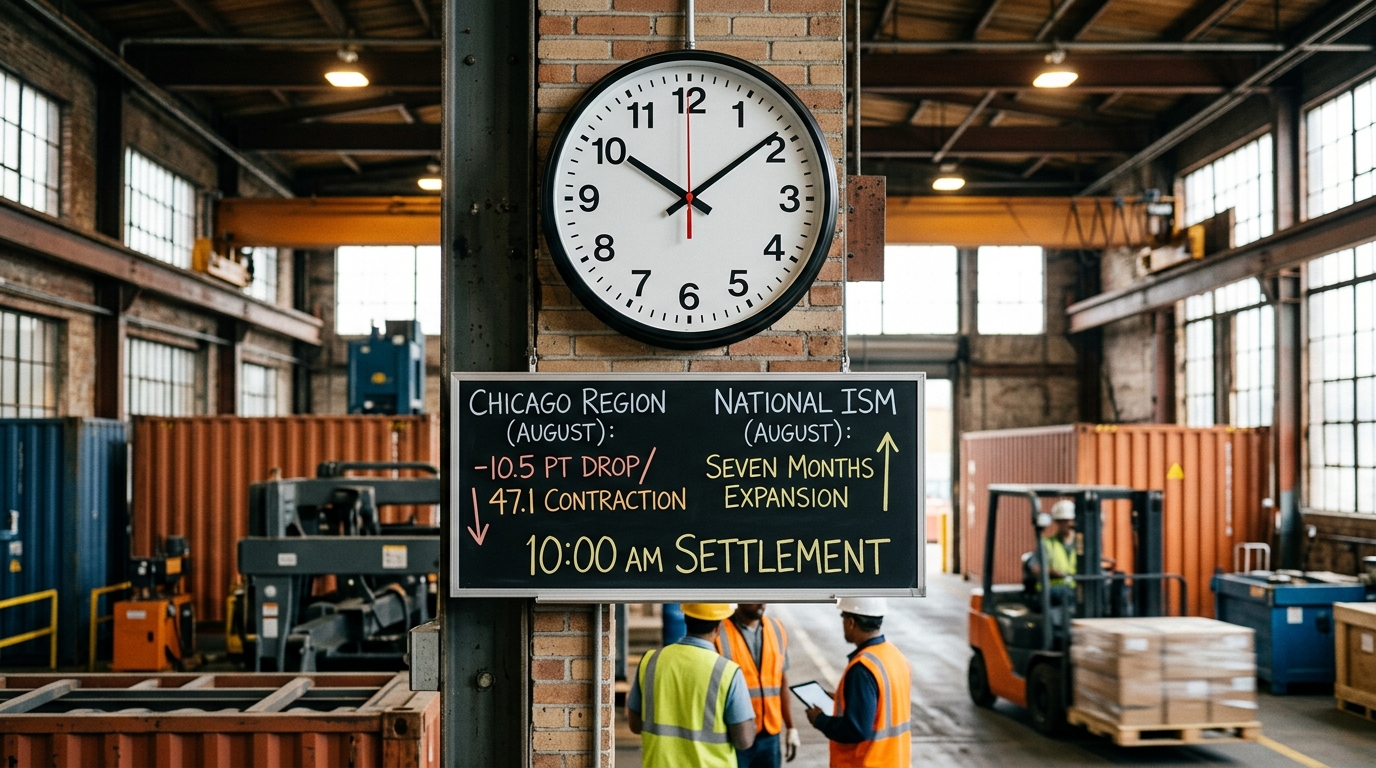
Two surveys of American manufacturing conditions are now telling completely different stories, and traders have roughly four hours to decide which one to believe before the national ISM Manufacturing number lands at 10:00 a.m. ET.
The Chicago Business Barometer came in at 47.1 for August, a 10.5-point collapse from July’s 57.6 and the index’s first contraction reading in four months. The consensus forecast had called for a modest rise to 57.9. That is not a miss. That is a completely different direction.
Meanwhile, the national picture coming into this morning looked nothing like Chicago. Economic activity in the manufacturing sector expanded in July for the seventh consecutive month, with the Manufacturing PMI registering 55.6 percent, 2.3 percentage points above June and the highest reading since May 2022. ISM’s Employment Index registered 52.8 percent in July, its highest level since August 2022.
There is an important structural reason this divergence is possible. The national ISM report’s information reflects the entire U.S., while regional reports contain primarily regional data from their local vicinities, and the information in the regional reports is not used in calculating the results of the national report. Chicago is not a proxy for the country. But it has historically been a reliable early signal, and a 10.5-point drop in a single month demands scrutiny of the national data regardless.
What Traders Should Watch Inside the ISM Release
The headline number matters less this morning than two sub-indices: new orders and prices paid. New orders are the leading edge of manufacturing demand. If they contract in August after expanding nationally through the summer, Chicago stops looking like a regional anomaly and starts looking like a leading indicator. If prices paid remain elevated while new orders slip, the Fed’s problem compounds immediately.
That Fed context is what makes today’s 10am release genuinely consequential. CME FedWatch showed markets pricing roughly a 58% chance of a 25-basis-point move at the September 15-16 meeting as of Friday after Fed Chair Kevin Warsh spoke at Jackson Hole. Warsh, though acknowledging that inflation numbers have been soft lately, said the progress isn’t enough and that recent readings “do not tell me that underlying trends have meaningfully improved.”
The consumer side is not offering any relief. The University of Michigan’s sentiment index was 51.7 in August, and despite the upward revision, sentiment fell about 6% from July and remained roughly 11% below its year-ago level, reflecting persistent concerns that inflation will remain elevated. Only 8% of consumers expect their income growth to outpace inflation in the year ahead, down from 18% in December 2024. One-year inflation expectations eased to 4.0% from 4.2%, while long-run expectations held steady at 3.3% for a third consecutive month.
That combination, softening demand signals alongside sticky inflation expectations, is precisely the environment where the Fed cannot take a benign ISM print and declare victory. A strong national number this morning gives Warsh cover to hike. A weak one forces the committee to weigh whether tightening into a manufacturing contraction makes any sense at all.
The Trader’s Lesson
When regional and national surveys diverge this sharply, the instinct is to dismiss the outlier as noise. That instinct is often correct. But experienced traders do not dismiss it until they see confirming or disconfirming evidence, and that evidence arrives at a scheduled time. Today is one of those sessions where the release itself is the trade, not the positioning ahead of it. The discipline is in waiting for the data rather than expressing a view on which survey is right. Chicago may be wrong about the national trend. It may be early. The ISM print will begin to answer that, and the new orders line will do most of the answering.