
September 3, 2026
Bonus Content: Gold Recovered Its 2026 Wipeout in 48 Hours. Lesson
Editor’s Note: What if you could claim a stake in the fastest growing startup EVER with less than $50? That’s what former tech executive Jeff Brown is revealing in this new presentation.
Even though this Elon Musk-backed startup has nothing to do with robots, self-driving cars, or rockets, it’s growing faster than Tesla, faster than SpaceX, and even 23 times faster than Nvidia. Read more below.
Dear Reader,
What if you could claim a stake on the fastest growing tech startup ever…
Before it goes public… starting with just $50?
As you know, Elon Musk just took SpaceX public in the biggest IPO ever.
But here’s the crazy part…
While everyone was distracted by the SpaceX IPO…
Elon Musk quietly started backing this NEW AI startup that has been called…
“The fastest-growing business in the history of capitalism.”
Even though this has nothing to do with robots, self-driving cars, or rockets…
Its CEO is projecting growth of 8,000% for this year…
Enough to turn $1,000 into $80,000.
It just filed the paperwork to go public in what’s set to be the next hot IPO on Wall Street.
But you do NOT have to wait until the IPO.
Click here and I’ll show you how to claim your pre-IPO stake for as little as $50.
We have so much to look forward to,
Jeff Brown
Founder & CEO, Brownstone Research
Gold Recovered Its 2026 Wipeout in 48 Hours. Lesson
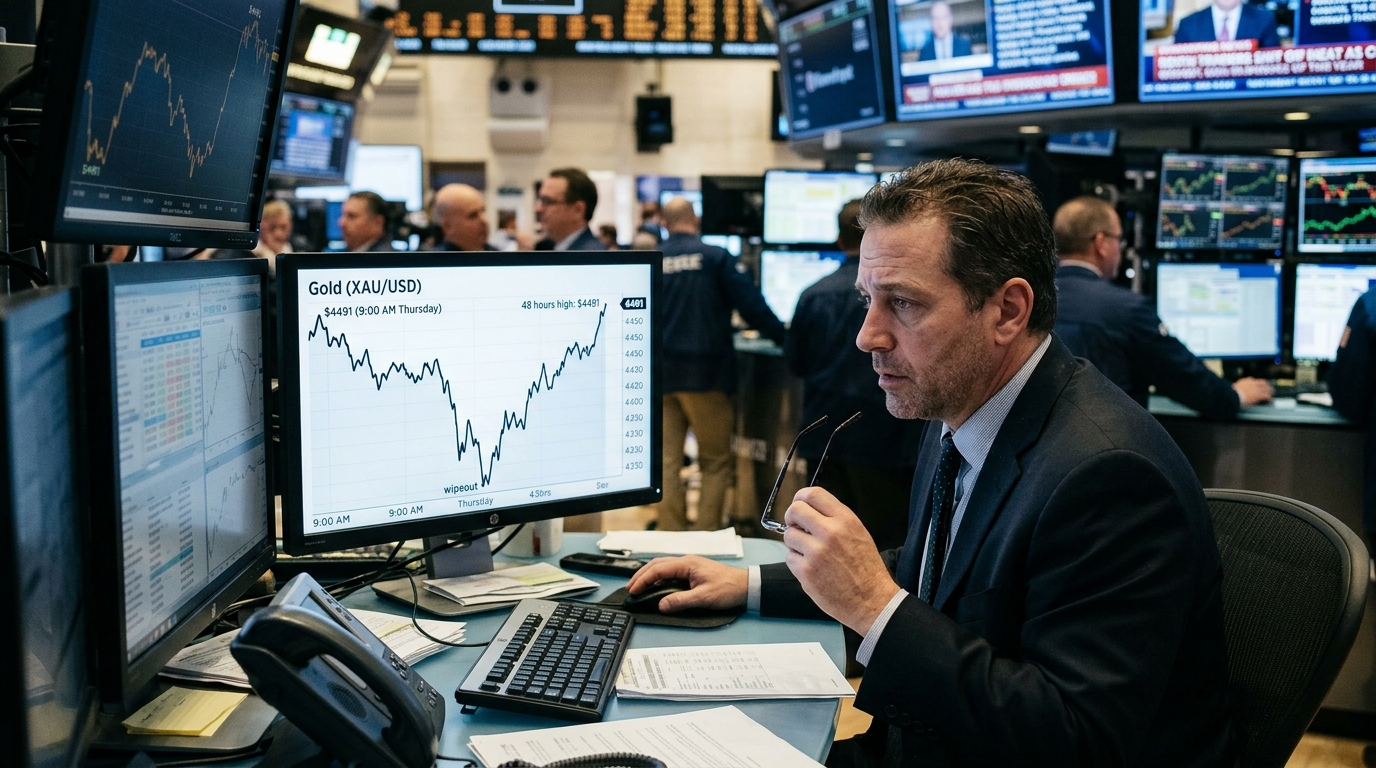
Gold sat at roughly $4,491 per ounce by 9 a.m. Thursday. As of 9:05 a.m. Eastern Time, gold was priced at $4,491 per ounce, representing a $157 rise from Wednesday at the same hour. Forty-eight hours earlier, bullion had erased every dollar it had gained in 2026. The round trip is this week’s clearest lesson in what forced liquidation does to a crowded trade, and why the recovery is just as violent as the selloff.
What Happened
Gold collapsed over 2.30% on Tuesday as the Middle East conflict escalated, with the U.S. and Iran exchanging strikes. That wasn’t the whole story. Gold fell for a third straight session, sliding to a two-week low as a global bond selloff drove yields to their highest since 2008 and traders raised the odds of a Federal Reserve rate increase at the September 15-16 meeting. The combination of an oil-driven inflation shock and a suddenly hawkish rate outlook is precisely the environment that forces long holders out, regardless of their conviction on gold’s long-term case.
The recovery Thursday had two catalysts. First, Trump signaled the latest Iran strikes would be short-lived. President Trump said the U.S. carried out a “very heavy attack” against Iran but also stated that the attack wouldn’t take “too long”, traders took that as a hopeful signal that this latest military reescalation will be short-lived. Second, and more consequential for rates: In remarks that contrast with statements last week from Chairman Kevin Warsh, Fed Governor Christopher Waller expressed confidence in current inflation trends, noting recent data suggests “we are finally seeing some signs of disinflation,” and said he is leaning toward keeping rates steady at the September meeting. Market-implied odds for a rate hike at the Sept. 15-16 meeting dropped sharply following Waller’s remarks, with traders now pricing the outcome closer to a coin flip.
Why It Happened
Tuesday’s collapse was not a fundamental reassessment of gold’s value. It was a positioning event. When a trade becomes crowded enough, the exit door shrinks. The correction was measured in dollars of yield, not ounces of demand. The catalyst was Tuesday’s session: reports of renewed U.S.-Iran military strikes near the Strait of Hormuz sent crude oil sharply higher, and that inflation impulse, layered on Fed Chair Kevin Warsh’s hawkish Jackson Hole message, drove markets to lift the implied probability of a September rate hike. Rate hike expectations hit gold from two directions simultaneously: a stronger dollar and higher opportunity cost for a non-yielding asset.
The recovery works the same way in reverse. When Waller’s comments peeled back those hike expectations Thursday morning, the traders who had sold into Tuesday’s panic had to decide whether they sold too much. Many apparently concluded they had. Silver confirmed the mood: silver futures opened at $66.17 per ounce Thursday, up 1.1% from Wednesday’s closing price. Silver climbed above $66 an ounce, rebounding from two-week lows as the U.S. dollar and Treasury yields retreated from recent highs following more dovish Fed remarks, with markets scaling back expectations for a September rate hike after Waller said he sees continued progress on inflation.
How Professionals Might View It
Experienced traders pay close attention to what a market does not do. Gold failed to hold Tuesday’s low on any subsequent session. That kind of failure, where a breakdown cannot attract sustained follow-through selling, often signals that the selling was liquidation-driven rather than a true change in the underlying demand picture. Professionals treat liquidation-driven moves differently from conviction-driven ones. They size positions to survive the former, rather than abandoning strategy because of it.
The Dutch central bank’s disclosure this week added a longer structural lens. The Dutch central bank announced it has moved billions of dollars worth of its gold reserves out of North America in a move it described as “crisis preparedness,” transferring 86 metric tons from the combined holdings in New York and Ottawa to London between March and August. “With this relocation, we have improved the tradability of our gold reserves,” the bank’s governor said, noting that gold held at the Bank of England “must meet modern international trade standards and is regarded as the world’s most easily tradable gold.” Sovereign institutions moving bullion for crisis liquidity purposes does not generate the same headlines as a $157 daily swing. It is, however, the kind of structural demand that professional traders track as a floor.
What Comes Next
Traders now see something close to a coin flip for a September rate hike, and they await Friday’s payrolls report and next week’s inflation data for further clues on the Fed’s policy outlook. GLD and GDX will respond to those releases more than to whatever happens in the Strait of Hormuz over the weekend. The next directional leg will likely be set by the August CPI reading due September 11, not by geopolitical headlines that have already proven reversible within hours.
The Trader’s Lesson
When a crowded trade breaks, it breaks fast and it recovers fast. The traders who performed best this week were not the ones who called the bottom or sold the top. They were the ones who sized their positions to stay in the game through both legs of the move. Gold is up over $930 from a year ago. The traders who let a two-day forced liquidation shake them out of a sound thesis will spend the next few weeks explaining why they sold near the low. Position sizing is not a defensive concept. This week, it was the only offense that mattered.