
Before you place another trade…
…make sure you use this 5-part formula that makes every trade a SAFE trade:
Why are we giving this away?
Because we think you’ll love it so much that you’ll come back to us down the road for more advanced training.
Make sense?
Click here to download the Safe Trade Options Formula…
Good Trading,
Bill Poulos
P.S. Take 5 seconds and get your free copy of the “Safe Trade Options Formula” right now before you close this email.
Two Massive Bond Auctions Next Week Will Test 5% Yields
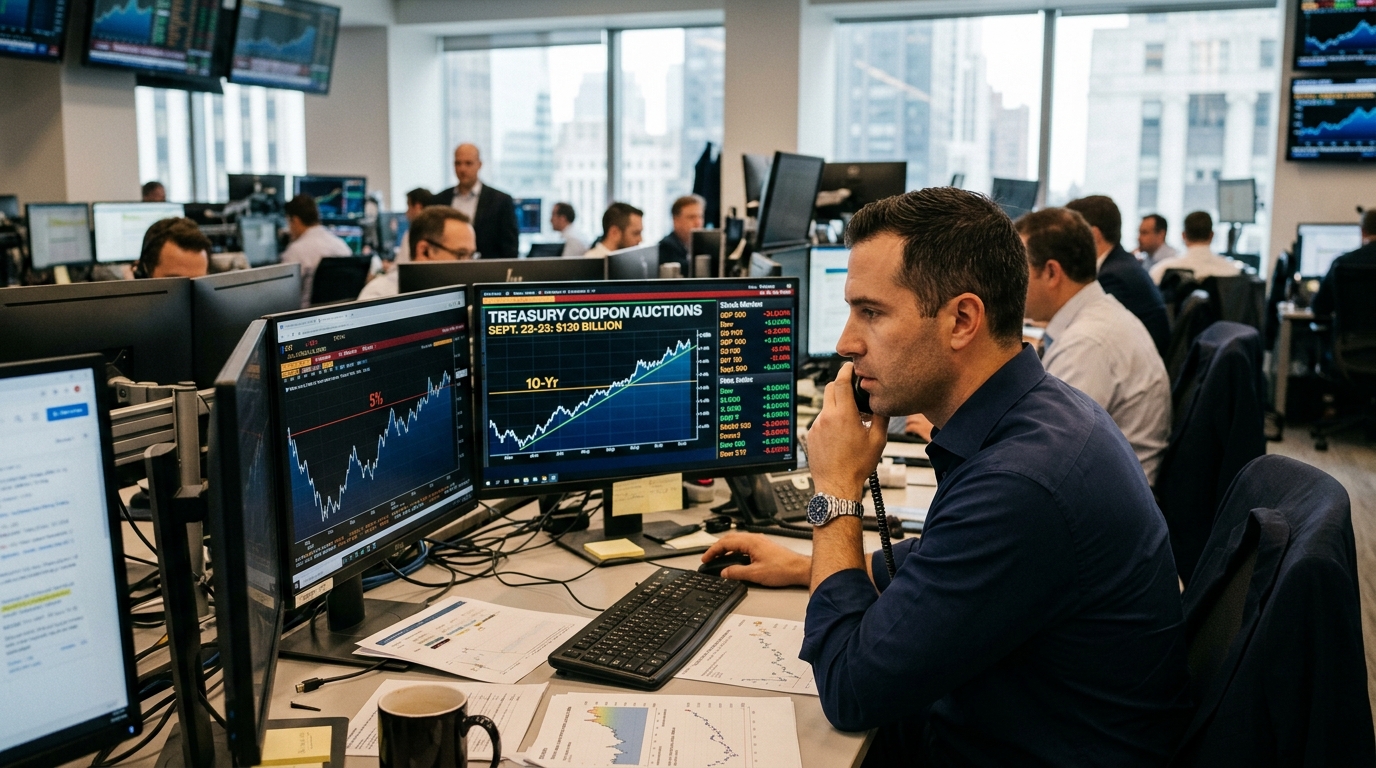
The bond market does not pause for digestion. Four days after the Fed’s first rate hike in three years sent the 10-year yield back above 5%, the Treasury returns to market with a heavy back-to-back coupon supply test. Traders who understand what to watch in Tuesday’s and Wednesday’s auction results will be better positioned than those who only check the score after the fact.
What Happened
The 10-year Treasury closed Friday at about 5.00%, while the 2-year note settled near 4.74% and the 30-year near 5.35%. The move was not gentle. The benchmark 10-year had already topped 5% earlier in the week, its highest level since 2023, amid concerns over the Fed’s ability to bring inflation under control and persistently elevated oil prices. Wednesday’s hike did not calm things, it clarified them. The Fed approved its first interest rate increase in more than three years, with the FOMC voting 12-0 to lift the target range to 3.75%-4%.
Updated projections showed most officials expecting another hike this year. Warsh declined to submit a dot but left no ambiguity in his language. He said this summer’s inflation readings do not indicate that underlying trends have meaningfully improved, and reiterated that he would be hard-pressed to describe broad financial conditions as restrictive.
Kansas City Fed President Jeff Schmid added fuel Friday. Schmid supported the rate increase and suggested more hikes could be warranted, saying “the Fed has work to do on inflation, and this week’s action was a step in that direction.” He has also argued that inflation excluding energy has been running hot, with a broad range of goods and services showing price growth inconsistent with the Fed’s price stability mandate.
Why It Matters This Week
The Treasury is scheduled to auction 2-year notes on Tuesday, September 22, and 5-year notes on Wednesday, September 23. The sizes are $69 billion and $70 billion respectively, $139 billion of coupon supply in 48 hours, the first since the hike landed. That is not routine. These are the auctions that will tell the market whether buyers absorb new paper willingly at current yields or demand a concession to do it.
Auction mechanics matter here. A strong result, high bid-to-cover ratio, yield stopping through the when-issued level, solid indirect bidder participation from foreign central banks, signals that demand is genuine at 5%. A weak result, where dealers are left holding large allotments, tends to push yields higher in the afternoon and weigh on equity valuations within hours. Stocks in 2023 and 2024 demonstrated this pattern repeatedly.
Before Tuesday’s auction, Chicago Fed President Austan Goolsbee speaks Monday morning at an OMFIF event in London. The session is titled “Monetary Policy in an Uncertain World,” which gives Goolsbee wide latitude to address the path ahead. Any tilt toward additional tightening will further pressure the short end and complicate demand for the 2-year notes hours later.
How Professionals Might View It
Experienced fixed-income traders distinguish between the size of an auction and the difficulty of placing it. $69 billion of 2-year paper is large. At roughly 4.74%, it offers a yield the 2-year has not sustained for years. That premium is real, but so is the risk that 16 of 19 FOMC participants now expect at least one more rate hike this year, meaning buyers of 2-year notes face additional duration loss if the next move materializes before year-end.
The 5-year Wednesday is arguably the more meaningful read. Five-year paper sits in the belly of the curve, where institutional positioning is most active and where the debate between “one-and-done” and “higher for longer” gets priced most directly. A tail on the 5-year auction, where the clearing yield lands above the when-issued, would signal that real money is not yet comfortable with the curve at current levels. That outcome historically moves TLT and IEF lower and drags rate-sensitive equity sectors with them.
The Trader’s Lesson
Scheduled supply events are not background noise. Coupon auctions during rate inflection points are genuine price discovery moments, and the afternoon results are worth tracking with the same attention traders give to CPI or payrolls. Watch the bid-to-cover, the yield relative to when-issued, and who is buying. Those three data points will tell you more about whether the bond market has accepted 5% as equilibrium, or is still resisting it.