
September 21, 2026
Bonus Content: Japan’s Rate Check Friday Is the Signal. Tokyo Is Away Until Thursday.
Editor’s Note: Our friend Louis Navellier has been a guest at Mar-a-Lago, President Trump’s private residence in Palm Beach, Florida. He’s one of America’s top tech investors, managing a $1.1 billion portfolio – including $358 million in AI stocks. He called Nvidia before it went up 44,000%. He predicted the dot-com crash and the 2020 Covid rally. And now he’s revealing what he calls the biggest prediction of his 40-year career.
Dear Reader,
Deep in the Appalachian Mountains of Tennessee…
Behind a triple layer of razor wire and a security clearance most Americans will never hold…
Something extraordinary is being built.
You won’t hear about it on CNBC.
The Wall Street Journal hasn’t touched it.
And yet, according to my research, what’s happening inside this facility will trigger one of the most dramatic wealth transfers in American history.
I know this place well.
It’s the same “secret city” that gave America the atom bomb.
The same lab that turned the tide of World War II.
And now – under a directive from President Trump himself – America’s top scientists and engineers have returned to this site for one purpose:
To build a new category of AI computer so powerful…
Trump himself compared it to a Manhattan Project – but for AI.
And I believe – based on months of exhaustive research – this device is going online very soon.
When it does, it won’t just leapfrog ChatGPT, Gemini, and even Elon’s Grok…
It will accelerate AI breakthroughs by 360-fold.
Breakthroughs that used to take five years? They’ll happen in five days.
And that will trigger a $100 trillion reset of the AI markets – the biggest disruption I’ve seen in my 40-year career.
I called Nvidia before it went up 44,000%. Apple before it went up 36,000%. Microsoft before its 60,800% rise.
But nothing in four decades has looked quite like this opportunity.
I’ve prepared a full presentation with the details – including the name and ticker of the one company I believe is best positioned to profit.
Click here to watch it now, free of charge.
Regards,
Louis Navellier
Senior Quantitative Investment Analyst, InvestorPlace
P.S. The “secret city” in Tennessee has been off-limits to the public for decades. But what’s being built there right now is about to become impossible to ignore. When Trump flips the “on switch,” I expect it to trigger a $100 trillion shock to the AI markets. Go here for full details – including the ticker symbol – before this video comes down.
Japan’s Rate Check Friday Is the Signal. Tokyo Is Away Until Thursday.
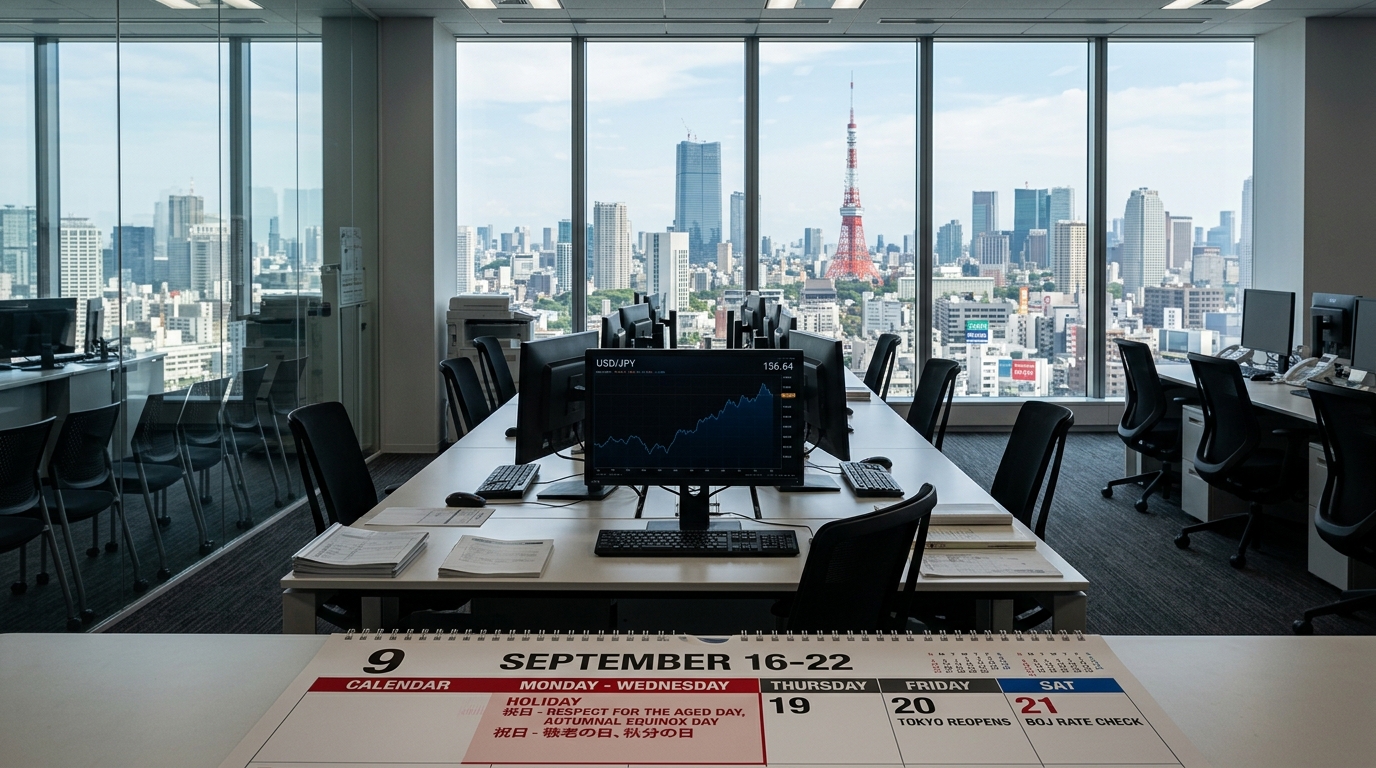
The yen sits near 156.64 per dollar this morning, down roughly 2% on the week, and the desk that would normally stabilize it is dark. The Tokyo Stock Exchange cash market is closed Monday through Wednesday for Respect for the Aged Day, a Citizens’ Holiday, and Autumnal Equinox Day. Yen trading continues offshore through Singapore, Hong Kong, Australia, and New Zealand, with thinner liquidity. That combination, a currency already under pressure and no domestic floor to catch a stumble, is precisely the kind of window that has preceded Japanese action before.
Here is the sequence worth understanding. The Bank of Japan raised its policy rate by 25 basis points to 1.25% on Friday, a split 7-2 decision. The BOJ ultimately disappointed yen traders who wanted clearer guidance on the central bank’s next move. The yen, rather than strengthening on a rate hike, fell. It dropped as much as 1.3% on Friday to close around 157 per dollar, down more than 2% on the week, after the BOJ raised rates with little guidance on further hikes. A hike that the entire market had priced in, delivered with two dissenters and a governor who emphasized supportive conditions, read as dovish. That matters: the yen’s weakness is not an accident of bad timing. It reflects a carry trade dynamic that a single quarter-point move cannot dissolve.
Even at 1.25%, Japan’s benchmark rate remains well below those of most major economies, and that gap continues to make the yen an attractive funding currency for carry trades. Investors borrowed this result; they borrowed it after the August coordinated intervention too. One fund manager exited long dollar-yen positions after the U.S.-backed intervention in August, then re-established dollar-yen long positions just slightly above 157. If the authorities move again this week and the carry trade comes back by next week, that is not a failed intervention for anyone except the trader caught on the wrong side of the initial 2% drop.
Which is the lesson. Tokyo has a history of stepping into currency markets when liquidity is thin during holidays, and concerns intensified following reports that the Bank of Japan conducted a rate check with market participants late Friday, a move often seen as a precursor to intervention. An intervention-style drop would be amplified by the lack of Tokyo cash-market flow, while a quiet session leaves the pair free to drift on the wide rate gap between Japan and the US. Both outcomes are live. The danger for active traders is treating this as a binary directional call rather than a volatility and risk management problem.
The precedent behind the current nervousness is substantial. On August 3, Japan’s Ministry of Finance said it had purchased yen in coordination with the U.S. to counter what it described as excessive volatility and disorderly moves. With the rate check Friday and those statements on record, officials have already pre-announced their posture. The only unknown is timing.
The Nikkei reported that Japanese officials conducted rate checks with banks, a step that traders view as the classic precursor to intervention, and a three-day Japanese holiday has left liquidity thin enough that any official move would land harder than usual. A move that lands harder than usual in thin conditions means slippage that retail and even institutional traders cannot manage by watching headlines. By the time the confirmation appears, the bulk of the price move is over.
The trader’s lesson here is not about direction. It is about respecting the asymmetry of a known trigger during unusual market conditions. Reducing gross exposure in USDJPY ahead of thin holiday windows, when officials have already telegraphed willingness to act, is not pessimism. It is basic risk management. Being right about the longer-term carry trade is small consolation when a 3% intervention spike takes out your stops on Tuesday at 3 a.m. Singapore time. Size down, widen your mental stops, and let Tokyo’s Thursday return tell you how the holiday was priced.