
As copper breaks records… capital is turning toward early-stage discovery stories that are only beginning to unfold.
One under-the-radar Canadian copper company – still trading undiscovered below $2 per share – is emerging at exactly the right moment.
The company controls a historic copper belt in Canada’s Yukon that produced for decades… and is now being explored as a unified system for the first time.
And the results are starting to speak for themselves:
- High-grade copper confirmed at the flagship
- Past-producing areas getting a fresh look via the drill bit
- Multiple additional targets advancing toward drilling
Multiple rigs are already operating. More are being added. And the company is fully funded through the end of 2027 for its biggest exploration program yet.
More rigs. More drilling. Multiple shots at discovery – from a copper stock still trading below $2.
We’ve compiled a FREE online report detailing the high-grade results, the district-scale opportunity, and where the 2026-27 drill campaign goes next – including our exclusive interview with the company’s CEO.
Click here for instant access – and get the full story before the next round of drill results arrives.
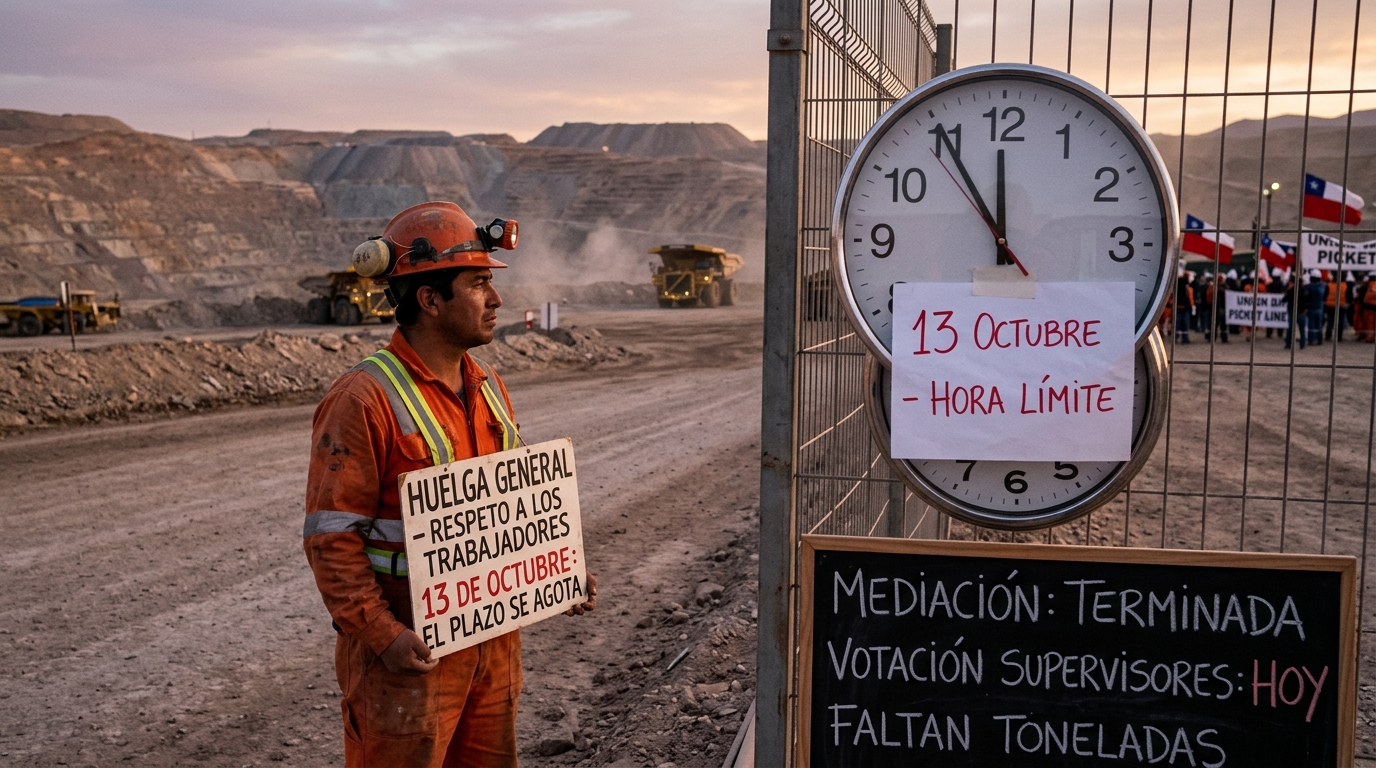
Copper’s October 13 Problem: When Chile’s Strike Clocks Run Out
Two Chilean copper mines are now running against the same legal clock, and the dates on that calendar matter far more than the headlines that triggered them. With copper sitting within range of its all-time record, traders in BHP, Antofagasta, Rio Tinto, Freeport-McMoRan, and the copper ETF COPX need to know exactly when labor friction becomes actual lost production.
What Happened
At Antofagasta’s Centinela mine, the Minera Esperanza and Distrito Centinela unions voted 98.73% in favor of a strike on September 28, rejecting management’s contract offer over compensation discrepancies. The company and unions must now enter a mandatory five-day government-led mediation process before workers can legally begin strike action, and that window can be extended by another five days if both sides agree. Union president Milenko Diaz estimated that if no agreement is reached, a strike could be legally authorized to begin October 13.
At Escondida, the world’s largest copper mine, the supervisors’ ballot closes today, September 30. In recent reporting, supervisors were due to vote from September 28 to September 30 on BHP’s latest contract offer. The union urged members to reject BHP’s latest contract offer, with union leader Alexis Barrera stating it “lacks essential elements.” Both the supervisors’ union and the rank-and-file union rejected BHP’s request to pause collective bargaining, framing the pause attempt as exploiting a tragedy following a fatal accident that suspended operations at Escondida on September 23. A no vote at Escondida starts the same five-to-ten day mediation sequence, placing a potential legal strike there in early-to-mid October as well.
Why It Matters at These Prices
Comex copper hit an all-time record of $6.83 per lb on September 22, 2026, while tight availability outside the U.S. has been a recurring theme in recent price action. Copper is set for a third consecutive monthly advance, with prices increasing approximately 9% in September. At these levels, the market is not pricing in disruption at two major Chilean operations simultaneously.
Centinela produced 240,400 metric tons of copper in 2025, while Escondida produced 1,261,200 tonnes in the year to June 30, 2026, a rate near 3,455 tonnes a day. That is roughly 3,455 tonnes of daily supply from Escondida alone that a strike would remove, on top of whatever Centinela contributes. Metal available in LME warehouses stood at just 133,725 tonnes on September 21, roughly 39 days of the halted mine’s output. The buffer is not generous.
How Professionals Are Reading This
Experienced traders know that a strike vote in Chile rarely means a strike begins the next morning. The mediation structure is designed to create settlement pressure, and it sometimes works. What the calendar does is convert a vague risk into a defined timeline, and defined timelines are tradeable.
The key date is October 13 at Centinela. That is when the maximum mediation window, five days plus a possible five-day extension, runs out and a walkout becomes legal. Because the next steps are predefined, markets can map a narrow strike-risk window into early-to-mid October, and when the risk is near-term, copper pricing often reacts most at the front of the futures market, where any disruption would hit supply now rather than years from now. Watch the front-month spread, not just the outright price.
BHP is the majority operator at Escondida, but Rio Tinto’s 30% stake and JECO’s 12.5% interest mean the financial pressure of any prolonged disruption is not BHP’s alone. For equity traders, that widens the exposure across RIO as much as BHP. Freeport and SCCO carry different operational risk, but would benefit from any copper price spike that a confirmed double-strike scenario generates.
The Trader’s Lesson
Labor disputes at major mines create what experienced traders call a binary event with a known expiry. The risk does not bleed in gradually; it resolves on a schedule set by statute. Rejection of a contract offer at a Chilean copper mine follows a well-worn sequence in that jurisdiction, with the timing set by the statutory cooling-off and mediation calendar rather than by the company. That predictability is the edge. Traders who map the legal calendar rather than react to each headline can position ahead of the resolution rather than chase it. At Centinela, the clock started September 28. At Escondida, it may start today. October 13 is the date worth circling.