
Dear Friend,
The biggest energy deadline in American history is 12 days away.
And it just aimed its full firepower at ONE company.
See, on July 4th, the One Big Beautiful Bill Act killed the federal tax credits that powered alternative energy for years.
But here’s what almost nobody knows:
When the White House killed credits for solar, wind, EVs, and every other renewable energy source in America…
They left one untouched.
Not only that, they reclassified it alongside oil and nuclear…
And gave it eight years of credits.
Because in June 2025, a drilling crew working near the Grand Canyon…
Unearthed a well of clean energy producing almost 8 times the output of the largest oil well in Saudi Arabia…
Capable of powering civilization for two million years.
Right here on American soil.
Google signed a 15-year contract.
Bill Gates wrote a $100 million check.
And now the clock’s running.
On October 20th, Washington puts 83 parcels of federal land on the auction block.
Whoever wins them could lock up this energy for decades.
One company already owns the entire chain.
Once the gavel drops, this stops being a secret.
Get the Grand Canyon ticker before October 20th here >>
The Buck Stops Here,
Kelly Maguire
Behind the Markets
P.S. The auction opens October 20th. After that, everyone will know who’s behind this discovery.
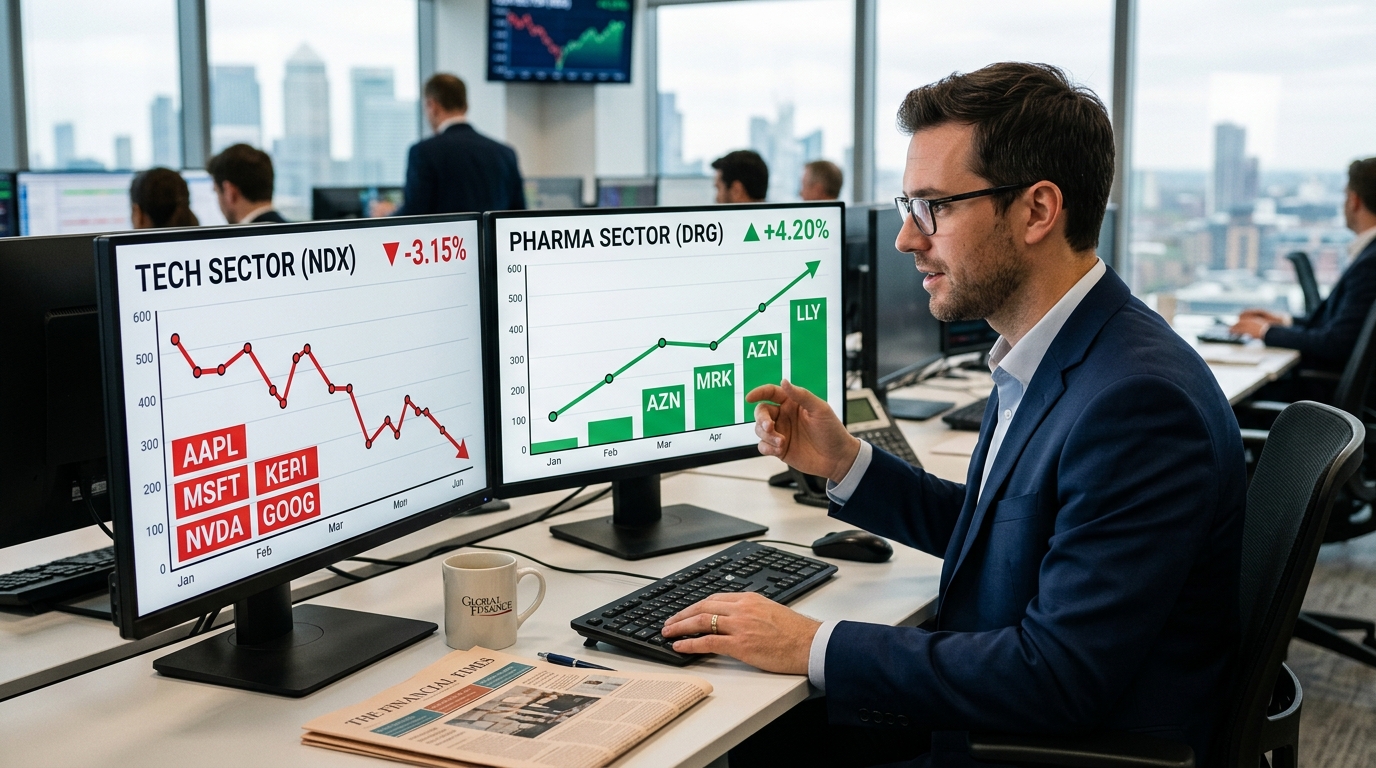
Pharma Stocks Rose 4% While Tech Fell 3%. That Gap Is the Story.
For most of this year, when technology sold off, the proceeds seemed to disappear. Cash, short-term Treasuries, nothing particularly identifiable caught the bid. Wednesday changed that. While the Nasdaq dropped nearly 2% and the technology sector shed about 3%, a cluster of large pharmaceutical names gained roughly 4% apiece, in lockstep, with real volume behind them. That is not a coincidence. That is rotation, and traders who missed it should understand exactly what they were looking at.
What Happened
The S&P 500 fell 1.11% to close at 7,718.94, while the Nasdaq Composite shed 1.88% to close at 26,692.87. Information technology was the session’s worst-performing sector, down about 3.0%. Against that backdrop, AstraZeneca gained 4.29%, Merck 4.09%, Bristol-Myers Squibb 3.99%, AbbVie 3.94%, Eli Lilly 3.90%, and Pfizer 3.89%. The healthcare ETF XLV rose 2.53%.
The catalyst was straightforward. The consumer price index rose 0.6% in September from the prior month, pushing the year-over-year gain to 3.7%, above the 3.6% economists had forecast. Core CPI rose 0.3% for the month and 2.6% from a year earlier, both exceeding expectations of 0.2% and 2.5%.
Why It Happened
Lower closing Treasury yields could not rescue risk appetite on Wednesday. Hot core inflation collided with existing AI financing concerns, sending technology and speculative exposures sharply lower while healthcare, dividends and long Treasuries gained.
The AI trade had two problems converging at once. Higher-for-longer rates compress the long-duration valuations that the AI infrastructure build-out depends on. And credit stress was already spreading through that ecosystem before the CPI data landed. CoreWeave fell about 15.5% as bond yields approached 15% after a widely circulated warning about neocloud survivability, while Oracle and other AI-linked names fell in sympathy. When both the rate argument and the credit argument turn against a crowded trade simultaneously, the exit is fast.
The credit stress hitting CoreWeave was not isolated. Hyperscalers spending over $700 billion on AI capex in 2026 face the same investor scrutiny over whether returns justify the cost.
Pharma offered the opposite profile. Healthcare and consumer companies benefited from a rotation away from technology after the CPI came in above expectations. Large-cap drug stocks carry dividend yields, relatively low sensitivity to AI capex cycles, and predictable cash flows. In a session where rate fears resurfaced and growth valuations compressed, that combination looked a lot better than it did a week ago.
How Professionals Might View It
Experienced traders will focus less on the individual names and more on what the internal structure revealed. Beneath the nearly flat Dow, participation deteriorated and new lows expanded. The recovery needed broader confirmation; instead, the market showed how narrow its support remained. That breadth deterioration is bearish for the index, but it is actually confirming for the rotation: when only a few groups hold up during broad selling, those groups are telling you where institutional capital is being repositioned, not just where retail is hiding.
The size and synchronicity of the pharma moves matter too. Six major names, all up roughly 4%, on a day the sector they belong to gained 2.5%, suggests something more deliberate than defensive panic. Funds rotating out of a crowded AI position don’t buy one drug stock. They buy the sector.
What Comes Next
The question for today’s session is whether this was a one-day trade or the opening move of a durable leadership change. One day proves nothing. But the conditions that drove it, sticky inflation, AI credit stress, rate uncertainty, have not resolved overnight. PPI data for September is due Thursday morning, and forecasts cluster around roughly half a percent month over month; another hot reading would extend the same logic that punished tech on Wednesday.
XLV and the individual names that led Wednesday deserve attention on any further broad-market softness. A group that holds its gains while the index struggles is demonstrating relative strength, the one signal that tends to persist long enough to trade.
The Trader’s Lesson
Rotation is only useful information when the money goes somewhere you can track. Most of this year’s tech selling went to cash, which tells you nothing about where to look next. Wednesday was different: six of the largest pharmaceutical companies in the world moved together, by the same amount, on the same day tech broke down. When capital moves that deliberately, the job isn’t to chase the names that already ran. It’s to identify whether the conditions that caused the move are still in place, and position accordingly before the second leg, not after it.