
There is a monetary shift building that retirement savers will not see until it has happened.
Almost every retirement account in America is held in dollars.
But what your account is really worth is not the number on the statement. It is what that number can buy.
And since 1971 when Nixon cut the tie between the dollar and gold, this number is buying less every single year.
You feel it at the pump. You see it at the cash register.
Your savings have been running uphill against that erosion for more than 50 years.
Now Congress is taking a second look at the gold the government owns.
And a bill in Congress would require the Treasury to reprice the government’s gold on its books, at market value.
Here is why it matters to you.
The government values its own gold at $42 an ounce. Congress set that price in 1973 and never changed it.
Gold trades at over $4,000 today.
America holds more gold than any country on earth. On the books, it is worth about $11 billion. In the real world, more than $1 trillion.
That is a gap of about 95 times, sitting on the nation’s books, in plain sight.
And Washington has noticed. That is what the repricing bill is.
If that number is ever corrected, Washington books a trillion-dollar gain. From gold.
The Americans who already hold physical gold did not wait for Washington to notice.
More than 60 million Americans qualify to move a portion of their savings into physical gold right now. Tax-free. Penalty-free.
The 2026 Gold Guide walks through every step.
Takes 30 seconds to request.
Nixon made his move on a Sunday night. No warning.
If it changes again, the only question is which side you are standing on.

Corteva Reports Wednesday as a Different Company Than You Remember
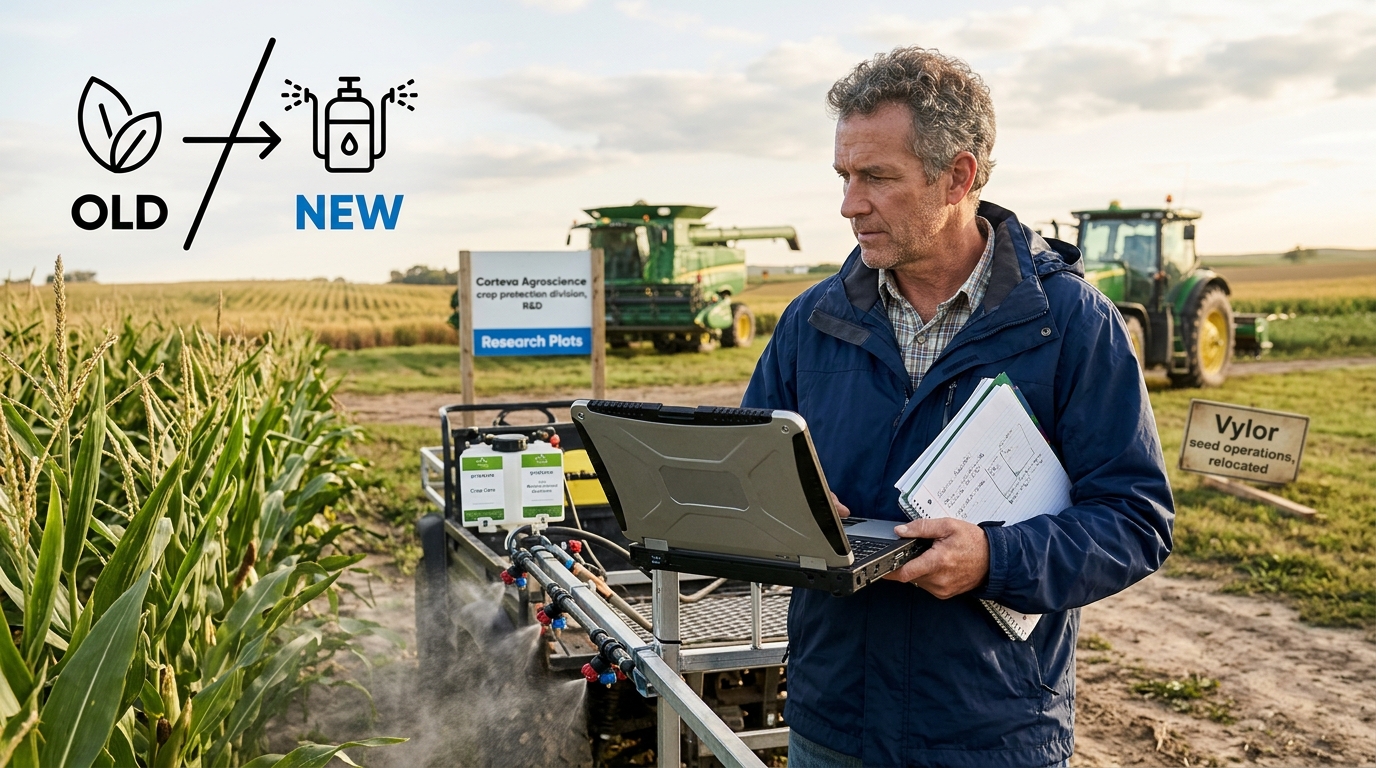
Most investors still think of Corteva as a seeds-and-chemicals company. It is not, as of five weeks ago. On October 1, Corteva completed the spinoff of its seed and genetics business into Vylor Inc. (NYSE: VYLR), giving existing shareholders Vylor shares via a distribution tied to their Corteva holdings. What reports after the bell Wednesday is a pure-play crop protection business under a new CEO, Luke Kissam, with a sharply different margin profile than the company that posted $2.30 in operating EPS back in July.
That context matters enormously for how to read Wednesday’s numbers. The Q3 report Corteva filed a year ago included seed revenue. This one will not. Analysts are modeling $1.77 billion in total revenue for the quarter, a year-over-year decline of roughly 32%, almost entirely because the seed segment no longer exists inside CTVA. The EPS consensus sits near breakeven at around $0.02 per share. But those headline comparisons are nearly meaningless without adjusting for the separation. The real question traders should be asking is what crop protection margins look like on a standalone basis, stripped of the seed business that was carrying the combined company’s profitability.
The answer going in is not comfortable. Through the first half of 2026, Corteva’s crop protection segment saw pricing decline low-single digits, driven primarily by competitive pressure in Latin America’s pre-emergent herbicide market. Brazil pricing was expected to fall mid-single digits in the second half. Analysts project crop protection biologicals revenue near $158 million for the quarter, up roughly 7.5% year over year, which is one of the few bright spots: newer, differentiated products are holding price better than older chemistry.
That biological and new-product mix is what Wednesday’s call needs to show traction on. The rump Corteva is essentially betting that volume growth in differentiated crop protection solutions can offset generic competition eroding legacy product pricing. In Q2, that trade worked: crop protection operating EBITDA rose 2% despite a 4% revenue decline, because productivity actions and favorable currency more than covered the price headwinds. Repeating that performance in Q3, without the seed business to absorb overhead, is a stiffer test.
The shares opened at $11.88 on November 3, giving the new, narrower Corteva a market cap of roughly $8.0 billion. That is a fraction of what CTVA commanded before the split, reflecting what the market already knows: crop protection is the harder business to own right now. Chinese generics continue to undercut older products, and farmer margins globally remain compressed, limiting what growers will pay for inputs.
The trader’s lesson here is about separation math. When a company splits apart, the surviving entity is often the one carrying the cycle risk the market preferred to ignore while the stronger business was blending results. Wednesday’s report is the first honest look at whether Corteva’s crop protection franchise can generate consistent earnings on its own. Watch the segment operating EBITDA margin number, not the top line. If that margin holds or expands despite Brazil pricing pressure, Kissam has a credible story. If it compresses, the stock has further to price in.