
Dear Reader,
The votes are counted. And whoever you voted for… one thing about your retirement didn’t change.
It’s still counted in dollars.
Two days after the vote, Wall Street showed how fast those dollars can vanish.
On November 5, the Dow dropped more than 1,800 points. The S&P 500 fell 4.4%, its worst day since April 2025, according to CNBC.
If your 401k tracks the S&P 500, you lost about that much in a single day.
But that’s the fast way to lose money. The slow way is worse.
In 1971, Nixon made YOUR money officially backed by nothing.
Since then, the dollar has lost 87.9% of its buying power, according to the Labor Department’s own CPI data.
No ballot can change that… because the people who manage the dollar aren’t on one.
That’s why I built a three-phase system that settles how much to hold before deciding what to buy… and moves a portion of your assets onto rails where you keep the keys.
I walk you through it in a free presentation.
See how to election-proof your retirement here →
To your wealth,
Tan Gera, CFA
Decentralized Masters
P.S. On November 5, all 11 sectors of the S&P 500 fell, and losing stocks outnumbered winners almost 6 to 1 on the New York Stock Exchange. Days like that show how little of your retirement you actually control. See how to hold part of your wealth where you keep the keys →
Qantas Shares Jump 6% on 850 Job Cuts. The Market Is Paying for Efficiency Now.
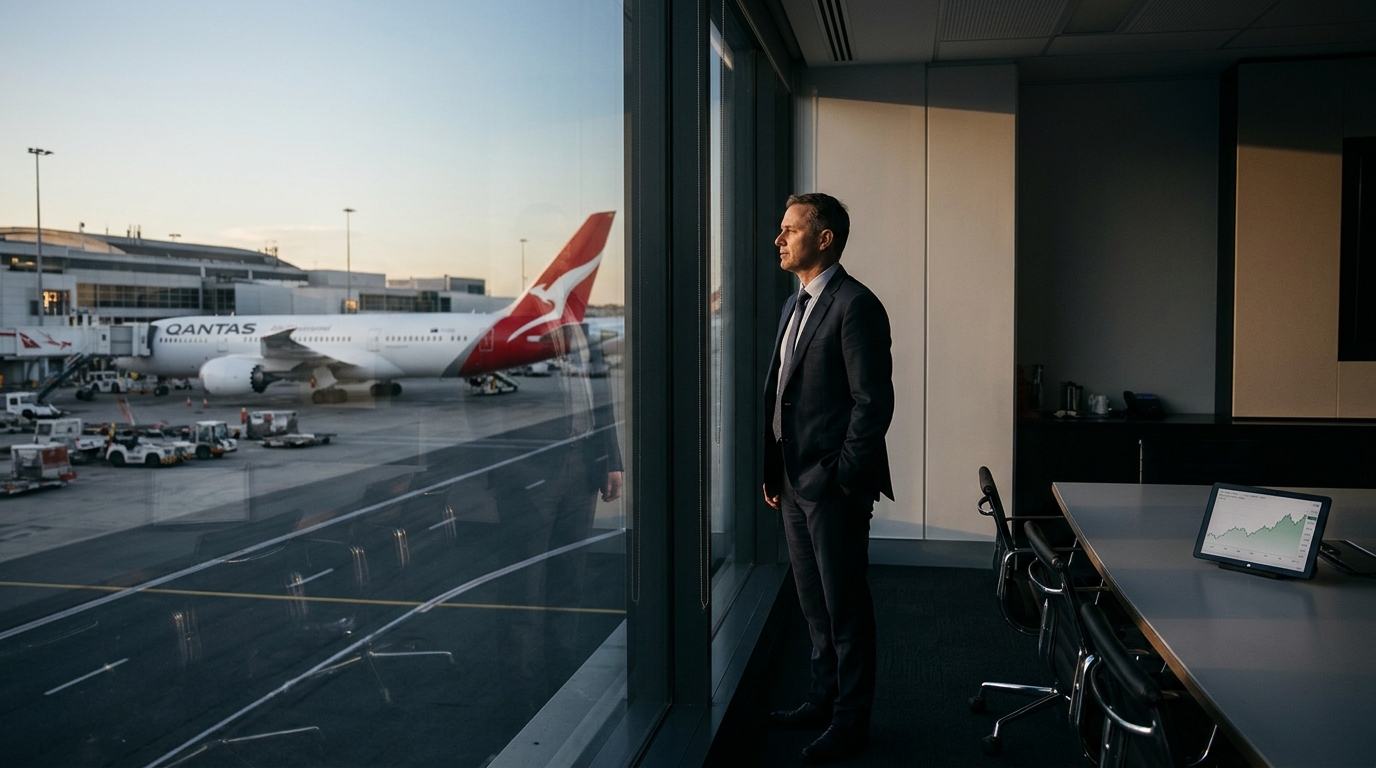
There was a time when airlines moved their shares by announcing new routes, bigger planes, or bold expansion plans. On Tuesday, Qantas moved its share price by telling 850 of its corporate employees they no longer have jobs.
The market approved immediately.
Qantas climbed 6.34 per cent on the day, making it one of the strongest performers on an already strong exchange. The S&P/ASX 200 gained 99.3 points, or 1.10 per cent, to close at 9,129.0, marking its highest finish since 25 August 2026. Qantas did not ride that wave passively. It helped generate it.
Qantas Airways struck a technology-outsourcing agreement with Accenture that will remove about 850 jobs at the Australian airline and increase its embrace of AI. The first phase of cuts would affect finance, procurement, human resources, and marketing staff. CEO Vanessa Hudson told staff in an email that the jobs would be cut over the coming years, with the first round to happen by mid-2027.
The job cuts affect around 3% of Qantas’s Australian workforce of 28,000. That is not a rounding error. It is a deliberate structural decision framed inside an AI modernization story. The airline said the move was in response to rapid changes in the industry due to AI, and the Accenture partnership would help it overhaul its legacy systems and simplify some corporate functions.
The unions heard something different. The Australian Services Union said staff were told by Hudson that up to 850 jobs could be sent offshore, and accused corporate Australia of using deals with global tech giants like Accenture as cover for offshoring. A Qantas spokesperson confirmed the work would be delivered by Accenture teams in India and in Australia. The company and the union also disputed whether assurances were ever given that offshoring was off the table.
The dispute over process matters for employees. For traders watching price action, it did not change the calculus at all. The market looked at a leaner cost base and bid the stock higher. That reaction is worth understanding on its own terms.
The same logic is playing out inside financial services, where the workforce being automated is considerably more expensive. Morgan Stanley co-designed an AI tool with OpenAI that automates the core tasks of its own junior investment bankers — and the market treated that as a feature, not a liability.
What we are seeing is a revaluation of how the market prices operational discipline. For most of the last decade, investors rewarded airlines and other capital-intensive businesses primarily on revenue growth, load factors, and route expansion. Cost-cutting was seen as defensive, something you did when the cycle turned against you. The Qantas session today suggests that framing has shifted. Qantas is the latest in a growing number of big Australian companies to offshore workers in a bid to cut costs and improve efficiency, and each time the market has largely applauded.
For disciplined traders, the lesson runs deeper than one airline stock. When the market consistently rewards a specific type of corporate action, that is information about where institutional capital wants to go. Cost reduction stories anchored in technology infrastructure, with a credible execution partner and a phased rollout, are attracting buyers. That is a pattern worth tracking across industrials and financials well beyond today’s session.
The same dynamic is visible in industrials beyond aviation. Caterpillar’s market showed that a clean operating margin, stripped of one-time items, is what institutional buyers are actually pricing.
The harder question is duration. A stock that jumps on job cut news is pricing in future margin improvement. If those margins do not materialize by the time mid-2027 arrives and the first tranche of changes is in place, the trade reverses. Anticipation is not confirmation. Professionals who trade the initial reaction know that; the ones who chase a week later often do not.
Today’s lesson: The market’s reaction to news matters as much as the news itself. When a stock rises on what most people would call bad news, ask what expectation just changed. That gap between headline and price response is where real edge lives.