
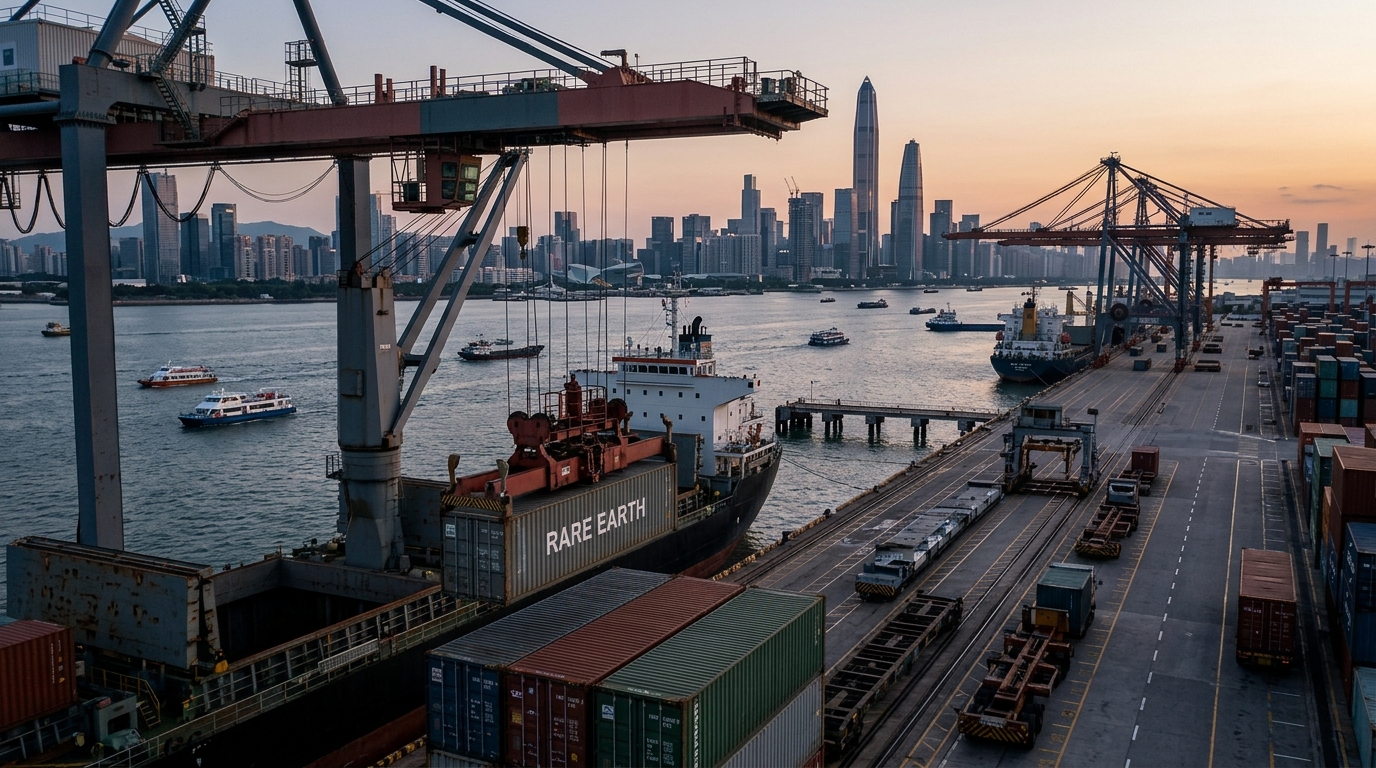
Markets spent much of October positioning for a clean outcome on Tuesday: China’s suspended rare-earth export controls would lapse on November 10, the threat would quietly drain away, and the rare-earth miner rally would lose its urgency. That scenario never arrived. On November 9, Beijing announced a two-month extension of export-control suspensions that were due to expire on November 10, pushing the new deadline to January 10, 2027. The extension was not a footnote. It was a choice.
China had introduced controls on certain rare earths in April 2025, expanded them significantly in October that year, and then paused that October 2025 expansion for one year following the Xi-Trump summit in South Korea. Monday’s announcement sits inside a broader de-escalation framework as Beijing continues negotiating with Washington over a lasting deal. But the structure of that package deserves attention.
China’s Ministry of Commerce and the General Administration of Customs issued an announcement continuing the suspension of six 2025 export-control measures through January 10 and averting an immediate regulatory cliff for U.S. manufacturers, while the April 2025 licensing requirements for seven medium and heavy rare earths, including dysprosium and terbium, remain in place and were not lifted by this extension. That is the part most investors missed. The suspension preserves the threat structure; it does not dissolve it.
Some Chinese suppliers had already halted rare earth shipments to American customers, and certain U.S. companies have reported long waits for export licenses. Extending the suspension buys diplomatic time but does not automatically clear backlogs or restore pre-2025 flows. Analysts warn that a two-month reprieve is not supply-chain independence, and that actual license approvals and shipment volumes must be tracked, not just diplomatic statements.
The timing is the signal. The extension comes ahead of Trump’s planned visit to Shenzhen for the APEC leaders’ summit later this month. Trump and Xi are expected to meet on the sidelines of the APEC Economic Leaders’ Meeting in Shenzhen on November 18-19, their third face-to-face meeting this year. Beijing chose to keep its strongest non-tariff leverage intact, in suspended form, heading into that meeting. The January 10 deadline will be sitting on the table in Shenzhen.
Stocks read the extension as relief. MP Materials closed up 6.61% on November 9 at $37.75. Those moves are understandable as a reaction to the expiry scenario not materialising, but they conflate the removal of one tail risk with the resolution of the broader supply question. MP Materials holds a government-backed price floor arrangement, while USA Rare Earth has disclosed a non-binding letter of intent with the Commerce Department for up to $1.6 billion in CHIPS Act support tied to building out its supply chain. Those backstops remain the actual investment thesis regardless of what MOFCOM announces month to month.
Further up the technology stack, the exposure runs differently. China mines roughly 60% of global rare earths and carries out about 90% of processing and separation. Nvidia’s costs can rise if key suppliers face rare-earth supply constraints, though that risk would typically show up through component availability and pricing rather than as a direct line item from TSMC. Apple, whose supply chain threads through Chinese processing for components across its device lineup, faces similar second-order exposure if the January deadline eventually triggers enforcement rather than another extension.
What to Watch Next
The Shenzhen APEC meeting on November 18-19 is the immediate test. If Trump and Xi reach a framework that specifies rare-earth access as part of a broader technology exchange, the January 10 deadline likely shifts again or becomes moot. If talks stall, the suspended measures can snap back into force in sixty days. China did not reverse the April 2025 rare-earth controls, and it has used export restrictions across a range of strategic materials in recent years. The suspension is a posture, not a concession. What APEC produces will tell investors whether January 10 is another deadline to roll over or the one Beijing finally decides to enforce.