
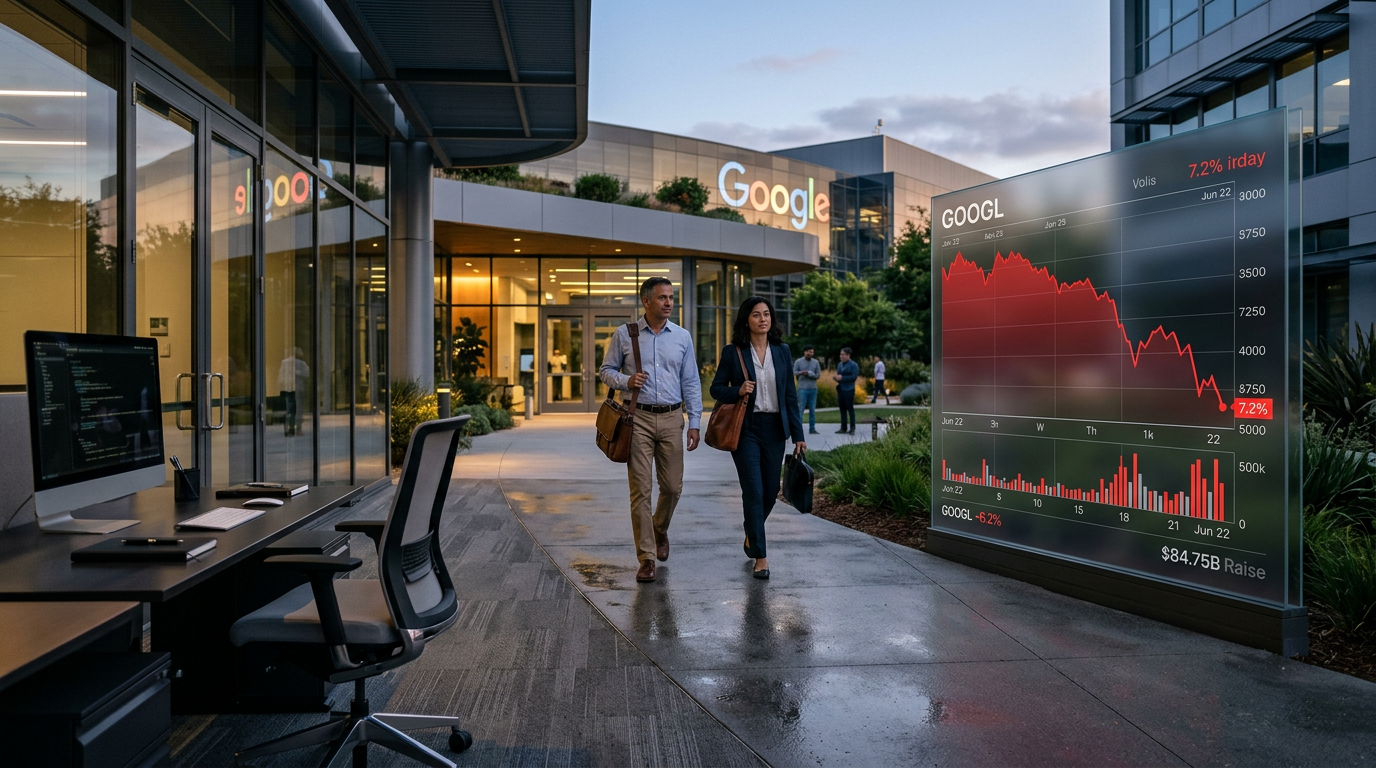
The sell-off on June 22 told a precise story. Alphabet (GOOGL) fell as much as 7.2% intraday — the steepest intraday drop since February — and closed down about 6.2%. The Nasdaq fell 1.32%. That divergence is the whole point. This was not a simple sector move. It was a company-specific repricing driven by two names, a record-sized equity raise tied to AI infrastructure spending, and a market that suddenly started asking questions it had been willing to set aside.
Noam Shazeer departed to OpenAI on June 18. John Jumper left for Anthropic on June 19. Two world-class researchers. One week. A market that had been comfortable with “talent war noise” suddenly wasn’t.
The numbers underneath this company, however, are still exceptional. That tension is the trade.
Market Context
The macro backdrop coming into this week was already complicated. Following last week’s FOMC meeting, investors continued to debate how soon the next hike could arrive. The S&P 500 closed Monday at 7,472.79, down 0.37%. The Nasdaq settled at 26,166.60. Big tech broadly had a rough session, with Alphabet and Amazon among the notable drags.
Thursday brings May PCE data — the Fed’s preferred inflation gauge. Core PCE is expected to rise on the month, according to economists polled by FactSet. That reading will either confirm or challenge the rate trajectory investors are currently pricing. For a company like Alphabet that is simultaneously funding an aggressive AI infrastructure buildout and defending its AI leadership position, the macro environment arriving into Q2 earnings could not be more complicated.
The Two Departures
Let’s be specific about what was lost, because the market reaction only makes sense in that context.
Noam Shazeer is one of the co-authors of the landmark 2017 paper “Attention Is All You Need” — the research that introduced transformer architecture, the foundational technology underpinning ChatGPT, Gemini, Claude, and virtually every modern large language model. Google paid $2.7 billion through the Character.AI acquihire in 2024 to bring him back. Less than two years later, he’s at OpenAI.
John Jumper led (and helped build) AlphaFold at DeepMind, the protein-structure prediction system that transformed biological research. Reuters and other reports described him as a 2024 Nobel Prize in Chemistry recipient, and he spent nearly nine years at DeepMind before announcing his departure to Anthropic on June 19.
Two landmark researchers leaving in the same week is historically unusual at the frontier of AI. The market’s reaction reflected that — alongside growing concern that cutting-edge AI is becoming more commoditized.
Worth noting: a California judge also denied Meta and Google’s YouTube requests for a new trial after a jury found the platforms were designed to be addictive for young users — adding legal exposure on top of the talent and capex pressures.
The Capex Question
Separate from the talent story, Alphabet is navigating a capital commitment that has no clean resolution in the near term. In early June, the company announced an $80 billion equity capital raise and then upsized and priced it at $84.75 billion. The raise includes a $10 billion investment from Berkshire Hathaway. Full-year 2026 capex guidance sits at $180 billion to $190 billion, and the company has indicated 2027 spending is expected to remain at similarly elevated levels.
CEO Sundar Pichai acknowledged on the Q1 earnings call that Alphabet is currently “compute constrained” — meaning the company cannot fully capitalize on existing cloud demand. That’s the reason for the spend. The cloud backlog was reported at $462 billion. But the equity raise creates dilution, and dilution changes the EPS math in ways not everyone has re-modeled yet.
The Fundamental Numbers
Q1 2026 was exceptional by any measure. Revenue of $109.9 billion grew 22% year-over-year, exceeding consensus. Google Cloud delivered about $20.0 billion in revenue — up 63% year-over-year. Operating income grew about 30% to $39.7 billion. Diluted EPS was $5.11. Net income of $62.6 billion was up 81% year-over-year (and was notably boosted by investment gains), while operating margins improved to roughly 36%.
The company is still operating at massive scale — roughly $403 billion of revenue and about $132 billion of net income on a trailing twelve-month basis — and expectations remain high for next year’s earnings power.
Slight tangent, but it matters: Google DeepMind also announced a reported $75 million investment in A24 this week, tied to an AI research partnership aimed at developing filmmaking tools. That’s a different kind of moat-building that is getting close to zero airtime in the current sentiment environment.
Analyst Positioning
Sixty-three analysts polled by S&P Global maintain a Strong Buy consensus on GOOGL, with an average 12-month price target of $432.83 and the high target at $515. The fact that broad target frameworks have not obviously collapsed following the talent exits is its own signal. The street is making a collective judgment: this is primarily a sentiment event, not a clean fundamental re-rating.
GOOGL is now trading well below its 52-week high (which has been reported around the low $400s, with some data sources putting it near $408.61 on May 18, 2026). The stock had already pulled back from its May peak above $400 before the talent news arrived — largely due to the capex and dilution concerns. The talent story accelerated a move that was already in progress.
Technical Structure
The $340 level is the first meaningful structural test. That zone has held on prior tests and represents the line between a recoverable sentiment-driven pullback and a more significant breakdown. A close below $340 on elevated volume changes the picture. Above that level, the stock is moving around in what looks like an emotionally driven air pocket — the kind of oversold zone that historically precedes mean reversion rather than further deterioration, particularly when the fundamental backdrop remains intact.
GOOGL’s MACD turned negative earlier this month. The stock is trading below its 50-day moving average. Near-term momentum is not supportive. But momentum indicators at single-digit timeframes after a sharp single-session drop on sentiment — not earnings — have a poor track record as long-term directional signals.
Volume on the sell-off was elevated, which means real institutional selling occurred. Whether that was rebalancing, stop-out cascades, or genuine re-rating is unclear from the outside. Elevated sell-side volume after a sentiment shock often creates the conditions for the next opportunity — not immediately, but over days and weeks as the dust settles.
Scenario Modeling
Bull Case
Thursday’s PCE reading lands soft, easing rate fears and giving tech broadly room to stabilize. Google Cloud continues its trajectory into Q2, and the cloud backlog of $462 billion provides revenue visibility that overrides near-term sentiment. Alphabet announces a meaningful research retention initiative or a new high-profile hire before Q2 earnings, restoring confidence. The stock recovers toward the $390 to $400 range on a timeline of four to six weeks — still below the analyst consensus of $432.83. The bull case does not require perfection, just fundamental stability and macro cooperation.
Base Case
GOOGL stabilizes between $345 and $370 over the next two to three weeks as the initial shock fades. The capex and dilution narrative stays active but does not worsen materially. Q2 earnings in late July confirm Cloud growth and operating leverage, giving the stock a catalyst to recover toward prior levels. Analysts largely hold targets. The stock re-rates slowly — not in a straight line — toward consensus. The base case requires patience and tolerance for continued volatility around macro data and any additional talent headlines.
Bear Case
Thursday’s PCE surprises to the upside, accelerating rate expectations and triggering a broader tech selloff that pressures GOOGL below $340 support. Additional high-profile departures are announced before Q2 earnings, compounding the talent narrative. EPS estimates are revised lower to reflect equity dilution from the $84.75 billion raise. The stock tests the $310 to $320 zone. The bear case requires both macro deterioration and continued company-specific credibility erosion — a combination that’s possible but not the base case for a company with a $462 billion cloud backlog and dominant global advertising share.
Active Trader Strategy Framework
Thursday’s PCE data is the first critical event. The macro read shapes everything. A soft number gives tech broad room to recover and likely pulls GOOGL’s near-term risk profile meaningfully lower. A hot number extends the pressure and warrants patience before adding exposure.
The $340 level is the line in the sand. Traders positioning ahead of Q2 earnings need a thesis built around what the numbers actually show — not what the talent headlines imply. Cloud revenue growth, the $462 billion backlog, and operating margin trajectory are the variables that will move the stock at earnings. Researcher departures, however notable, rarely restructure a cloud business in one quarter.
Defined risk structures make sense in this environment. Single-session moves of 7% are a reminder that sentiment can override fundamentals in the short term. Size accordingly. GOOGL is liquid enough to allow layered entries rather than single-point risk decisions.
Watch the $340 level. Watch Thursday. Don’t make a permanent positioning decision based on a single session’s emotion.
For informational and educational purposes only. Not investment advice. Trading involves risk, including loss of principal.