
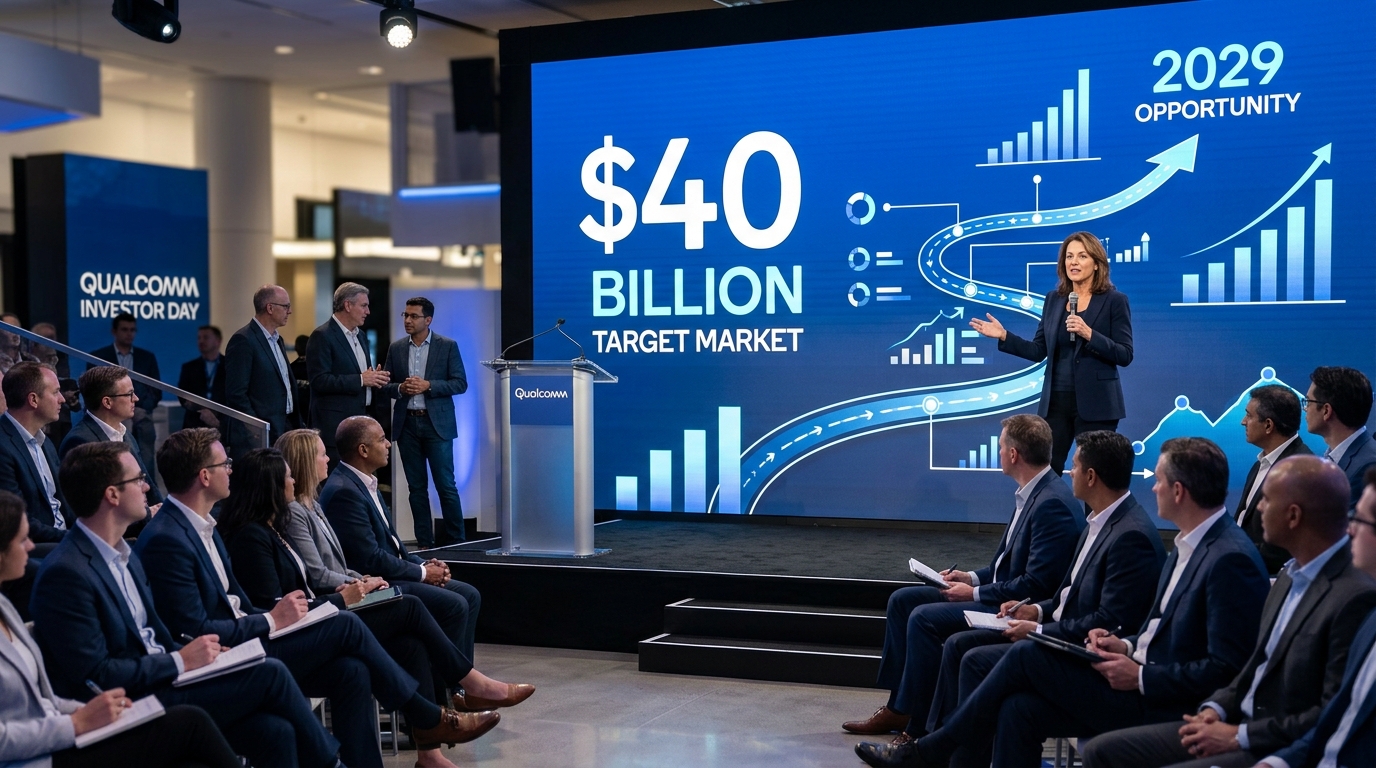
Wednesday night, Qualcomm shares jumped more than 10% in after-hours trading. By Thursday’s close, most of those gains had evaporated. That move tells you everything about where QCOM is right now: a stock that the market desperately wants to believe in, but keeps asking for proof.
The Investor Day was real. The ambition was not subtle. And the questions it raised are going to dominate the QCOM conversation for the next 12 months.
What Actually Happened on June 24
On June 24th, Qualcomm held its 2026 Investor Day in New York and formally unveiled the Dragonfly data center portfolio, and announced an agreement to acquire AI software company Modular in an all-stock deal valued at about $3.92 billion.
The headline number was aggressive. Qualcomm announced that by fiscal 2029, non-handset revenue for its QCT semiconductor segment will reach $40 billion, approximately 2x its prior fiscal 2029 target. The data center business alone carries a revenue target of more than $15 billion by fiscal 2029. And it did not stop there: the automotive design-win pipeline was expanded to $65 billion with a revenue target of $10 billion by fiscal 2029. The company also targets more than $18 non-GAAP EPS in fiscal 2029.
Wall Street reacted like it always does to a big slide deck with big numbers. Surge first, think later.
The Catch That Matters
Here is where it gets interesting. The chips powering that $15 billion do not exist in shipping form yet. Qualcomm has said its first-generation Dragonfly C1000 CPU for Meta will be in production starting in the second half of 2028. Investors are underwriting a roadmap.
That is not necessarily a dealbreaker. Nvidia built its current $3 trillion-plus valuation on roadmaps investors believed years before the revenue materialized. The difference is that Nvidia had an installed base and a developer ecosystem that gave the market confidence in execution. Qualcomm is showing up late to a party already being dominated by Nvidia, AMD, and now custom silicon from the hyperscalers themselves.
The Dragonfly C1000 is positioned as an Oryon-based data center CPU with 250+ cores, aimed at “agentic AI” and general-purpose workloads, with production slated for the second half of 2028. The question is whether it is big enough to matter by 2028.
The Anchor Customers Are Real, But So Is the Timeline
Qualcomm and Meta announced a strategic multi-generation agreement for Qualcomm to be a supplier of data center CPUs for Meta, and Mark Zuckerberg was quoted in Qualcomm’s press release confirming the partnership. Qualcomm’s first-generation Dragonfly C1000 CPU is slated to be in production starting in the second half of 2028.
Having Meta as a named customer is legitimizing. Nobody doubts Qualcomm can execute on mobile silicon. The data center game is different, and the multi-year gap before meaningful revenue ships is a long time in a market that is moving this fast.
The Modular acquisition, at approximately $3.92 billion, brings an open, AI-native software stack enabling models to run across different chip architectures without developers needing to rewrite code for each type of hardware. Qualcomm has positioned this as a move toward a more open, vendor-neutral software ecosystem that can run across diverse compute environments. If you are going to compete with Nvidia, you have to break the CUDA lock. Modular is a credible attempt at that.
Where the Stock Actually Sits
Qualcomm has done something unusual in 2026: it has rallied past where most of Wall Street thinks it should trade. As of late June, QCOM changed hands near $222, yet the consensus 12-month price target sits around $184, meaning the stock is priced above the average analyst forecast.
That inversion is the whole game. When a stock trades above the average analyst target, the asymmetry tilts negative. Beats are partly priced in, while a disappointment around a catalyst like Investor Day can trigger an outsized gap because the elevated expectations unwind all at once.
The current business financials: operating cash flow was $7.41 billion last fiscal half, while capital expenditures were about $1.08 billion, implying roughly $6.3 billion in free cash flow. Qualcomm ended the quarter with $5.43 billion in cash and equivalents on hand. The balance sheet is solid. The near-term earnings are under pressure from handset softness.
The Apple Overhang Is Still There
This is the structural risk that no Investor Day slide can make disappear. Apple’s move to in-house modems, reportedly targeting 2027, is the largest structural risk, on top of cyclical smartphone demand and China exposure. Qualcomm currently models a roughly 20% modem share for Apple’s fall phones, with royalty revenue holding at a similar scale pending renegotiation, but the direction of travel is down.
So you have the bull case (data center pivot buys the stock years of new revenue growth before the Apple loss matters) fighting the bear case (the pivot is 2028 revenue, the Apple loss is 2027, and there is an earnings trough in between).
Technical Framework
By the close on June 25, QCOM sat at $204.90, down from recent highs. The post-Investor Day fade is a classic “buy the rumor, sell the news” pattern, amplified by the fact that the stock had already rallied hard into the event. QCOM ran roughly 54% since late March. A lot of good news was already in the price.
Key technical levels now: the $195–$200 zone is near-term support following the retracement. A hold above $200 keeps the bullish intermediate structure intact. A breakdown below $190 opens the door to a more significant unwinding of the Investor Day premium. On the upside, a decisive move and close above $225 would signal that the market is underwriting the roadmap rather than waiting on proof.
Three Scenarios
Bull Case: Hyperscaler custom silicon agreements ramp faster than the model timeline suggests. Early Dragonfly engineering samples impress in late 2026, and the market starts treating the FY29 targets as credible rather than aspirational. QCOM retests the $240–$260 range. Analyst upgrades from the current cautious Hold consensus begin flowing in Q4 2026.
Base Case: The stock consolidates in the $195–$225 range for the next two quarters as the market waits for the first real data point on data center traction. Handset softness keeps near-term earnings messy. The Apple modem transition begins in 2027, creating noise. QCOM trades like a “wait and see” multiple.
Bear Case: The $15 billion data center target is viewed increasingly as aspirational. Apple’s modem transition accelerates into 2026 product lines. Handset demand deteriorates further as the consumer environment weakens. The FY29 targets get revised lower at the next major event, and the stock re-rates back toward the $150–$165 range that reflected the pre-pivot multiple.
Active Trader Strategy Framework
Size positions for a name that can move several percent on a single headline. That is the right way to think about QCOM. This is not a set-it-and-forget-it story. It is a catalyst-driven, event-to-event trade where the gap between the roadmap and the reported numbers creates both opportunity and risk.
The next hard checkpoint is Q3 fiscal 2026 earnings, expected in late July. Qualcomm guided Q3 2026 revenue of $9.2 billion to $10 billion, with non-GAAP EPS of $2.10 to $2.30. That is a wide range, which suggests management itself is uncertain. A beat at the high end of that guidance, combined with any early color on data center design wins, could reignite the Investor Day rally. A miss at the low end, with no concrete data center progress to point to, hands the bears everything they need.
The Dragonfly story is real. The Modular acquisition is smart. The financial framework is enormous. Whether the execution follows the ambition is a 2027 and 2028 question. Until then, QCOM will trade on expectations and headlines, which means volatility is the only certainty.
For informational and educational purposes only. Not investment advice. Trading involves risk, including loss of principal.