
Hey there, bargain hunter.
Let me just say the number out loud: $41.46 billion in a single quarter.
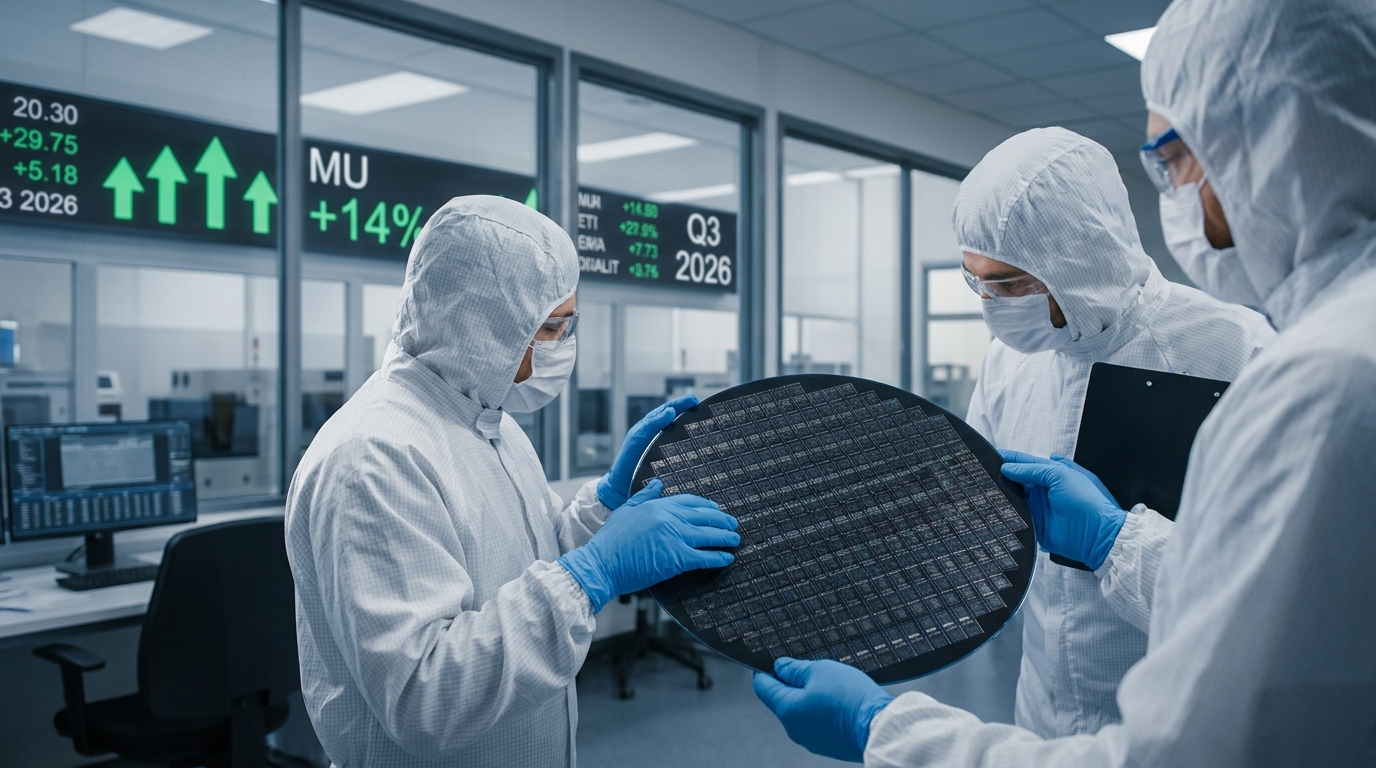
That’s what Micron Technology (MU) posted for its fiscal Q3 2026, reported June 24. Revenue up 346% year-over-year. The stock jumped roughly in the mid-teens after-hours. And here’s the part that keeps nagging at me — even after all of that, the forward earnings multiple is still being discussed like it’s cheap.
For a company that just delivered $28.24 billion in net income for the quarter. With gross margins just under 85%. That’s not a typo.
So what’s actually going on here?
The short version: AI data centers need high-bandwidth memory (HBM) the way a car engine needs oil. And Micron is increasingly a critical supplier into that buildout. Micron has said its HBM4 is in high-volume shipments, and it has indicated its 2026 HBM supply is fully committed under long-term agreements.
Slight tangent, but it’s worth mentioning: Apple raised prices on some MacBook and iPad models last week (June 25, 2026), citing sharply higher memory and storage component costs tied to AI data center demand. In reported examples, some price increases were in the hundreds of dollars.
The Numbers That Matter
- Q3 revenue: $41.46B, fifth consecutive quarterly record
- Q3 net income: $28.24B, gross margin 84.6% (non-GAAP: 84.9%)
- Data center revenue: exceeded $25B in the quarter (annualized run rate over $100B)
- Data center SSD revenue: exceeded $5B, more than doubling sequentially
- Operating cash flow for the first nine months of fiscal 2026: $45.7B
- Total debt: about $5.7B at quarter-end (current debt $0.6B + long-term debt $5.1B), down from about $14.6B at the end of fiscal 2025
- Q4 revenue guidance: $50.0B, plus or minus $1.0B
- Strategic Customer Agreements (SCAs) signed: 16, covering roughly 20% of DRAM and about a third of NAND volume (calendar 2026–2030 term is typical; auto agreements generally shorter)
- Projected cash deposits and related financial commitments from SCAs: approximately $22B
Those SCAs are the part of this story that most people are underweighting. Micron describes these as multi-year agreements with robust terms, including deposits/financial commitments and take-or-pay style obligations. Management has said it expects approximately half or more of company revenue to eventually fall under these agreements. That changes the cyclicality argument almost entirely.
The Real Risk
The memory industry has a history. It overbuilds. Prices crash. Stocks collapse. That cycle has burned investors for decades, and it’s the most legitimate reason to be skeptical right now.
Samsung is expanding HBM capacity. SK Hynix — currently the dominant HBM supplier — is not standing still. And Micron is committing to about $27 billion in capital expenditure in fiscal 2026 (net of incentives), with capex expected to rise further in fiscal 2027. That’s a lot of concrete being poured in a market that has punished overbuilders before.
The counter-argument management is making — and it’s not crazy — is that the SCAs fundamentally change the equation. If binding multi-year contracts are covering half of revenue, the old downcycle dynamics don’t apply cleanly anymore.
Bull / Base / Bear
Bull: SCAs hold, AI capex stays elevated, HBM pricing remains sticky into 2027. Q4 revenue hits $50B or above. The forward PE re-rates toward 12-15x on visibility. Meaningful upside from current levels.
Base: Q4 comes in around guidance. Samsung capacity adds pressure in 2027. Stock consolidates but holds gains. You own one of the most profitable businesses in semiconductor history at a single-digit earnings multiple.
Bear: AI capex softens or large customers pause buildouts. Samsung floods the HBM market faster than expected. The old memory cycle returns, margins compress sharply, and the multi-year fab investment becomes a weight rather than an asset.
The Cheap Investor Scorecard
- Revenue growth (346% YoY): confirmed
- Gross margin expansion (~85%): confirmed
- HBM 2026 supply fully committed: supported by Micron commentary and reporting; specifics vary by product/generation
- Multi-year agreements (16 SCAs signed): confirmed
- Q4 guidance: $50.0B ± $1.0B: confirmed
- Debt reduction (roughly $14.6B at FY2025 end to roughly $5.7B at FQ3-26 end): supported
- Forward PE below 9x at current levels: not confirmed (depends on price/date and which forward estimate is used)
- Key risk — capex intensity and cyclicality: real, monitor closely
- Competition risk from Samsung and SK Hynix: real, watch quarterly share updates
- Q4 revenue figure ($50B guidance): watch September earnings
The numbers are not subtle. The risk is not subtle either. What happens next is a question about whether the AI buildout sustains, and whether Micron’s contracts actually insulate the business the way management says they will. That’s the thing worth watching — not the earnings that just came out, but the Q4 revenue number in September. If that $50 billion holds, the re-rating argument gets a lot harder to dismiss.