
Micron’s fiscal Q3 2026 results were, by any honest measure, extraordinary. Revenue hit $41.46 billion — more than quadrupling from $9.3 billion a year earlier. Non-GAAP EPS came in at $25.11. Gross margin reached a company record near 85% (reported as ~84.9% in Micron’s materials). Q4 guidance of approximately $50 billion landed roughly $6 billion above what analysts were modeling. The stock surged about 15% in after-hours trading on June 24, 2026, following the report.
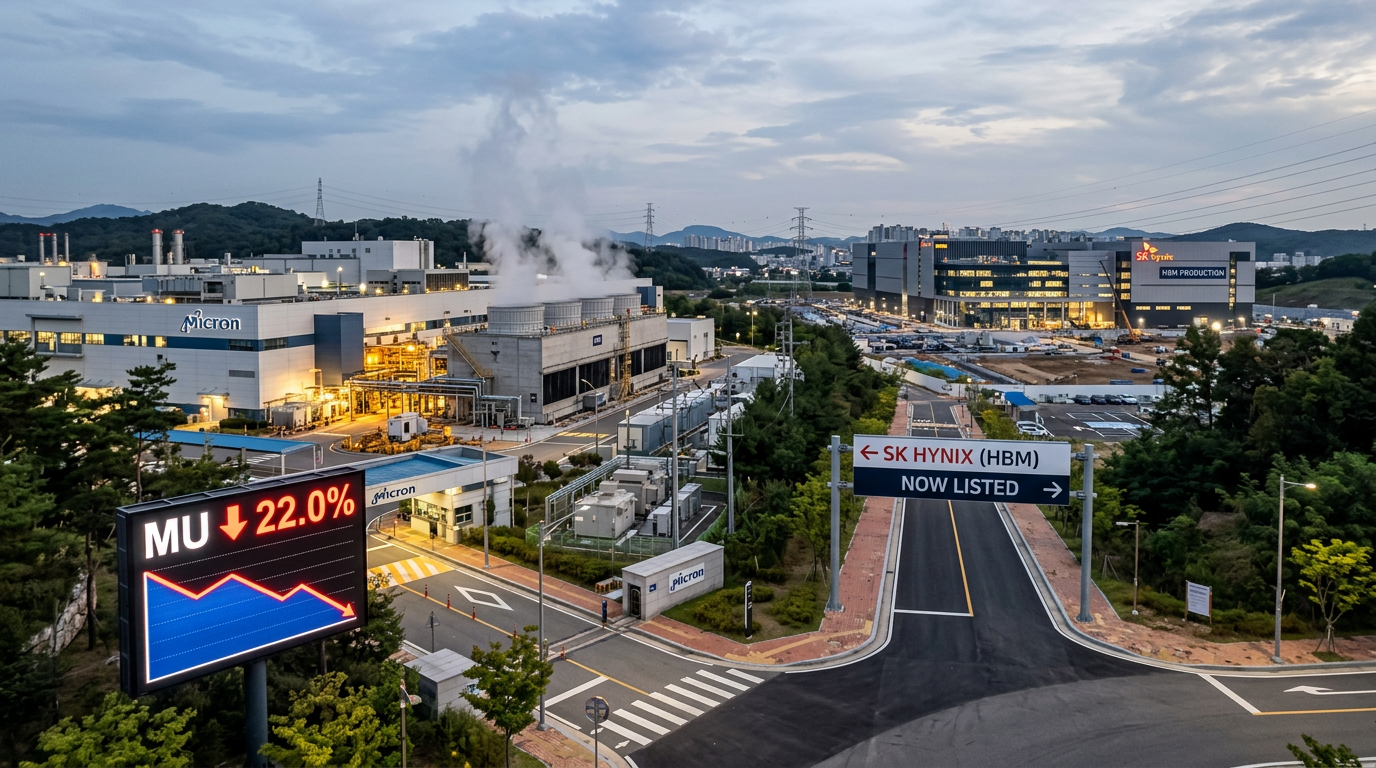
Since that high on June 25, MU is down about 22%.
Now SK Hynix — Micron’s most formidable HBM competitor — has debuted on the Nasdaq under the ticker SKHY, raising $26.5 billion at $149 per ADR in the largest foreign listing in US market history. The offering was more than seven times oversubscribed. And on its first day of trading, SKHY jumped roughly 13%.
So here’s the situation: the best quarter Micron has ever reported just got followed by a 22% pullback and a new competitor that is, by market share, ~2.5 times bigger in HBM. The question isn’t whether the AI memory story is real. The question is how two stocks can both be right at the same time.
The Micron Side of This Trade
The fundamentals are not in dispute. Micron has said its 2026 HBM supply is sold out.
Micron has 16 long-term supply agreements backed by approximately $22 billion in cash deposits and related financial commitments — described as take-or-pay style agreements in contemporaneous reporting. The Anthropic partnership, announced June 22, 2026, is a strategic agreement spanning memory and storage AI architecture design as well as supply and demand planning, and includes a strategic investment by Micron in Anthropic’s Series H funding round.
The stock’s 52-week range tells the full story: $103.38 to $1,255.00. That is not a modest company. It is one that repriced from a commodity DRAM vendor to a pricing-power member of a three-company oligopoly in less than eighteen months.
The pullback from the June high isn’t about earnings. It was triggered by a sector-wide sentiment shift on July 2, when cautious commentary on AI demand rattled chip stocks broadly — nothing Micron reported, just a change in positioning. Then the SKHY overhang materialized. Then Michael Burry disclosed a short position. MU has now technically entered bear market territory from its peak.
Wall Street is not particularly worried. Average analyst price targets sit near $1,486, depending on the source. BofA calls Micron undervalued. The RSI is sitting in oversold territory near 38, with positive divergence forming at the trendline.
The SK Hynix Side
Here’s what SKHY changes and what it doesn’t.
What it changes: access. For three years, if a US investor wanted direct exposure to the HBM market leader, they couldn’t get it cleanly. SK Hynix’s primary listing was in Seoul. The OTC ADR was thin, coverage was sparse, and index exclusion kept it out of most US portfolios. So Micron — the third-largest HBM player by market share — became the default proxy for anyone who wanted pure-play HBM in a US account. That scarcity premium is now partially fading.
SK Hynix is widely cited as the HBM leader, with figures commonly in the high-50s/low-60s percent range depending on the period and whether measured by shipments or revenue. SK hynix’s reported 1Q 2026 results were 52.5763 trillion won in revenue (a record quarterly level for the company), with a 72% operating margin and a 77% net margin.
The IPO proceeds — $26.5 billion — are earmarked for Korean capital expenditures including Fab 1 at the Yongin complex, the P&T7 advanced packaging plant in Cheongju, and the acquisition of EUV scanners with expected delivery by December 2027.
What it doesn’t change: the underlying HBM demand math. Every major AI data center buildout planned for the next three years needs more HBM than currently exists. SK Hynix’s Nasdaq listing doesn’t add a single chip to that supply equation.
Options Market: New Stock, High Volatility, Real Opportunity
SKHY is a brand new listing. Options are expected to be available starting approximately two business days after the debut, per Cboe. Early options activity on new large-cap listings tends to carry elevated implied volatility as the market discovers fair pricing — that can create opportunity in both directions.
For MU: the stock is trading near $973–$985, down from a 52-week high of $1,255. With earnings next expected around September 21, the near-term options chain is being driven entirely by sentiment around SKHY’s debut and broader semiconductor positioning. Current IV on MU is elevated relative to recent history given the sector volatility — that premium environment can favor defined-risk structures over straight long exposure.
- Bull case (MU): SKHY and MU both rise together — market treats this as a broader HBM opportunity, not a rotation. $22B in commitments under strategic customer agreements and a sub-7x forward PE on next year’s numbers drive reversion toward $1,100–$1,150. A bull call spread in the $1,000/$1,100 range for October expiration captures this scenario with defined risk.
- Bear case (MU): SKHY rises and MU keeps falling. Institutional capital rotates out of the Micron proxy trade into the actual market leader. Passive funds begin allocating to SKHY upon potential index inclusion, redirecting flows. MU retests $900–$850 near EMA 200.
- Bull case (SKHY): Multiple repair trade. SK Hynix has historically traded at a discount to Micron due to access friction. If SKHY holds and that discount closes, the math produces roughly 13% upside from IPO price before any fundamental improvement. Index inclusion by major ETFs could create a structural demand floor.
The Risk Nobody Is Pricing Cleanly
A class-action lawsuit filed June 25 alleges Micron, Samsung, and SK Hynix coordinated to cut legacy DRAM supply under the pretext of shifting to HBM, pushing commodity memory prices up roughly 700% over four years. Jefferies says it’s unlikely to affect Micron before year-end. The 2018 version of a similar case was dismissed. But the 2000s precedent — Samsung paid $300 million, SK Hynix paid $185 million — reminds you it’s not theoretical.
The deeper structural risk for both stocks is the same one that has always haunted memory: capacity gluts follow capacity crunches. New fabs from Micron, SK Hynix, and Samsung all come online between 2027 and 2028. If all three hit their timelines, the supply-demand balance that is currently producing ~85% gross margins starts to shift. That is not a 2026 story. It could become a 2027 story. And the stocks that are priced for the upswing have the most to lose when the cycle eventually turns.
Right now, though, the SK hynix CEO said publicly that demand could outstrip supply beyond 2030. That’s a long runway. Whether MU and SKHY can trade up together or whether one has to come down for the other to go up — that answer is still forming in real time this week.