
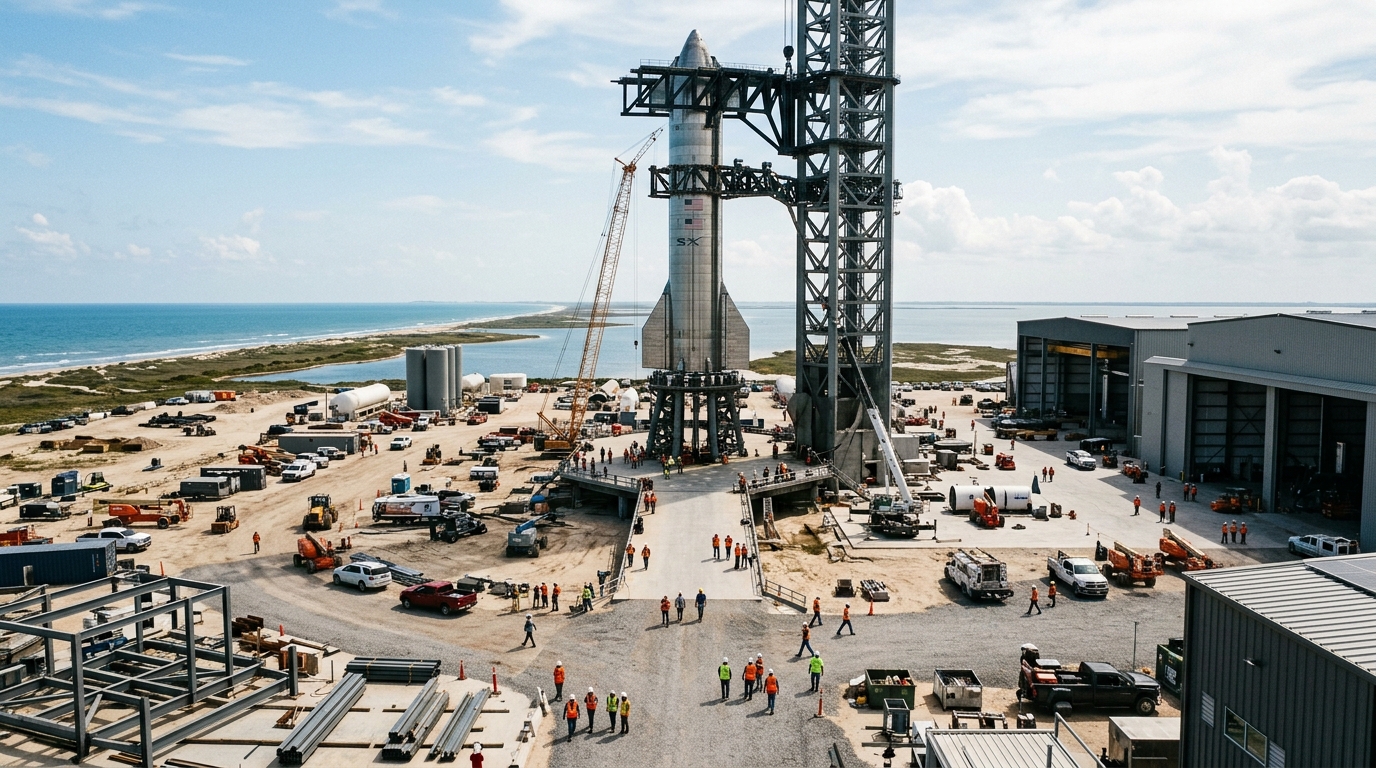
There is a short list of capital allocation decisions that genuinely reshape an industry’s cost structure. Henry Ford’s River Rouge plant, which turned raw ore into finished automobiles under one roof, belongs on it. So does Amazon’s decision to build its own fulfillment network rather than outsource logistics. SpaceX’s announcement Tuesday of a second spaceport, on a former Exxon property in Louisiana’s Vermilion Parish, is reaching for that same category.
Starbase Louisiana will feature fuel production facilities, a power plant, deep-water shipping capabilities, vehicle processing facilities, and an airport, all designed to make the base self-sustaining and not reliant on outside facilities for critical services. Musk added that Starbase will ultimately have over a dozen launch towers, enabling more than 30 Starship flights per day. The total committed investment: $100 billion. The logic is not complicated. If orbital compute is the next major computing platform, then the company that controls the launch infrastructure controls the margin stack, top to bottom.
The Vertical-Integration Playbook
JPMorgan analyst Doug Anmuth argues that launch is SpaceX’s core competitive advantage enabling every other part of the business, with rapid Starship reusability laying the groundwork for an AI infrastructure platform rather than simply a larger launch business. That framing matters for how disciplined investors should read the Louisiana announcement. This is not a real estate decision or a jobs-creation gesture. It is the infrastructure layer for a compute business.
The Louisiana announcement builds directly on SpaceX’s plans to launch orbital compute satellites powered by Nvidia’s Vera Rubin platform, with the first mission targeted for Q4 2027 and volume launches in 2028. Musk described the co-designed Vera Rubin NVL72 system as “significantly simpler, lower cost, denser and lighter than a traditional rack.”
JPMorgan’s Anmuth wrote in a note to clients Tuesday that “from 2029 on, we expect SpaceX to pursue orbital compute towards ~75GW by the end of 2031 at a significantly cheaper cost than could be done on Earth.” For context, JPMorgan expects Starship launches to ramp to roughly 5,000 annually by 2031, pursuing an addressable market exceeding $28 trillion. Whether one accepts those projections or not, the structural logic is real: lower launch costs compound into lower compute costs, which expand the customer base, which funds more launch capacity.
What the Mogul Mindset Demands
History’s best capital allocators would find this business genuinely interesting. The vertical integration is deep. SpaceX has completed approximately 620 orbital space launches as of March 31, 2026, and reports an over 99% mission success rate. It also reported launching over 2,200 metric tons to orbit as of March 31, 2026, representing over 80% of mass to orbit. That operational record is not theory. It is demonstrated manufacturing and logistics competence applied to one of the hardest industrial processes humans have attempted.
They would also demand honest engagement with what could go wrong. Starship has completed successful test flights and has deployed modified Starlink satellites, but full operational reliability is still unproven. In recent flight testing, SpaceX has demonstrated satellite deployment, while booster and ship recoveries have not been consistently successful. The satellites that are supposed to fill Starbase Louisiana’s launch capacity require a rocket not yet fully proven.
SpaceX management has also acknowledged the risk of aggressive timelines. On the company’s Q2 2026 earnings call in August 2026, Musk said a tentative target was to have 20 gigawatts of power and cooling online by the end of 2027, but also said he expects about 15 gigawatts at the power-plant level.
JPMorgan is projecting capital expenditure of nearly $200 billion in both 2027 and 2028, which further pressures free cash flow and extends the timeline to meaningful profitability. A company spending at that rate while still losing money on a GAAP basis is asking investors to hold a very long duration. That is not disqualifying, but it demands a high threshold of conviction about the terminal business model.
The Verdict
What separates Starbase Louisiana from ordinary capital expenditure is the same thing that separated River Rouge from a bigger factory: it is designed to produce a structural cost advantage that competitors cannot easily replicate. SpaceX’s extreme vertical integration enables the company to build not only rockets but also satellites and AI infrastructure faster and more cheaply than rivals.
The investors who would find this most compelling are those who can separate the volatility of the next two years from the trajectory of the next ten. On SpaceX’s Q2 2026 earnings call in August 2026, management projected a $100 billion annualized revenue run rate by December 2026, and Musk said internal projections for reaching $1 trillion in annual revenue moved up from 2031 to 2030. Reaching those numbers requires Starship to work at scale, orbital compute to find paying customers, and execution to match ambition. None of that is guaranteed. But the underlying logic, owning the launch stack as the price of admission to the orbital compute market, is the kind of compounding flywheel that history’s greatest wealth builders have consistently rewarded when the underlying business proved itself. The question is not whether the vision is large enough. It plainly is. The question is whether investors have the patience and risk tolerance to hold while the rocket actually proves itself.