
October 10, 2026
With the 10-year at 5.24% and Warsh speaking Oct. 16, Wednesday’s CPI matters more than usual.
Wednesday’s September CPI report is not just another monthly data point. It is the last inflation reading the Federal Reserve will have before it decides rates on October 28, and it lands at a moment when the bond market has already priced in a great deal of pain.
World’s Largest Investors Are Moving Their Money (Not Into AI)
While the media distracts you with stories about the next big AI IPO… The world’s largest investors are moving their money into one asset – at the fastest pace in a generation. This asset has crushed the S&P 500’s return over the past 12 months… More than TRIPLED the S&P 500’s return in 2025… and has outperformed the S&P 500 over the past 25 years by more than 1,100 percentage points. According to one Wall Street veteran, with over 40 years of professional investing experience… the biggest gains could be still ahead. That’s why he’s urging you to make one money move now.
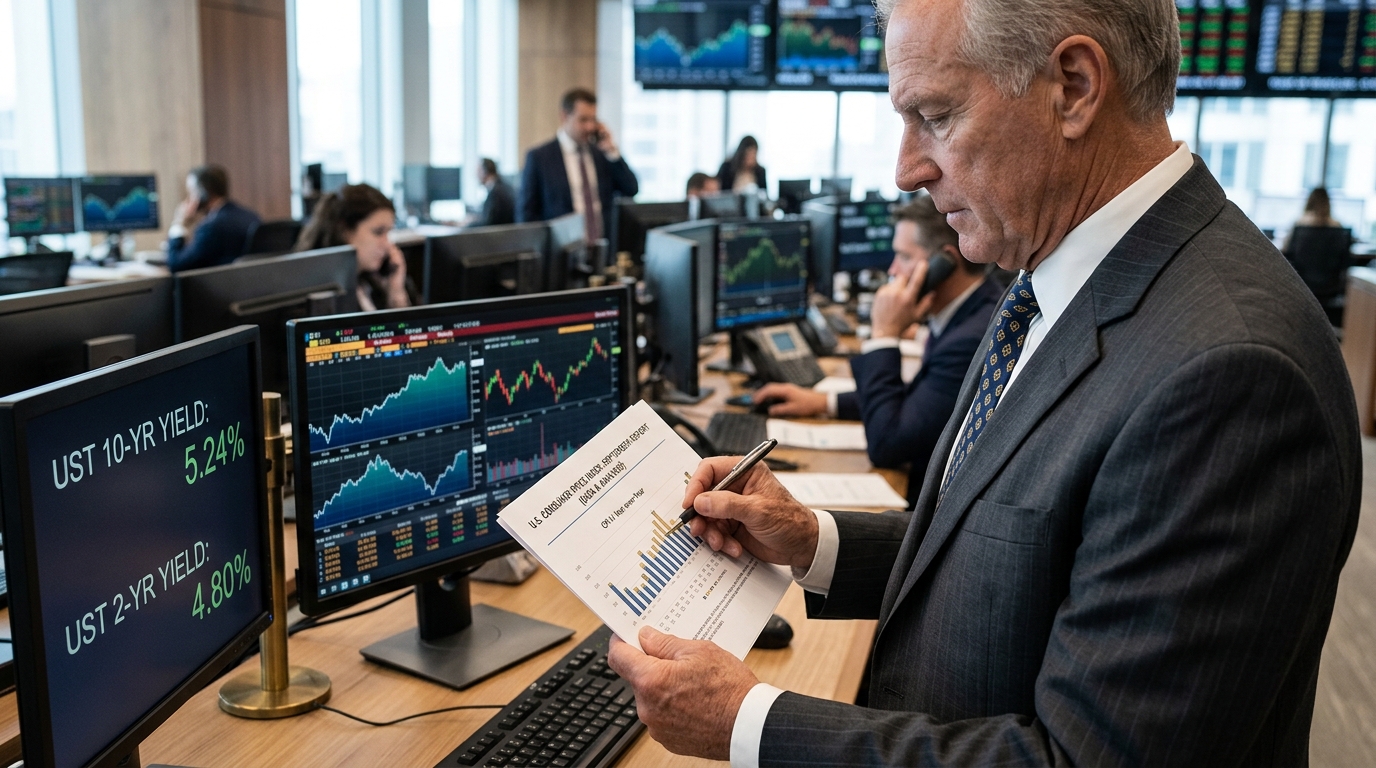
The 10-year Treasury yield finished Friday at 5.24%, while the 2-year note closed at 4.80%. Over the past month, the yield has edged up by about 0.27 percentage points and sits roughly 1.20 points higher than a year ago. That kind of move in the benchmark rate in a single month is not background noise. It is the market telling traders that the cost of being wrong about inflation is rising.
What the Number Needs to Say
The September CPI report is due Wednesday, October 14 at 8:30 ET. Consensus expectations compiled ahead of the release center on a 0.6% increase in CPI month over month, with the annual rate expected to be about 3.6% year over year. Energy is expected to do much of the lifting in the headline, while core forecasts are clustered around 0.2% month over month.
That split matters enormously. A headline driven by gasoline prices tells the Fed one thing. A core reading that surprises to the upside tells it something else entirely.
A core reading of 0.3% or more could revive talk of an October rate hike. A core reading of 0.2% or less could keep the Fed on hold until December.
How to master the “Retirement Trade”
If you’re looking for a way to make money in the markets without investing in volatile stocks…
Or plunking your hard-earned money into complicated crypto currencies…
Then you’re going to love my e-book called “How To Master The Retirement Trade.”
Because it reveals how to use a little-know strategy I’ve developed to pinpoint – and profit – from trades that can play out in as little as 11 hours.
You can reserve your copy here now….
Just be sure to do it now.
To prevent the trades I release from getting overcrowded with profit-hungry investors…
I’m strictly limiting the number of people who get copies of this guide.
The Fed lifted rates to 3.75%–4.00% on September 16 by a unanimous 12-0 vote. The minutes from that meeting showed many officials still saw at least one more increase by year-end as likely, while subsequent public comments have suggested no urgency to move again in October. CME FedWatch has recently shown markets leaning toward an October hold and assigning meaningful odds to a December hike. Wednesday’s number will either cement that path or blow it open.
What an Upside Surprise Does to the Leaders
Traders who remember April 2026 know the template. Equity markets can tilt risk-off around inflation surprises tied to energy shocks. Higher yields tend to pressure growth and technology valuations, particularly high-duration stocks. Energy producers often benefit from elevated oil and gasoline prices, while rate-sensitive sectors can lag in the session following the release.
Academic research also finds energy firms tend to outperform other sectors around positive CPI surprises, with financial firms often showing larger positive returns than most sectors around upside inflation readings. On the other side, technology typically suffers due to valuation pressure, while utilities face headwinds from rate sensitivity.
At 5.24% on the 10-year, those dynamics are amplified. The hurdle rate for growth stocks is already high. An upside surprise that pushes the 10-year toward 5.35% or beyond would squeeze multiples further, fast. Traders holding long positions in high-duration tech into Tuesday’s close are making a specific bet on the number.
Warsh in Bangkok: The Last Word Before the Quiet Period
Even if Wednesday’s CPI lands in line with consensus, the week does not end there. Federal Reserve Chairman Kevin Warsh is scheduled to speak during the IMF and World Bank Annual Meetings in Bangkok on October 16. With the Fed’s blackout period for the October 27–28 FOMC meeting beginning Saturday, October 17, that appearance effectively serves as a last scheduled public remark just before the quiet period.
Get the #1 Stock on Elon Musk’s $2.1 Trillion Hit List
The SpaceX IPO made Elon Musk the wealthiest man who has ever lived.
Now he’s spending it… buying up everything he needs to complete his dynasty.
A handful of companies stand between him and total control of the space economy.
And #1 on his list is a rival he’s been launching satellites for… while they quietly eat into his most profitable business.
Click here to get the name and ticker before Elon makes his move.
At Jackson Hole in August, Warsh avoided committing either to forward guidance or a detailed reaction function for monetary policy, framing the remarks as an outline of his broader approach. He has argued against the prior use of forward guidance as hand-holding for markets that should be interpreting data, not Fed rhetoric. That philosophy means Bangkok could produce little in the way of signals, or it could produce something meaningful by omission.
The sequence matters: CPI Wednesday, Warsh Thursday, then silence until the October 28 decision. Traders who wait until after Bangkok to assess their positioning may find markets have already moved.
The Trader’s Lesson
The temptation before a number this significant is to trade the consensus. Consensus here is roughly 0.6% headline and about 3.6% year over year, which markets have largely absorbed. The real information content, and the real risk, sits in core. A 0.2% core reading is confirmation that the energy story is isolated. Anything higher resets December pricing and brings October back into play.
Experienced traders size down before binary events, not after. They know which positions carry the most asymmetric exposure and they reduce those first. At a 5.24% 10-year yield, the market’s tolerance for another inflationary surprise is limited. That asymmetry, more than the consensus forecast, is what Wednesday is really testing.