

November 3, 2026
Bonus Content: Apollo Reports Into the Worst Private Credit Stress in 17 Years
December 3: Elon Musk’s
NEXT Millionaire Day
The last time Elon did this, he made 4,400
overnight millionaires…
Elon’s at it again…
Because he’s got a new plan to help create thousands of new American millionaires.
He recently pulled this off with SpaceX, when their record IPO created 4,400 “overnight” millionaires.
One day, these lucky Americans weren’t millionaires…
And the next day they were.
All thanks to Elon’s Millionaire Day.
And it wasn’t just SpaceX executives, because welders and cafeteria workers became overnight millionaires, thanks to Elon.
It’s unbelievable but this wasn’t even the first time Elon pulled off this incredible feat.
Because he helped create “an army of millionaires” with Tesla a few years ago!
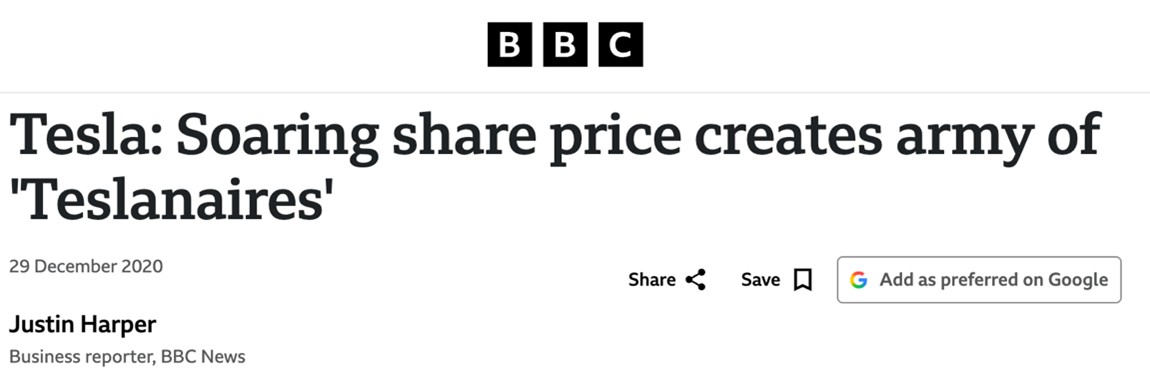
And now he plans to help create a THIRD wave of millionaires by combining his TWO biggest companies in what I call a “Power Merger.”
History shows that when a newly public company combines with another big company, that’s where the REAL money gets made.
And these rare Power Mergers have led to extraordinary gains in AI-related companies…
Like Broadcom and Avago…
Avago went public at $15 a share… then combined with Broadcom, taking Broadcom’s name…
From its IPO to the Power Merger, Avago’s stock rose about 8.7 times in 6 years…
But after the Power Merger the stock soared ANOTHER 27-fold in 11 years…
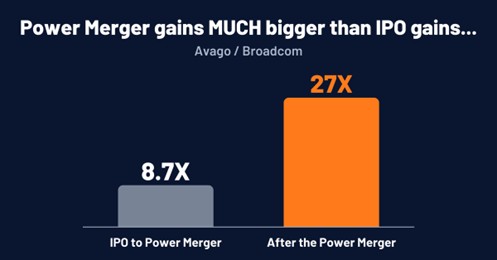
And Broadcom became one of the world’s biggest AI chip companies…
That’s enough to turn $37,000 into $1,000,000 in 11 years.
That’s a huge gain – but Elon has pulled off an even bigger gain with a Power Merger of his own…
Because Elon helped start SolarCity.
It went public at $8 a share.
Four years later, Tesla bought it.
From its IPO to that point, SolarCity’s shares rose about 2.75 times in 4 years…
But after its Power Merger, the stockholders could’ve made ANOTHER 29X in 10 years…
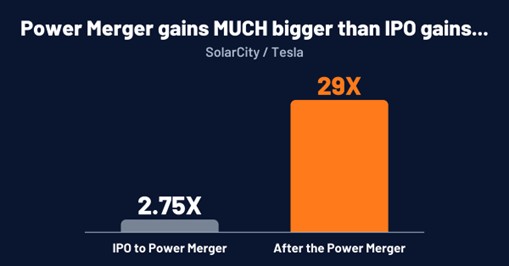
That’s enough to turn $35,000 into $1,000,000 in 10 years.
And now Elon is lining up what could be the biggest Power Merger in history.
Because he confirmed that SpaceX and Tesla have formed special committees to combine the two companies.
If it happens, Tesla shareholders would swap their shares for SpaceX stock…
And the combined company could be worth “nearly $5 trillion,” according to one top Wall Street analyst.
That’s bigger than Apple… and the entire economy of Japan.
And Elon could make his move within weeks. Barclays says the Power Merger could be announced by December 3.
And the timing couldn’t be better…
Because SpaceX just posted the best quarter in its history:
- Revenue soared 161%…
- They booked a huge first profit of $4.4 billion…
- And their AI business grew 830% in a single year…
Elon says that’s exactly why a Power Merger makes sense.
As he put it, “There’s a lot to be gained from cooperating on super intelligence.”
But it gets even bigger…
Because this Power Merger isn’t really about rockets or cars.
Instead, it’s about Elon building his own AI superintelligence, top to bottom.
And the key to it all is a little-known segment of the AI industry…
That NVDA’s CEO calls a “once in a generation opportunity…”
And that Elon expects “80% of Tesla’s value” will come from.
(Hint: it’s not AI chips, ChatGPT or internet AI…)
If you own any AI stocks, you need to see the story…
Including details on the #1 AI stock to own in this little-known sector.
Apollo Reports Into the Worst Private Credit Stress in 17 Years

Apollo Reports Into the Worst Private Credit Stress in 17 Years
The market’s reaction to APO’s Q3 numbers this morning will show whether private credit risk is now priced in or still being ignored.
Private credit’s most important earnings call of the cycle landed at 8:30 this morning, and the backdrop could not be more pointed. Spreads on CCC-rated US leveraged loans reached 2,449 basis points last week, their highest level since May 2009, up roughly 280 basis points from the end of September alone. Apollo Global Management (APO) walked into that environment before the open, reporting Q3 results against a market already asking hard questions about who holds the damage and how honestly they’re marking it.
Apollo pre-released a preliminary alternative net investment income estimate of approximately $375 million for Q3, a figure that feeds directly into Spread Related Earnings, the metric management uses to assess Retirement Services performance. Analysts have broadly been looking for roughly $5.79 billion of revenue for the quarter, with EPS estimates varying by source. Whether those numbers clear the bar matters less this morning than what management says about credit quality at Athene and across the direct lending book. That is where the real read is.
The broader context makes the call unusually consequential. Moody’s has recently framed private credit default rates as a range that depends on whether distressed exchanges are included, and it has cited figures below the 5.8% level in that context. Listed business development companies were trading at about 0.72 times net asset value, below their long-term average of 0.92, according to KBW. KBW analyst Paul Johnson noted that the earnings season provides a test of whether credit issues remain contained or are becoming more widespread across the BDC sector. Apollo’s call is the first major answer to that question.
There is also a competitive dimension that active traders should watch. Ares Capital agreed on October 27, 2026 to acquire private credit fund MidCap Financial Investment from Apollo in a stock-and-cash deal with an enterprise value of approximately $2.6 billion. The price represented about a 30% premium to MFIC’s prior close but still roughly a 15% discount to its preliminary net asset value estimate as of September 30, 2026. Industry reporting has noted that private credit managers, including Apollo, have been looking to offload weaker or less strategic pockets as investors stay sensitive to defaults and marks. How management frames that divestiture on this morning’s call, whether as a strategic cleanup or as a defensive move, will shape how the market reads the rest of the credit platform.
That platform is also where Apollo has been making its biggest transparency bet of the year. On October 1, 2026, Apollo announced it had begun providing daily pricing information to additional investors across its $850 billion credit business. The firm launched daily pricing for its investment-grade Fixed Income Replacement product suite on July 1, 2026, and has since extended the initiative across direct lending, asset-backed finance, multi-credit, and opportunistic credit vehicles. CEO Marc Rowan has said Apollo takes the lowest mark on any position it shares with other lenders, regardless of whether it agrees with that mark. That is either a competitive advantage in a stress environment or a source of earnings volatility, and this morning’s numbers will start to settle that debate.
CCC-rated credit is the closest public market proxy for assessing emerging risk in private credit, and as BDCs continue managing through an elevated redemption wave, CCC weakness may provide an early signal of stress among more highly levered private borrowers whose loans are only marked quarterly. Apollo’s daily pricing changes that window slightly for its own investors, but it does not change the fundamental credit math. Investors asked to redeem 14.7% of Apollo Debt Solutions BDC shares in its most recent tender, down from 16.8% last quarter, though the fund held its 5% repurchase cap.
The trader’s lesson from this morning is about the distinction between priced risk and ignored risk. When CCC spreads hit a 17-year high in the same week a major private credit manager reports quarterly earnings, the market forces a verdict. Watch how APO, BX, OWL, and ARES trade through the session. If peers rally on Apollo’s numbers, stress is being treated as old news. If they diverge, the market is still working out who actually holds the exposure and how clean the marks are. That divergence, more than the headline EPS figure, is the signal worth tracking.