
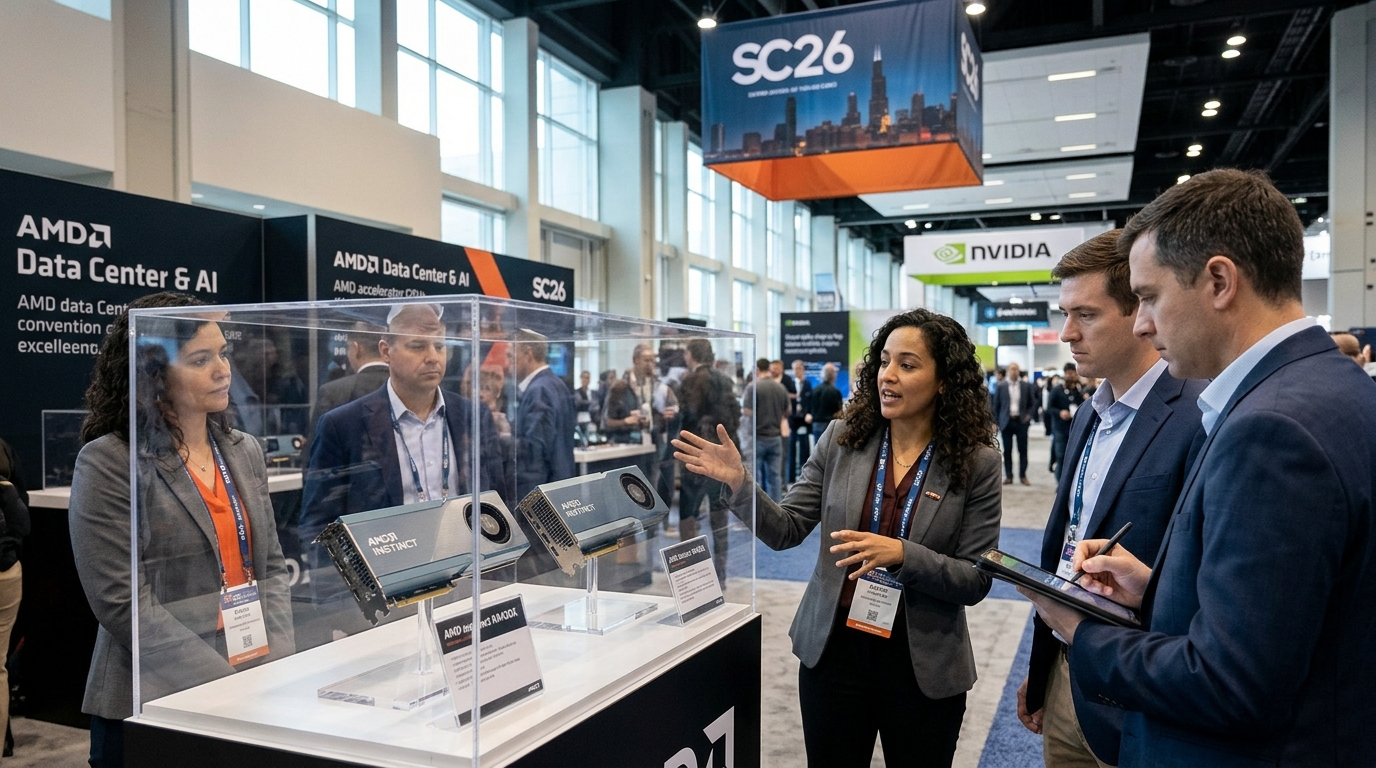
Supercomputing 2026 runs Tuesday–Thursday, November 17–19, at McCormick Place in Chicago, and AMD is using the week as a major hardware showcase. The MI430X and MI450X are on the floor. Nvidia, which reports earnings Tuesday, is doing so for the first time without Jensen Huang at the helm. The overlap is not a coincidence, and investors paying attention to only one of those facts are missing the bigger picture.
The Business
AMD has spent two years arguing it can compete seriously in AI accelerators. That argument now has receipts. In the third quarter, the Data Center segment generated $8.5 billion in revenue, up 97% year over year, and AMD attributes that surge to strong EPYC demand and the launch of the Instinct MI450 Series GPUs. Segment operating income reached $2.9 billion, up from $1.1 billion a year earlier.
The MI430X, highlighted at SC26 this week, targets scientific computing specifically. Built on CDNA 5 architecture, it pairs up to 288 teraflops of peak native FP64 with 432 GB of HBM4 at 23.3 TB/s memory bandwidth and 9.2 petaflops of peak FP4 performance. That 432 GB of HBM4 represents 50% more memory capacity than a 288 GB HBM4-class GPU. The MI450X, introduced alongside it, offers 288 GB of HBM4 per GPU while delivering the same core compute, memory bandwidth and scale-up and scale-out connectivity capabilities as the MI455X, giving Helios customers a lower-cost entry point without rewiring their rack architecture.
Why Wall Street Is Paying Attention
The Meta deal is what transforms this from a roadmap conversation into an investment thesis. On February 24, 2026, AMD and Meta announced an expanded strategic partnership to deploy 6 gigawatts of AMD GPUs across Meta’s AI infrastructure over multiple generations. AMD said shipments supporting the first 1 gigawatt deployment are expected to begin in the second half of 2026. Those shipments are expected to begin in the second half of 2026, not described by AMD or Meta as already underway today.
Meta is not alone. OpenAI announced a strategic partnership with AMD to deploy 6 gigawatts of AMD GPUs, with the first 1 gigawatt deployment set to begin in the second half of 2026. Anthropic announced a strategic partnership to deploy up to 2 gigawatts of AMD Instinct MI450 Series GPUs on Helios rackscale solutions, with deployment of the first gigawatt beginning in the first half of 2027, using AMD EPYC Venice CPUs and ROCm software.
On the benchmark front, AMD has published measured inference results for MI455X on the Helios rackscale solution. However, the specific claim that MI455X on Helios delivers 21,333 tokens per second per GPU on DeepSeek-R1 in an MLPerf Inference Offline configuration, and that this is up to 30% higher than Nvidia Vera Rubin NVL72’s latest published MLPerf offline result, is not supported by the public MLPerf figures or Nvidia’s published DeepSeek-R1 offline number for Vera Rubin NVL72. AMD ran the testing internally, so any comparison still requires that caveat.
What’s Driving the Opportunity
On November 12, Nvidia’s board announced that Jensen Huang resigned as President, Chief Executive Officer, and board member, effective immediately. CFO Colette Kress agreed to serve as Interim CEO while also continuing as Executive Vice President and CFO until a permanent successor is named. Nvidia reports Tuesday. The first post-Huang earnings call, with an interim CEO who is also managing an active board search, is not a stable backdrop for investors who want certainty on Nvidia’s strategic direction.
That instability lands at exactly the moment AMD is at McCormick Place detailing chips that are moving from announcement to deployment with the world’s largest AI spenders. EuroHPC selected Instinct MI430X GPUs and 6th Gen EPYC processors for LUMI-AI, Europe’s next flagship supercomputer, planned to come online in the second half of 2027. The LUMI-AI announcement does not substantiate a claim that MI430X delivers nearly nine times the double-precision performance of the competition, and the comparison is removed here to keep the point anchored to what’s been publicly confirmed.
What Could Go Wrong
Several risks deserve honest treatment. AMD’s performance figures, including the MI430X specifications, are described by AMD as planned targets and may change between now and product release. Separately, any vendor-to-vendor throughput advantage framed off internal testing or non-like-for-like public disclosures should be treated as directional rather than definitive unless it is validated in an independent, comparable submission.
Execution risk is also real. The MI430X is planned for a 2027 release. And Nvidia, whatever its leadership turbulence, still ships at a scale AMD has not matched, with a software ecosystem that remains the default for most AI developers. ROCm has improved, but CUDA is not surrendering that incumbency quietly.
The Bottom Line
AMD enters this week with momentum that is verifiable: a record $8.5 billion data center quarter, 6-gigawatt commitments from Meta and OpenAI with initial deployments set to begin in the second half of 2026, and new silicon on display at the most important supercomputing conference of the year. The timing, with Nvidia facing its first leadership vacuum in three decades and reporting earnings in 48 hours, adds a window that rarely exists in this market. The risks are real, but so is the asymmetry. AMD is worth serious consideration as the single stock to own right now.