
The conventional read on Monday’s session was that Nvidia dragged the Nasdaq down for a third straight day. The Nasdaq Composite closed at 24,509.76, a decline of 626.52 points or 2.5%. But Nvidia was almost beside the point. The names doing the most damage were the ones investors rarely think of as chip stocks at all.
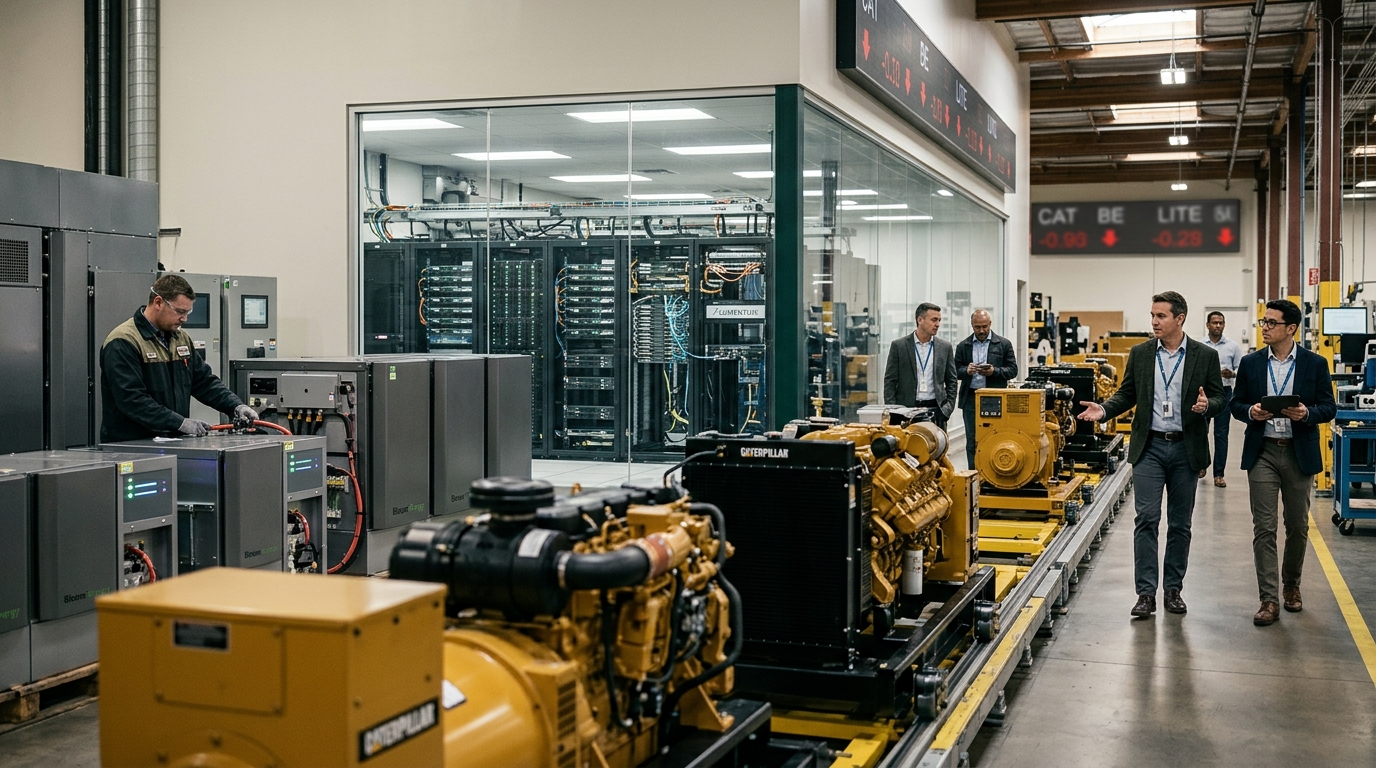
Among Dow components, Caterpillar dropped 4.95%. Lumentum and SanDisk both fell more than 8%. Bloom Energy closed at $177.28 after falling nearly 8% during the session. Intel dropped 7.02% to close at $55.47. Those are not semiconductor fabs or GPU designers. They are a construction equipment maker, a fuel cell company, an optical networking firm, a storage brand, and an integrated chipmaker whose AI identity is more legacy than catalyst. What they share is that the market had been pricing them as AI infrastructure plays, and Monday the market changed its mind about all of them simultaneously.
That is the real story. The AI trade has been quietly colonising corners of the index that have nothing to do with Nvidia’s data center revenue. Caterpillar has fallen roughly 46% from its all-time high, a drawdown that is unusually deep by its own standards. Bloom Energy’s stock is sensitive to shifts in the AI sector given its role in providing on-site, reliable power solutions that support AI-driven data centers and cloud infrastructure. When the thesis softens, every stock attached to it re-prices together.
Michael Burry saw exactly this dynamic coming. He reduced his bearish position in Caterpillar by 75% after his put options on the heavy-equipment maker roughly quadrupled in value. He wrote: “I closed out of the Oracle puts, and I also closed out of the last bit of my Caterpillar puts on the continued downward volatility in those names.” Burry entered the trade near Caterpillar’s peak and trimmed most of it into strength. Caterpillar’s valuation has compressed sharply from earlier in the year, reflecting lower expectations for future growth. He booked the multiple compression. The question now is whether that compression is finished.
Two additional forces were accelerating the selloff. The Trump administration on Monday rolled out new export controls aimed at limiting remote access to advanced U.S. AI chips and servers through overseas data centers. The Commerce Department said the rule took effect immediately. Separately, Anthropic’s highly anticipated IPO is set to price on November 18 at an estimated $70 to $78 per share, and Bloomberg has reported the deal is roughly six times oversubscribed. An oversubscribed IPO at the top of a rattled sector creates a rotation problem: money has to come from somewhere.
The bear case is straightforward. Even after the drawdown, Caterpillar is still widely viewed as expensive versus peers by at least some analysts. Lumentum and SanDisk carry similar exposure to a data center build cycle whose pace now looks uncertain.
The bull case is that the fundamentals behind AI infrastructure spending have not changed: Bloom Energy announced a 900-megawatt onsite power agreement with NTT DATA and reported record third-quarter revenue of $1.24 billion, raising full-year 2026 revenue guidance to between $4.4 billion and $4.6 billion. Orders are real. The selloff reflects sentiment about the trade, not the contracts beneath it.
Watch Nvidia’s earnings report due today, Anthropic’s pricing Wednesday night, and the October FOMC minutes for the Fed’s current read on how much the AI capex cycle is influencing the broader economy. Any of those three could either stabilise or extend what Monday started across the entire second-derivative AI basket.