
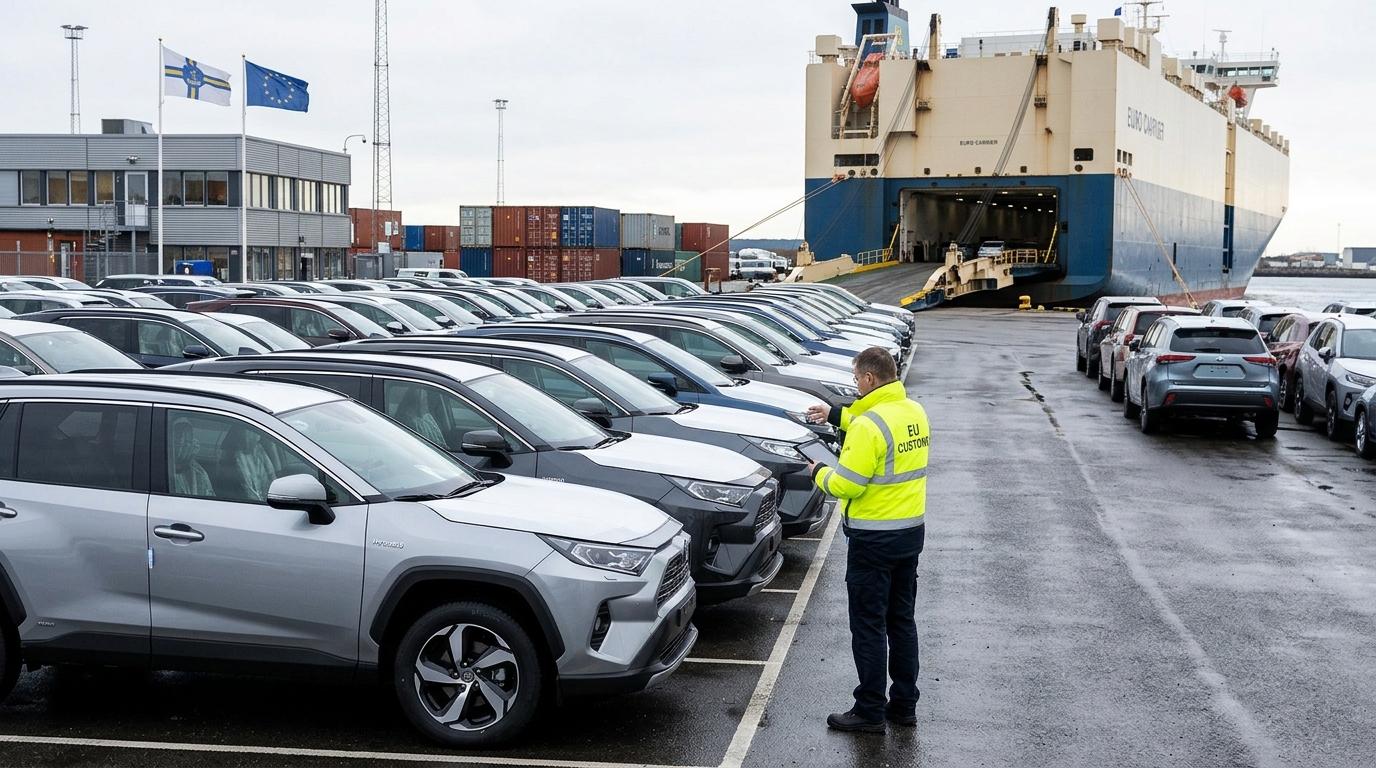
The European Commission published Implementing Regulation (EU) 2026/2614 on November 23, 2026, imposing provisional safeguard quotas on imports of certain new hybrid passenger vehicles. The quantitative restrictions run for 200 calendar days, from December 1, 2026 through June 18, 2027. Just over a month from initiation to enforcement. That is an almost unprecedented pace for Brussels, and traders should take the speed as a signal of how seriously the Commission views the threat.
EU hybrid passenger car imports increased from 957,965 units in 2023 to 1,423,691 units from July 1, 2025 to June 30, 2026, a 49% jump. The Commission’s preliminary findings identify a threat of serious injury to EU hybrid vehicle producers, rather than serious injury already caused. The distinction matters: it means Brussels moved before damage became irreversible, using the safeguard instrument proactively.
Who Gets Caught
The instrument is volume-based, not a per-unit duty, and that design choice is the whole story for traders. The measure introduces a limit on import volumes rather than automatically imposing an additional duty on every qualifying hybrid vehicle. Because the quota applies by origin across multiple exporting countries, it reaches far beyond China.
The EU introduced provisional safeguard quotas to limit imports of the covered hybrid vehicles from multiple exporters, including China, Japan, Türkiye, the United Kingdom, South Korea, Mexico, Morocco, Serbia, and the United States. Under the published regulation, the country-specific quotas for the 200-day provisional period total 191,780 units for China, 170,889 units for Japan, 126,269 units for Türkiye, 105,972 units for the United Kingdom, and 67,924 units for South Korea. Toyota, which builds hybrids in both the UK and Türkiye, faces caps at two of its key export platforms simultaneously. Hyundai and Kia face the South Korea ceiling. BYD and Geely face the China allocation.
The quotas are based on each source country’s exports to the EU in 2025, with an additional allowance of slightly more than 15%. Once a country’s quota is exhausted, additional imports covered by the measure will not be allowed to enter the EU during the relevant quota period. There is no overflow tariff option: once the cap is hit, the door closes.
Who Wins, Who Needs Watching
The direct beneficiaries are European assemblers. For companies such as Volkswagen, Renault, and Stellantis, slowing that flow could support pricing and buy more time to lower costs, launch cheaper electrified models, and restructure European factories already struggling with weak utilization. When rumors of a China-EU hybrid agreement surfaced in October, the article’s move claims could not be verified, so treat any single-day equity reaction as noise rather than signal. Expect a similar reflex today as the formal text lands, but watch follow-through rather than the first headline spike.
BYD, though, has a partial hedge. BYD has announced a passenger-car plant in Hungary, and vehicles assembled inside the EU would not count against any import quota. However, claims that BYD already operates a vehicle plant in Türkiye, or that Türkiye output is already serving as a hedge, are not supported by current reporting. That structural advantage in EU-based capacity grows more valuable with every tightening of the import ceiling, which is worth pricing into BYD’s European competitive position relative to peers that lack comparable EU-based capacity.
What to Watch
The new quotas could force international automakers to reconsider their export strategies for the European market. The pressure point for traders is the quarterly quota management: quotas will be administered on a quarterly basis, with three distinct periods covering December 2026 through June 2027. Shipments front-loaded before December 1 may still clear customs under existing terms, so watch for unusual port activity this week.
The 200-day clock runs toward definitive measures. If the Commission confirms serious injury in a final ruling, permanent quotas or duties could follow. The provisional period is not a reprieve; it is the starting gun.