
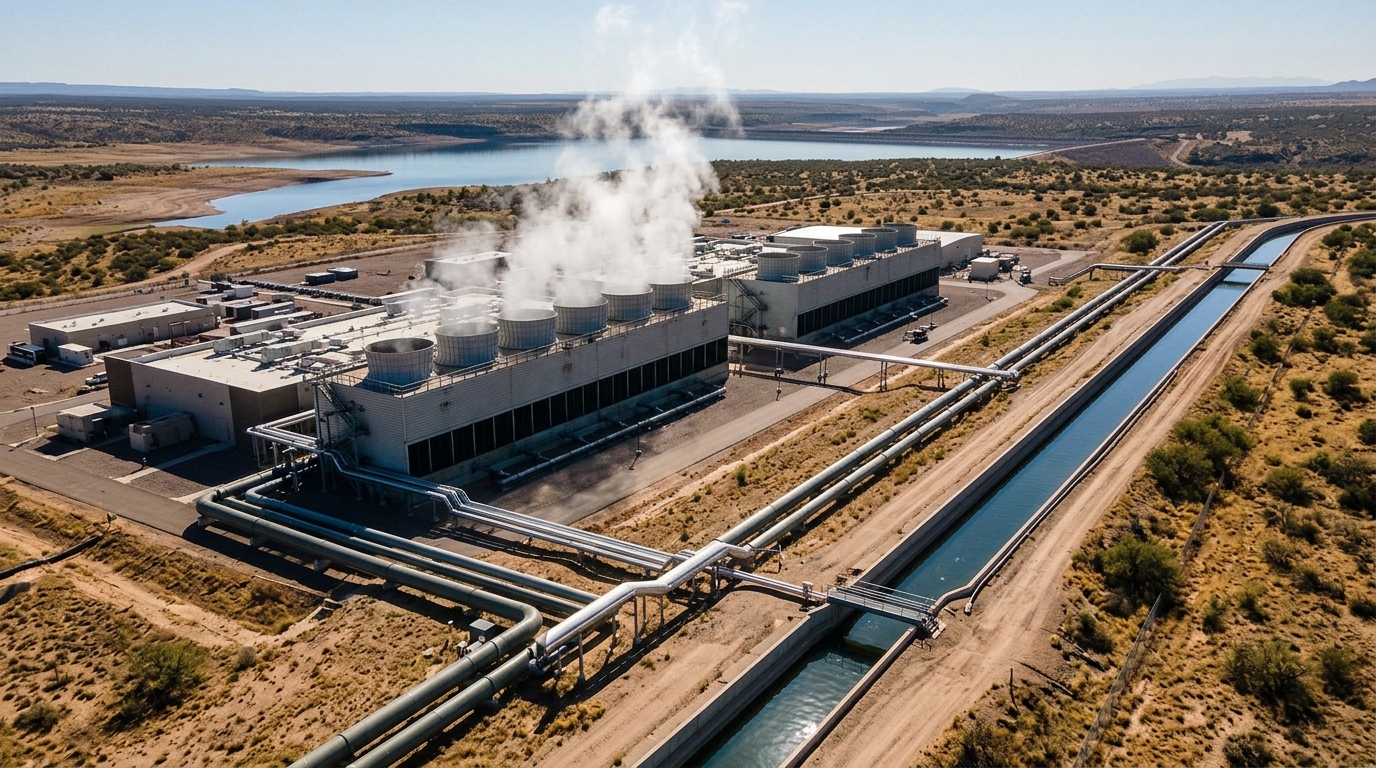
The AI infrastructure trade has been well-covered from the power angle. Nuclear, natural gas, grid buildout — everyone knows that story now. What almost nobody has mapped is the water angle. And it may be the more interesting trade.
Artificial intelligence is turning data centers into a major stress test for America’s water systems. The pressure is no longer just about power.
Here is the physics problem. Every AI chip running a workload generates heat. As Nvidia’s flagship Blackwell rack architecture scales toward 100 kilowatts per rack, and as AMD and custom hyperscaler silicon push densities even higher, the heat problem becomes the binding physical constraint on whether a data center can run at all. Air cooling cannot solve this at scale. The physics of moving enough cool air through a 100-kilowatt rack is a losing battle. Liquid cooling — pulling heat directly off the chip with a fluid loop — is the only proven solution that works for the rack densities AI requires.
According to Deloitte, next-generation AI racks could reach 370 kW in 2026, making liquid cooling and advanced power architectures essential rather than optional. And liquid cooling requires water infrastructure — clean, conditioned, chemically managed water running continuously through systems that cannot fail.
The M&A Signal Nobody Processed Correctly
On March 20, 2026, Ecolab announced something that should have gotten more attention than it did. Ecolab announced a definitive agreement to acquire CoolIT Systems, a high-growth, high-margin leader in liquid cooling technology for next-gen AI data centers. CoolIT is expected to generate approximately $550 million in sales over the next 12 months.
CoolIT is a pure-play data center liquid cooling company with end-to-end capabilities that designs and manufactures high-performance liquid cooling systems, including coolant distribution units, cold plates, and direct-to-chip cooling technologies. With more than 25 years of experience, their technology helps the world’s largest hyperscale and colocation operators run more efficiently. As data centers shift from air cooling to liquid cooling to support rising compute demands, CoolIT’s mission-critical technologies provide the performance needed for advanced AI workloads.
What the deal actually signals: if the case for cooling and water stocks were already widely understood, Ecolab would not have needed to pay 29 times forward EBITDA to assemble it inside a single corporate structure. Nor would KKR have generated a 15-times return on the underlying CoolIT investment. Premium multiples and venture-style returns on industrial assets are how the market signals that the next leg of capital deployment has not yet arrived.
Ecolab just told you, in the clearest possible language, that the water treatment and fluid management side of AI infrastructure is worth paying a massive premium for. The broader market has not connected those dots yet.
Vertiv Is Showing You the Order Book
Vertiv just reported Q1 2026 results in late April. Organic sales grew 23% year-over-year. Americas grew 44% organically. The backlog stands at roughly $15 billion, up 109% year-over-year, with a book-to-bill ratio of 2.9 times, meaning Vertiv is booking nearly three dollars of new orders for every dollar of equipment shipped. Management raised full-year 2026 guidance to $13.75 billion in revenue and $6.35 in adjusted EPS, implying 51% earnings growth.
A 2.9 book-to-bill ratio does not happen in an uncertain market. That is a company with locked-in demand that it physically cannot ship fast enough. Vertiv’s advantage is deep integration with Nvidia; when Nvidia designs a reference architecture for a new supercluster, Vertiv co-engineers the thermal solution. The company reported a 252% increase in orders as rack densities blew past 100 kW, and projects roughly $13.5 billion in organic revenue for 2026, up about 28%.
The global AI datacenter liquid cooling market was valued at an estimated $3.20 billion in 2025, is projected to reach $3.70 billion in 2026, and is expected to expand significantly to $17.83 billion by 2036, registering a CAGR of 16.9% during the forecast period. That is a nearly six-fold increase in ten years from a market already in rapid growth mode.
The Water Utility Angle Most Investors Have Not Found Yet
Years of underinvestment are giving way to large-scale infrastructure upgrades, digital modernization, and private-sector partnerships. The result is a market that combines the dependable income of regulated utilities with the higher-margin potential of advanced water technology.
The AI boom has triggered a 20% CAGR in water cooling demand. Companies providing industrial chillers and cooling towers are seeing record orders from hyperscale data center operators. This is reaching beyond the pure-play cooling names into the broader water infrastructure sector. Advanced Drainage Systems reported a telling detail in its most recent results: on May 21, 2026, the company reported fourth-quarter fiscal 2026 net sales of $676.8 million, up 9.9% year over year, with stormwater sales rising 11.7%. Management said the company remains focused on gaining share in growing construction segments, specifically naming data centers as one of the markets supporting its long-term strategy.
The Zacks Utility Water Supply industry currently carries a Zacks Industry Rank placing it in the top 25% of more than 243 Zacks industries. That ranking reflects institutional money already starting to notice.
The Framework
There are three distinct layers to this trade. The pure-play cooling infrastructure layer — Vertiv, Modine, nVent — carries the most direct AI data center exposure with the highest growth rates and the richest valuations. The water treatment and chemistry layer — Ecolab post-CoolIT acquisition, Xylem — offers more moderate valuation with a newer and still-underpriced AI angle layered onto an existing business. The regulated utility layer — American Water Works, Xylem’s municipal customers — provides slower growth but durable cash flows and meaningful dividend yield as portfolio ballast.
U.S. data center power demand is projected to grow from roughly 150 TWh in 2024 to roughly 400 TWh by 2030, a near tripling in six years. Hyperscaler 2026 data center capex of approximately $330 billion flows roughly 60% to silicon and 40% to physical infrastructure including real estate, power, cooling, and networking.
The chips get the headlines. The water infrastructure quietly becomes the constraint. That asymmetry in attention is exactly where the opportunity tends to live longest before the crowd arrives.