
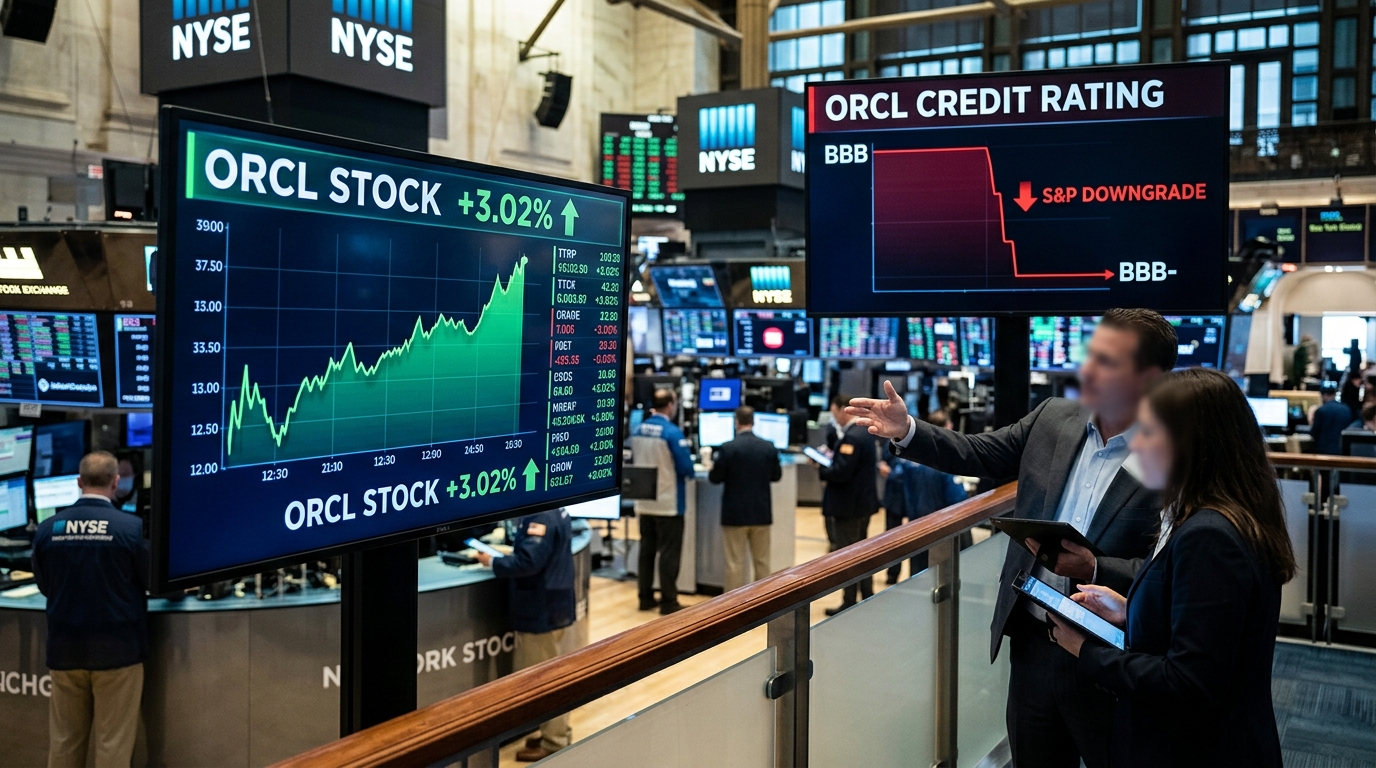
Something unusual happened to Oracle today. S&P Global Ratings cut its long-term issuer credit rating on the company to BBB-, the lowest rung of investment grade before junk territory. The stated reason: rising business risk and weaker cash flow. One more downgrade and a company that has never issued subprime debt would officially be there.
The stock went up anyway.
That is not a normal reaction. And it is the most interesting signal in the market right now.
What Actually Happened
S&P Global Ratings downgraded Oracle from BBB/A-2 to BBB-/A-3 amid “rising business risk and weaker cash flow,” though the company’s long-term outlook was left as “stable.” A drop to BBB- is a significant psychological and financial blow for a tech blue-chip. It leaves Oracle just one notch above speculative grade, commonly known as junk status.
Here is the part that makes it more complicated. Investors chose to focus on Oracle’s staggering $638 billion backlog of cloud contracts rather than the immediately apparent threat to its balance sheet. That is not irrational. It is a bet. The question is whether it is a well-informed one.
Q4 revenue rose to $19.2 billion, up 21%, with cloud at $9.9 billion up 47%. Full-year revenue reached $67.4 billion, and GAAP EPS increased 34% to $5.83. Cloud infrastructure is the standout, with fiscal 2026 revenue of $18.1 billion up 77%, and total Remaining Performance Obligations at $638 billion, up 363%.
That backlog number is real. Signed contracts. Not projections.
The Number Equity Investors Keep Skipping
Fiscal 2026 capital expenditures were $55.7 billion, producing negative free cash flow of $23.7 billion despite $32.0 billion of operating cash flow. That is not a rounding error. That is a structural cash hole.
And to fund it, in fiscal year 2026, Oracle raised $43 billion in debt financing and $5 billion in equity financing. In fiscal year 2027, Oracle expects to raise approximately $40 billion more through a combination of debt and equity, including a previously announced $20 billion at-the-market equity issuance.
Slight tangent, but it matters: most investors think of equity issuance as a secondary concern. At this scale, it is not. To keep its head above water and protect its remaining investment-grade rating, Oracle is aggressively leaning on equity dilution. Following a $5 billion mandatory convertible preferred stock issuance in February 2026, the company plans an additional $20 billion equity issuance later this calendar year. That is shareholder value being printed away to fund datacenter construction. Every share you hold today buys a smaller piece of the backlog tomorrow.
The Credit Market Is Already Saying Something the Stock Is Not
This is where it gets interesting. Equity analysts from Piper Sandler maintain an Overweight rating, while credit markets are demanding the highest-ever premium to insure the company’s debt — a 198-basis-point spread on five-year credit default swaps. That disconnect is not noise. It is a genuine disagreement between two very sophisticated pools of capital.
Credit investors get paid back before equity holders. They are almost always more conservative. When they are this alarmed on a company that equity analysts are still calling a buy, the gap deserves serious attention.
Oracle’s capex trajectory goes from $21.2 billion in FY2025 to a projected $80 billion in FY2028, representing 60% of sales, driving timing-related free cash flow burn of negative $25 billion in FY2026 through negative $16 billion in FY2028. The cash burn does not reverse quickly. The bull case requires holding through years of dilution and debt issuance before the backlog starts converting at scale.
The Backlog Is Real. The Conversion Is Not Guaranteed.
According to Oracle’s 10-K filing, only about 12% of the $638 billion in contractual obligations is expected to convert into revenue in the next fiscal year. The remainder stretches years into the future, leaving the company exposed to risks such as customers failing to renew, construction delays, and power shortages that could stall new datacenter operations.
Analysts estimate more than half of the $638 billion backlog may be tied to its relationship with OpenAI. If OpenAI’s computing needs keep growing, Oracle wins big. If OpenAI’s demand or funding tightens, Oracle absorbs the loss through leases and debt already on its books.
That concentration is the part most investors are not modeling correctly. A diversified backlog is a moat. A backlog built around a single counterparty’s AI ambitions is a bet on that counterparty.
Options Market Behavior
With the S&P downgrade landing mid-session and the stock still printing gains, implied volatility is elevated relative to recent history. The equity-credit divergence creates a scenario where both put buyers and call sellers can make a case. For traders expecting resolution in either direction, defined-risk structures around the August or September expiry allow participation without binary exposure to the financing timeline. IV rank has moved higher this week as uncertainty around Oracle’s capital structure has increased — worth monitoring heading into any institutional rebalancing tied to index-grade credit requirements, which could accelerate forced selling if Moody’s follows S&P’s move.
Bull Case. Bear Case. What to Watch.
The bull case is clean: analysts remain surprisingly calm, with an average price target implying more than 80% upside from current levels. They see the payoff arriving after 2027, when new facilities begin generating profits. Cloud revenue guidance of 58% to 64% growth into Q1 FY2027 supports that view if execution holds.
The bear case is equally clear. The high-debt, high-capital-consumption expansion model leaves management with very little room for error, and the sharp stock price swings over the past month have fully demonstrated how quickly market sentiment can turn. A Moody’s downgrade following S&P’s move could trigger forced selling from investment-grade-only funds, which would be a mechanical pressure event entirely separate from the business fundamentals.
The risk analysis comes down to one question: does Oracle have enough time and financing flexibility to bridge from negative free cash flow today to the backlog conversion that justifies the stock? “The demand is real with cloud infrastructure revenue and backlog growing fast. But the funding question is getting harder, not easier, with capex coming in well above estimates and free cash flow still negative.”
What This Means for the Broader Market
Oracle is not unique in this dynamic. Like Oracle, both Amazon and Google face the same fundamental tension: mounting debt-funded spending against the promise of long-term AI monetization. Amazon’s free cash flow is projected to turn negative this year, while Google retains a stronger near-term cash position. The Oracle downgrade is a preview of the accounting reckoning that the entire AI infrastructure buildout will eventually face.
When S&P moves on Oracle, the next question is whether Moody’s follows. And whether the market, which has so far chosen to look past the credit signal at the backlog number, keeps doing so when the institutional forced-selling clock starts ticking.
Today’s 3% gain on a junk-adjacent credit downgrade is either a sign that equity investors see something the bond market is missing — or a sign that the bond market is one rating action ahead of where the stock is priced.
That gap is the trade.