
August 26, 2026
Bonus Content: Crude Down 9%, Airlines Up: Reading the Reversal
In case you missed it…
…make sure you get your free “Simple Options Trading For Beginners” book before your link expires.

I eventually plan to charge money for this training, so do yourself a favor and download it now…
That way, no matter what it costs in the future, you’ll have a free copy.
Sound good?
FREE: Simple Options Trading For Beginners << Get It Now
Good Trading,
Bill Poulos
P.S. Go here to save a copy of your “Simple Options Trading For Beginners” book while it’s still free.
Crude Down 9%, Airlines Up: Reading the Reversal
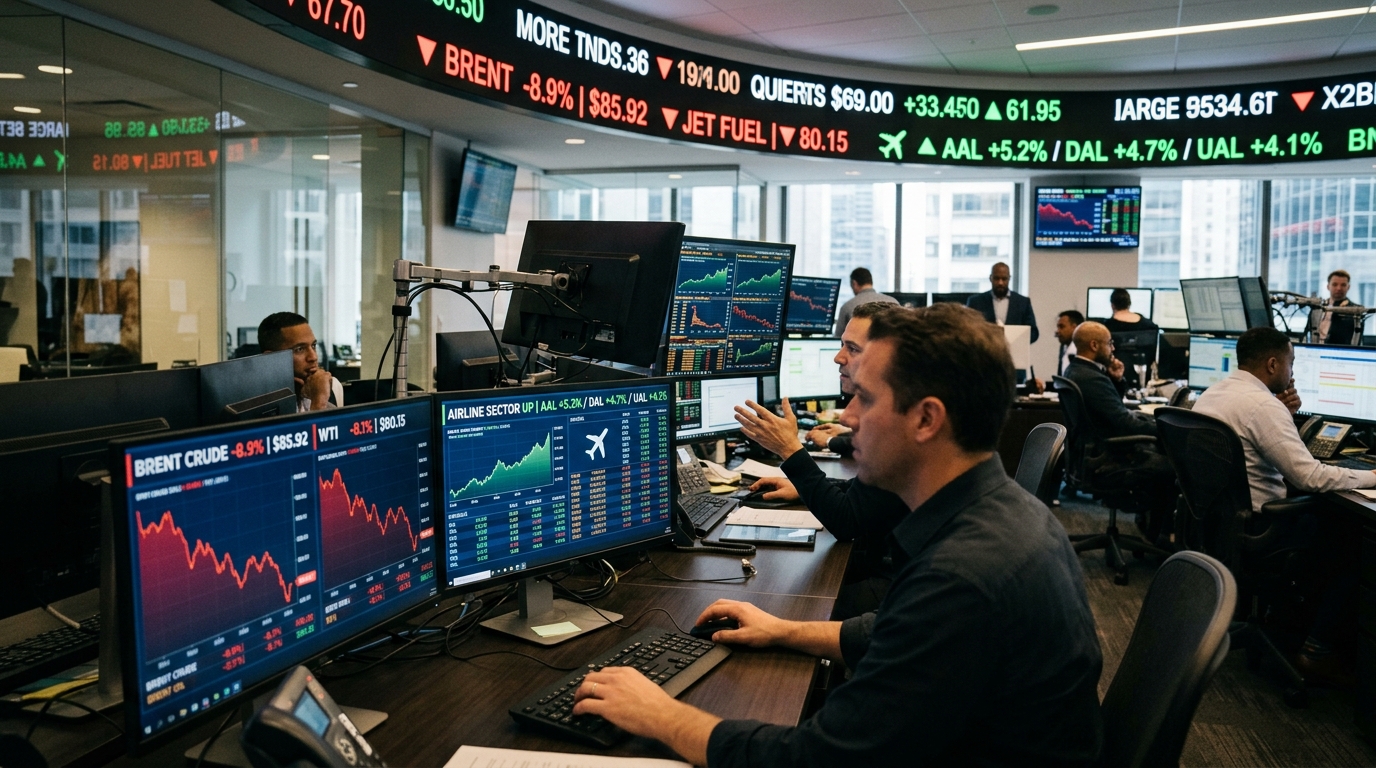
A week ago, the dominant trade in every asset class was built on one assumption: the Strait of Hormuz stays closed, oil stays high, and anything sensitive to fuel costs gets hammered. By Tuesday’s close, that positioning was being systematically unwound. Brent traded near $86 a barrel, taking its decline this week to almost 9%, while West Texas Intermediate was near $80. Airlines gapped up across the board. Treasury yields fell. Energy lagged badly. This is what a crowded trade in reverse looks like.
The catalyst was a joint statement from Tehran and Muscat. Iranian Foreign Minister Abbas Araghchi and his Omani counterpart Badr Albusaidi discussed an “interim framework” aimed at resuming shipping through the Strait of Hormuz, according to a joint statement carried by the Oman News Agency. The proposal includes a joint temporary navigational corridor and a joint mine-clearance effort to restore safe navigation. Both sides also signaled they want to broaden the conversation. The joint statement said both sides “emphasized the importance of holding joint talks with regional countries bordering the waters of the Persian Gulf.”
The market moved on the word “interim.” But experienced traders should sit with that for a moment, because they have seen this framing before. The 60-day window established by the Islamabad Memorandum of Understanding of June 17 lapsed on August 17 with no peace agreement, no extension, and no active talks. Every operative commitment in that deal failed early: the U.S. oil waiver survived 20 of the 60 days, the blockade lift 27, and Iran’s mine-clearance obligation was never completed. The corridor that opened under the June MOU collapsed within weeks. Tuesday’s framework is the second attempt at a structure the market already watched disintegrate.
That context matters enormously for how to size any position built on this catalyst. CBA estimated Brent could fall toward the bottom of a $70-$100 range if oil flows through Hormuz recover even modestly, calculating that just 50% to 60% of pre-war quantities would be enough to revive expectations of an oversupplied global market. That is the bull case for airlines and bonds. The risk case is an August 17 repeat.
The cross-asset read is clean. When crude prices fall, market expectations for future inflation fall with them, priced directly into government bonds. The whole Treasury curve moved Tuesday: the 2-year yield eased to 4.208%, the 10-year slipped from 4.704% to 4.662%, and the 30-year fell from 5.231% to 5.19%. On the equity side, Alaska Air rose 2.48%, United Airlines gained 2.18%, Delta added 1.25%, Southwest climbed 1.20%, and American Airlines rose 1.03%. Energy names went the other direction. Crude fell as diplomatic efforts gained traction and the threat of renewed military escalation faded, while Washington’s latest sanctions on Tehran stopped short of harsher measures on trading partners including China.
How Professionals View the Session
The lesson here is not about Hormuz. It is about the mechanics of unwinding a consensus position. When every participant in a market is positioned the same way, the trigger for the reversal does not need to be definitive. It only needs to be plausible enough to make the first sellers move. Once fuel-cost-short airlines started covering and crude longs started trimming, the move fed itself.
Disciplined traders ask two questions at moments like this. First: is the catalyst durable, or is this a relief rally inside a still-broken situation? The June MOU precedent argues for caution. Technical talks between the two sides will continue with the aim of agreeing on a permanent maritime corridor, future administration of the strait, and a mechanism for information exchange and traffic management. That is a long list of unresolved items. Second: even if the framework fails, has the market’s positioning already adjusted enough that the next catalyst needs to be much larger to move prices the same distance?
The answer to the second question is probably yes. A 9% crude decline in three sessions is not a minor position trim. That is a structural rotation. Traders who chased airlines on Tuesday are now exposed to a re-escalation that could reverse the entire move in a single session, as happened repeatedly this summer.
The Trader’s Lesson
When a geopolitical trade that has been running for months begins to reverse, the temptation is to chase the new direction at full size. The better discipline is to recognize that the uncertainty hasn’t resolved, only shifted. Smaller initial size, defined risk levels, and a clear view of what would invalidate the thesis are what separate traders who profit from reversals from those who simply swap one crowded position for another.