
October 15, 2026
Wednesday’s S&P selloff crossed the Pacific overnight and turned into something far worse
For generations, miners followed what they could see at the surface. Now modern tech is taking the story deeper.
The clues have been there for decades but the investigation is just happening now.
For investors who like seeing an opportunity before the answers are obvious, this is worth a read.
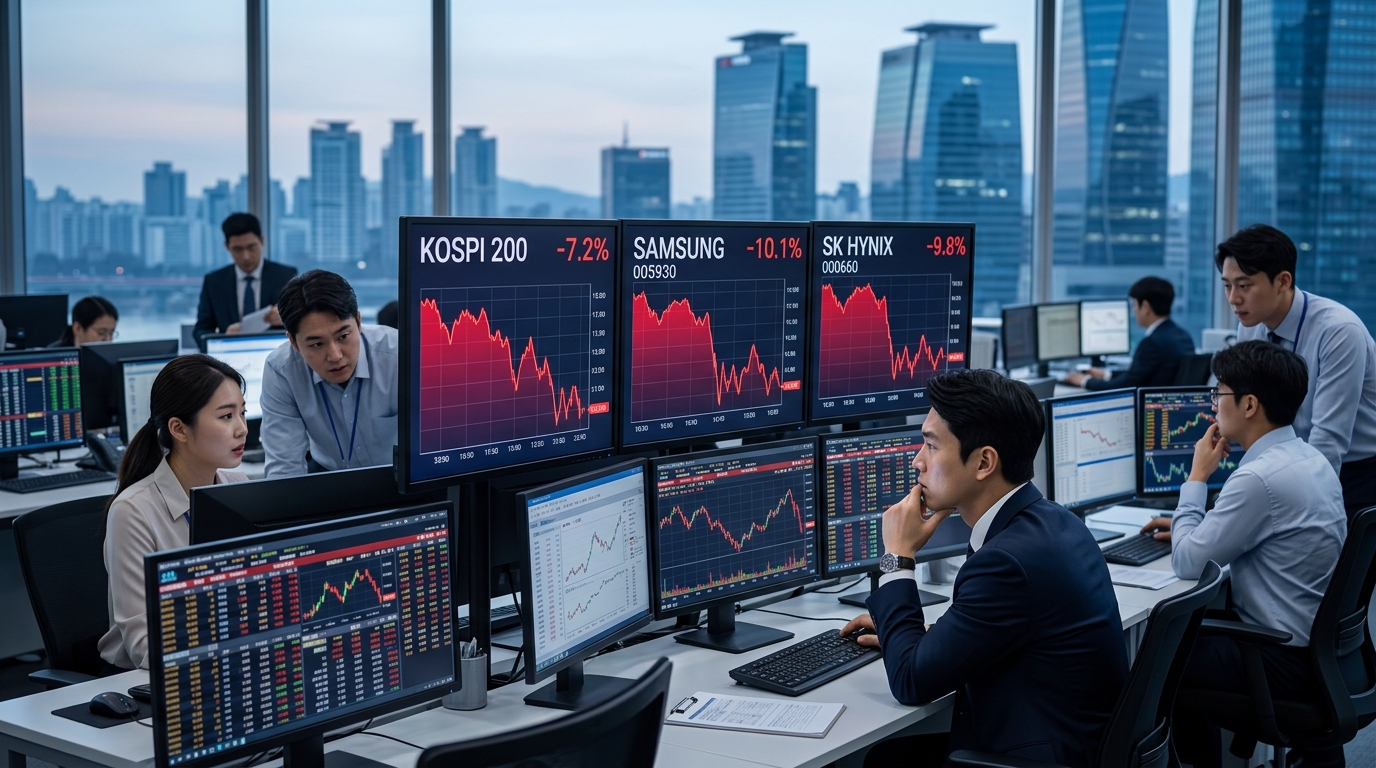
Samsung and SK Hynix Just Lost 10% in a Single Day.
Wednesday’s S&P 500 session was bad. Thursday’s Asian session was a different animal entirely.
He Doesn’t Buy Gold. He “Skims” It.
A former hedge fund manager ranked in the top 1% by Barron’s has developed a three-step strategy to profit from gold – without buying a single ounce.
His followers have had the chance to collect $2,975… $3,781… and even $6,786 at a time. With a 73% win rate.
He calls it “Gold Skimming.” And he’s just revealed the full strategy for the first time.
The S&P 500 fell 1.1% and the Nasdaq dropped 1.9% on October 14, the worst session for both indexes since July, with AI stocks leading the retreat. That alone would be enough to set nerves on edge heading into Asia. But the mechanism behind the selling mattered more than the headline number: CoreWeave plunged more than 15% after its corporate bonds fell below 80 cents on the dollar, a threshold widely viewed as a sign of financial distress. When credit markets and equity markets signal distress simultaneously in the same name, institutional traders read that as a regime shift, not a dip to buy.
Hotter US inflation supplied the immediate catalyst, but the deeper concern is increasingly about AI economics and whether the companies funding the infrastructure boom can sustain spending at current levels. That is an important distinction. A single CPI reading can be shrugged off. A question about whether the entire AI capital expenditure cycle is financially sound cannot.
What Seoul Did With That
The benchmark KOSPI tumbled 7.57% to close at 5,554.22, marking its steepest decline since July 28. Samsung Electronics and SK hynix both plunged around 10%. Those are not normal correction numbers.
The selloff opened rough and kept sliding. A sell-sidecar hit shortly after the open, suspending index futures-linked program trades for five minutes. Shortly after noon, circuit breakers kicked in and froze trading, first in the tech-heavy KOSDAQ and then in the KOSPI, for 20 minutes. It was the first time since July 29 that both markets had activated circuit breakers on the same day.
The reason Seoul amplified the pain so dramatically comes down to concentration. Samsung and SK hynix have, at points this year, accounted for about half of the KOSPI’s market capitalization, amplifying the index’s decline as investors retreated from memory chipmakers that had benefited from the AI boom. When the stocks that underpin your entire index are the exact names the global selloff is targeting, the index itself becomes a leveraged expression of that single thesis.
The 60-Second Change That Stays With You
One small setting could change how you enter and exit every options trade. It’s easy to overlook, but many beginners learn its importance the hard way. Discover the permanent rule inside Your First Trade Playbook – free for a limited time.
Foreign investors withdrew a net 2.9 trillion won during the session.
Tokyo Told the Same Story, Differently
The Nikkei 225 closed at 64,425.95, a fall of 4.90%. Selling was concentrated among AI-linked stocks, with Advantest and Tokyo Electron sliding 13.9% and 7.3% respectively. SoftBank Group skidded 9.4%. The Nikkei’s loss was roughly half Seoul’s, but the names responsible were identical in character: companies whose entire valuation rests on AI infrastructure spending continuing at pace.
This pattern of concentrated selling in Asian chip names is not new. Samsung and SK Hynix have drawn the same coordinated unwind before, and US holders of those names felt it directly.
Twenty of the most valuable global AI and semiconductor stocks shed more than $1 trillion in value so far this week.
The credit pressure is not isolated to US names. Equity markets have already shown they punish AI infrastructure borrowing announcements the moment a tech giant signals it needs debt to keep building.
Three Pressures on the Dollar, One Question for You
Foreign governments trading around it. Deficits requiring more of it. And a digital version that would change what privacy means. Any one of those is manageable. Together they are worth understanding before they show up on a statement. Reagan Gold Group’s free guide lays it out plainly, with no jargon and no obligation.
What Professionals Will Watch at the US Open
Thursday’s US open is not simply a continuation trade. It is a test of whether the credit concern that CoreWeave’s bonds surfaced on Wednesday has spread. Reuters tied the falls to rising borrowing costs, reporting Oracle’s credit default swap spread up 26 basis points to a record 288, SoftBank’s up 24 to 424, and CoreWeave’s past 1,000. When spreads move like that, risk managers at funds holding Nvidia, Broadcom, or any AI-adjacent name are recalibrating position sizes regardless of their fundamental view.
“The market is reacting sensitively to whether capital raising will be sustainable and whether massive infrastructure investment will lead to real income, rather than revenue growth itself in AI services,” said Seo Sang-young, an analyst at Mirae Asset Securities. That is the question every AI-exposed trader should carry into Thursday’s session.
The Trader’s Lesson
Seoul and Tokyo just gave US traders a live demonstration of what happens when a crowded, concentrated trade gets hit by two simultaneous shocks: an inflation reading that raises the cost of capital, and a credit signal that questions whether the borrowers at the center of the trade can survive tighter conditions. The KOSPI’s circuit breakers were not a foreign market anomaly. They were a stress test of the same thesis US markets are holding.
When credit markets and equity markets sell the same names at the same time, the right response is not to hunt for a level. It is to wait for evidence that one of those two pressures has eased before adding exposure. Patience here is risk management, not hesitation.