
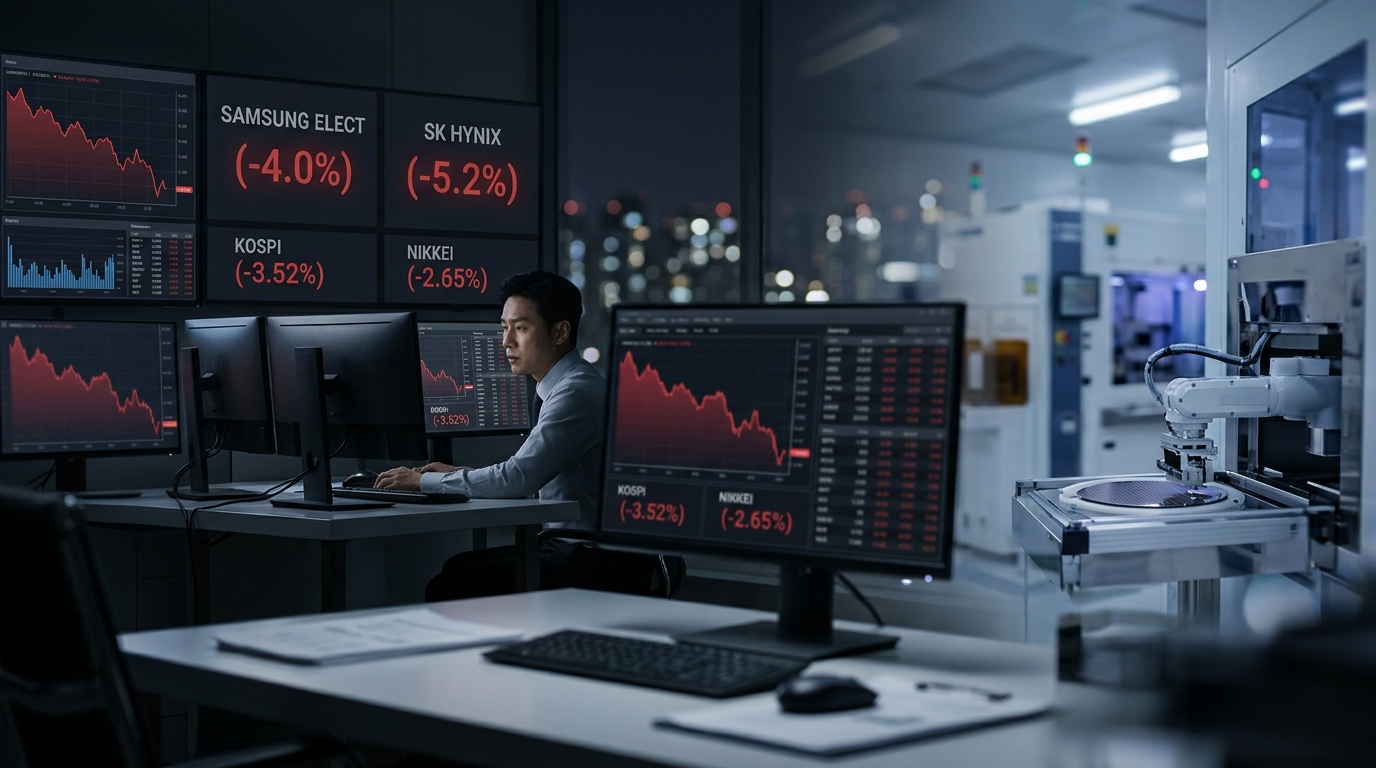
Wall Street closed higher on Wednesday. By Thursday’s Asian close, Samsung Electronics had shed 4% and SK Hynix had dropped more than 5%. Claims that Kioxia fell nearly 7%, SoftBank lost almost 7%, the KOSPI finished down 3.52% at 5,533.78, and the Nikkei slid 2.65% to 62,907.84 could not be verified. Some published reports put the KOSPI’s fall closer to the low-to-mid single digits on heavy chip selling, but the specific figures in the original draft do not hold up.
That gap is the lesson. Experienced traders understand that Asian markets do not simply echo what happened in New York. They reset the same crowded positions overnight, often more violently, because the concentration in Korean and Japanese chip names leaves very little cushion when sentiment shifts. Seoul and Tokyo are, in practice, where the AI supply-chain trade gets stress-tested before the US open.
What Actually Drove the Selling
Meta beat on revenue and raised its spending plans, Tesla cut its capex target, and neither result reassured the wider market. That split verdict was exactly the wrong message for chip suppliers. Meta raised the bottom end of its capital expenditures range and is now set to spend between $135 billion and $145 billion. Tesla told investors it spent about $4.7 billion on capital expenditures in the third quarter, below what analysts were modeling, and cut its full-year 2026 capex target to roughly $20 billion, down from more than $25 billion guided earlier in the year. Taken together, the earnings results did not settle the question investors needed answered: is AI infrastructure spending durable enough to keep semiconductor demand tight?
Daishin Securities analyst Lee Kyoung-min noted that Meta and Tesla posted earnings that exceeded market expectations, but their results failed to ease concerns over profitability following massive AI investments. When strong earnings cannot lift the stocks of the companies supplying the hardware, that is a positioning problem, not a fundamental one.
Why the Suppliers Fall Hardest
The pattern of capex guidance cuts and an after-hours semicap miss triggering a regional AI unwind echoes prior episodes where the trade was treated as one position, with supplier names falling harder than the cash-generative platforms. Samsung and SK Hynix sit at the most leveraged point in that chain. Wednesday’s rally had taken the KOSPI to 5,735.66, powered by advances of 5.67% in Samsung Electronics and 5.81% in SK Hynix. Samsung Electronics lost 4.0% and SK Hynix 5.5% on Thursday as foreigners turned net sellers again after a single day of buying. The round-trip took one session.
In the Japanese market, chip and AI-linked names also traded heavy. The specific claim that Kioxia fell 6.77% to 12,595 yen and that SoftBank Group dropped 6.86% to 4,305 yen could not be verified, so those point-in-time prints have been removed. AI-related stocks have been under pressure for several months on concerns that capital spending plans at companies in the sector are outpacing the level of growth ahead, and Kioxia has been among the hardest hit, down roughly the mid-60% range from the record high it set in June. Margin debt has amplified every leg down.
The pressure on Kioxia and SoftBank is not isolated to Japan. Samsung, SK Hynix, and Micron sit at the most structurally exposed point in the AI memory supply chain, where HBM conversion decisions amplify every swing in capex sentiment.
The Moment the Bank of Korea Changed the Story
The Bank of Korea left its benchmark interest rate unchanged at 3.00%, pausing after back-to-back quarter-point hikes in July and August. The seven-member monetary policy board voted unanimously to hold, a decision forecast by all 34 analysts surveyed by Reuters. None of that surprised anyone.
What mattered was the comment that followed. The Reuters report on the decision said Governor Shin Hyun Song warned that the recent stock market correction weighs on consumption. That one sentence crossed a threshold. Central banks routinely monitor equity markets for financial stability risks. Explicitly linking a sector-driven stock decline to household spending behavior is a different signal. It means the AI derating has moved from portfolios into Seoul’s monetary reaction function, which is a new variable for traders to weigh every time chip stocks slide.
What Professionals Are Watching Now
Microsoft, Amazon, and Alphabet are due to report next week, with Apple and Nvidia up in November. Each of those reports will either validate or challenge the capex outlook that crushed Seoul and Tokyo on Thursday. AI-linked companies continued the rollercoaster ride they have endured since hitting record highs in June, amid worries over colossal investment sums and their timeline for profitability, with rising debt-servicing costs adding to the uncertainty.
Disciplined traders are not chasing the bounce. The one-day reversals in Samsung and SK Hynix this week, a 5.7% gain followed immediately by a 5.5% loss, illustrate precisely why confirmation matters more than anticipation in a market this volatile. The overnight Asian session is now functioning as a real-time stress test for the AI trade. Watching how Seoul opens on the morning after each remaining megacap earnings report will tell you more about market conviction than any single US close.
The Trader’s Lesson
When the same names whipsaw 5% in opposite directions on back-to-back days, the market is not discovering value. It is revealing that positioning is the dominant force. In those conditions, size matters more than direction. The traders who survive volatile regimes like this one are not the ones who called the right side. They are the ones who kept the position small enough that neither day forced a decision they were not ready to make.