
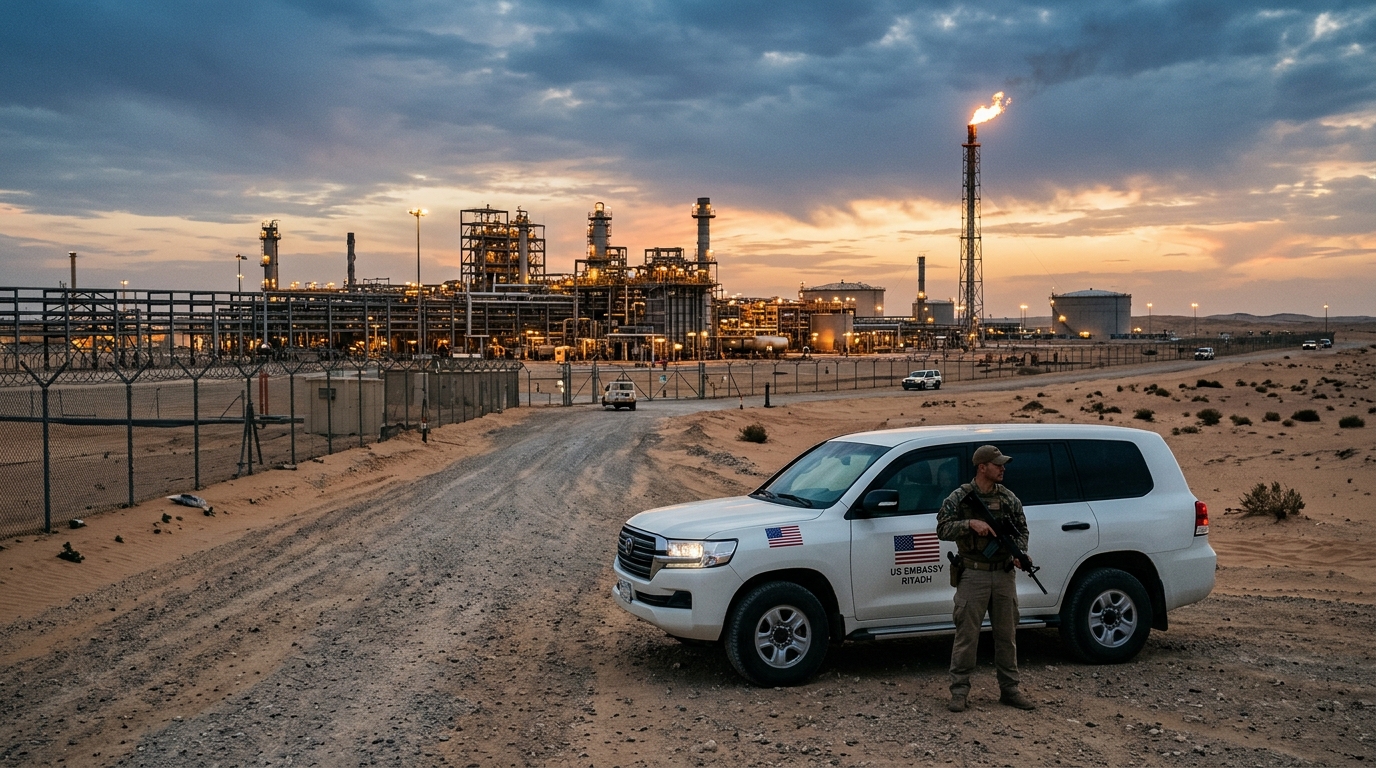
Wednesday evening changed the map. A Houthi drone aimed at a processing plant at the Shaybah oilfield was intercepted, and its debris struck a contractor’s vehicle, killing two and injuring two. Hours later, the US State Department ordered the departure of non-essential staff and family members at its embassy in Riyadh, a move that comes amid intensifying strikes on Saudi Arabia by the Iranian-allied Houthi militia in Yemen. Then came the detail that matters most to traders: multiple reports said the US military has also been quietly reducing its footprint at posts in the Middle East due to ongoing regional threats from the Houthis and direct threats from Iran.
Global oil prices climbed more than 2 percent on Thursday. That is not a shipping-lane fear trade. It is a production-infrastructure fear trade, and that distinction matters for how you position.
Why Shaybah Is Different
Shaybah is one of Saudi Arabia’s major oil-producing facilities, located deep in the Empty Quarter desert near the border with the UAE. The remote field has a production capacity of approximately 1 million barrels per day, making it an important component of Saudi Arabia’s energy infrastructure. Wednesday’s drone was intercepted. The debris still killed two people and caused a fire. The two deaths at Shaybah underscore the continuing danger to Saudi energy facilities, even as the kingdom reports successful interceptions and maintains that oil production has not been disrupted.
There is a compounding problem on the export side. The East-West pipeline, which has a stated pumping capacity of about seven million barrels a day, carries crude from the kingdom’s eastern oilfields to Red Sea export terminals, allowing shipments to bypass the Strait of Hormuz. Crude flows on that pipeline were reportedly halted on October 5 after a Houthi strike damaged a pumping station east of Riyadh. Both the production layer and the bypass-export layer are now under active attack. That is the first time since the conflict broadened that both have been hit in the same week.
The Fixed Income Complication
Oil at $111 does not sit in isolation. The yield on the US 10-year Treasury note rose to about 5.13% on October 21, 2026. Today, however, Treasury yields moved lower as investors monitored developments in the Middle East. A flight-to-safety bid is competing with the inflation fear. Watch which force closes the session with the upper hand: a yield drop that holds through the afternoon tells you risk appetite is deteriorating faster than inflation expectations are rising, and that is a more defensive posture across equities.
Energy Sectors and Stocks on the Radar
The clearest beneficiaries remain the integrated majors. Oil prices are rising as fears grow that the regional conflict could disrupt flows through the Strait of Hormuz, pushing energy stocks higher, with investors focusing on Exxon Mobil (XOM) and Chevron (CVX) as potential beneficiaries. Among the two, CVX carries a forward P/E around the low teens with a dividend yield around 3%, while XOM is roughly a $730 billion company.
Upstream pure plays with high oil-price sensitivity deserve a place on the radar alongside the majors. Refiners are a more complicated call: crude above $111 compresses crack spreads unless product prices follow proportionally, and product price elasticity weakens as consumers pull back.
Trading Plan and Key Risks
The bull case for Brent holding above $110 rests on one question the market cannot yet answer: what happens if the next drone is not intercepted? Shaybah’s processing plant was the target Wednesday. A direct hit at that facility, or at the East-West pipeline’s remaining operational segments, could remove meaningful supply at a moment when the market is already leaning heavily on limited bypass options around the Strait of Hormuz. There is no clean bypass left if both routes are compromised simultaneously.
Key levels: Brent $105 is the support zone the market defended before Wednesday’s attack. Reference levels are $105 below and $113 above. A confirmed close above $113 opens the door to a move toward the intraday highs seen earlier this month. On the downside, any credible de-escalation signal, including a US-brokered ceasefire proposal or a confirmed pause in Houthi operations, could flush $5 to $8 out of the geopolitical premium quickly.
The ordered departure of US personnel from Saudi Arabia is not a trade signal by itself. It is a confidence indicator. Washington does not evacuate embassy families unless it believes the threat is sustained and directional. Treat it as confirmation that the risk window is weeks long, not days. Position sizing in XOM, CVX, and the XLE ETF should reflect that the trade has a longer fuse than a typical geopolitical spike, but also that the downside is sharp if diplomacy moves faster than the drones.