

November 2, 2026
Bonus Content: December Rate Hike Odds Have Slipped to 70%. Today’s Three Reports Explain Why.
Dear Reader,
Based on my 55 years of watching the market, I’m deeply concerned that we’re in the early stages of a financial crisis that could be larger than the Great Financial Crisis of 2008.
This has very little to do with the national debt, as bad as that is.
Nor is it another debt crisis in the housing market like the one that tanked the markets in 2008.
In fact, it doesn’t even involve the “AI bubble” or the high-flying stock market, although major, widely held stocks will almost certainly be among the first to crash.
No, this is something far worse, and even more dangerous.
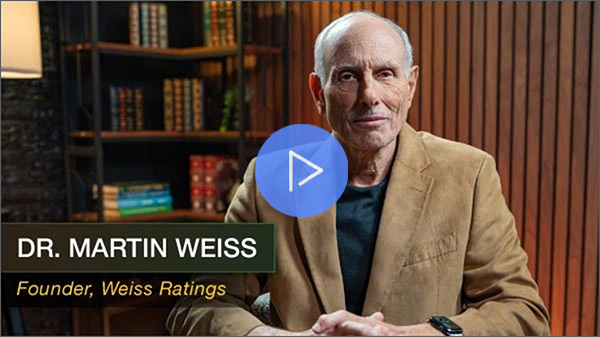
I’m Dr. Martin D. Weiss, New York Times best-selling author, named “Mr. Independence” by Forbes and founder of Weiss Ratings, rated #1 in the Wall Street Journal.
Why #1? Because for 55 years, I have run Weiss Ratings as the nation’s only 100% conflict-free, independent financial rating agency in America.
We have never accepted a dime from rated companies for the grades we issue, and we never will. We answer to no one but our members.
Since 1971, when I founded this company, I have publicly predicted six major American crashes before they happened, always naming the companies most likely to fail with ample warning.
And today I’m issuing a public warning about what could be the biggest crisis to ever hit America.
In previous financial crises, many have lost half, or even most of their retirement savings.
My job – and my family’s job for nearly one hundred years – has been to give Americans the warning before the warning is too late.
And that’s what I’m doing in a free video you can watch today.
>> Go here now to see the most important warning of my career. <<
Good luck and God bless!

Martin D. Weiss, PhD
Weiss Ratings Founder
December Rate Hike Odds Have Slipped to 70%. Today’s Three Reports Explain Why.

Markets enter Monday carrying a specific kind of tension: not uncertainty about direction, but uncertainty about speed. The Federal Open Market Committee voted 10-2 to hold rates at 3.75%–4.00%, with Governor Lisa Cook and Cleveland Fed President Beth Hammack both favoring a quarter-point increase. That split sent a clear signal. In just two days after the meeting, hike odds rose by more than 7 percentage points. But something has changed since then.
The current market-implied probability of a 25-basis-point hike stands near 70% for the Fed’s December 8-9 meeting. A week ago that number sat closer to 85%. The pullback matters because today’s calendar is the main reason it moved, and it will determine whether the slide continues or reverses before the close.
The Order of Operations
Three releases land in a five-hour window, and the sequence is not arbitrary. Each one tests a different piece of the December hike argument.
10:00 ET, ISM Manufacturing. October ISM manufacturing is due at 10am, with a prior reading of 54.5 and consensus sitting at 54.7. September’s ISM reading of 54.5, following August’s 54.6, established a steady base above 50, while S&P Global’s October flash at 56 reinforced momentum in new orders and production. A print that clears the consensus meaningfully, say 55.5 or above, hands hawks a fresh argument: the industrial economy is running warm enough to absorb another quarter-point. A miss below 54 complicates that case almost immediately.
2:00 ET, Senior Loan Officer Opinion Survey. This is the release most traders will underweight, which is exactly why it deserves attention. The SLOOS surveys up to 80 large domestic banks and 24 U.S. branches and agencies of foreign banks, and the Fed times it so results are available for the October/November FOMC meetings. The prior survey showed that bank lending standards to businesses of all sizes were steady during the second quarter. If today’s survey shows renewed tightening in commercial and industrial loan standards, it would suggest the existing rate level is already doing work. That cools the urgency for December. Easing standards, by contrast, would suggest credit conditions remain loose enough to justify another move.
3:00 ET, Treasury Borrowing Estimates. Treasury’s marketable borrowing estimates land at 3:00pm, the first half of the quarterly refunding that sets the borrowing math for Wednesday’s refunding announcement. During the October–December 2026 quarter, Treasury expects to borrow $628 billion in privately-held net marketable debt. Any revision higher would push more supply into a market already sensitive to term premium. Bloomberg has flagged the risk of an overhaul of auction sizes at Wednesday’s refunding announcement. With the 10-year near 5%, any shift toward longer maturities would hit term premium and, through it, equity volatility.
The borrowing estimate is not just a supply number — it feeds a larger fiscal arithmetic. The pace at which Treasury supply is compounding against a market already sensitive to term premium leaves fixed-income investors with very few good exits.
What the Bond Market Is Already Telling You
The 10-year Treasury yield stood near 4.9% in early Monday trade, while the 2-year sat near 4.59%. Treasuries were boosted on Friday by a sharp sell-off in equities led by technology stocks, as investors sought safe havens. That flight-to-safety bid compressed long yields even as rate-hike pricing stayed firmer on the short end. The 2-year is the instrument that tells you what traders actually believe about December; watch whether it drifts above 4.60% after the ISM reading or retreats after the SLOOS.
The Trader’s Lesson
The December hike question will not be resolved today, but today’s session will narrow the range of reasonable outcomes. Disciplined traders know the difference between a catalyst that changes the fundamental view and one that simply accelerates or delays a move that was already coming. Three data points in five hours cannot confirm or kill a Fed decision on their own. What they can do is shift the probability enough to change pricing in short-duration Treasuries, tech multiples, and rate-sensitive sectors before the week’s heavier catalysts arrive. Position sizing ahead of a sequenced data day like this should reflect that what you are really managing is not one risk event but three, with each one capable of amplifying or neutralizing the last.