
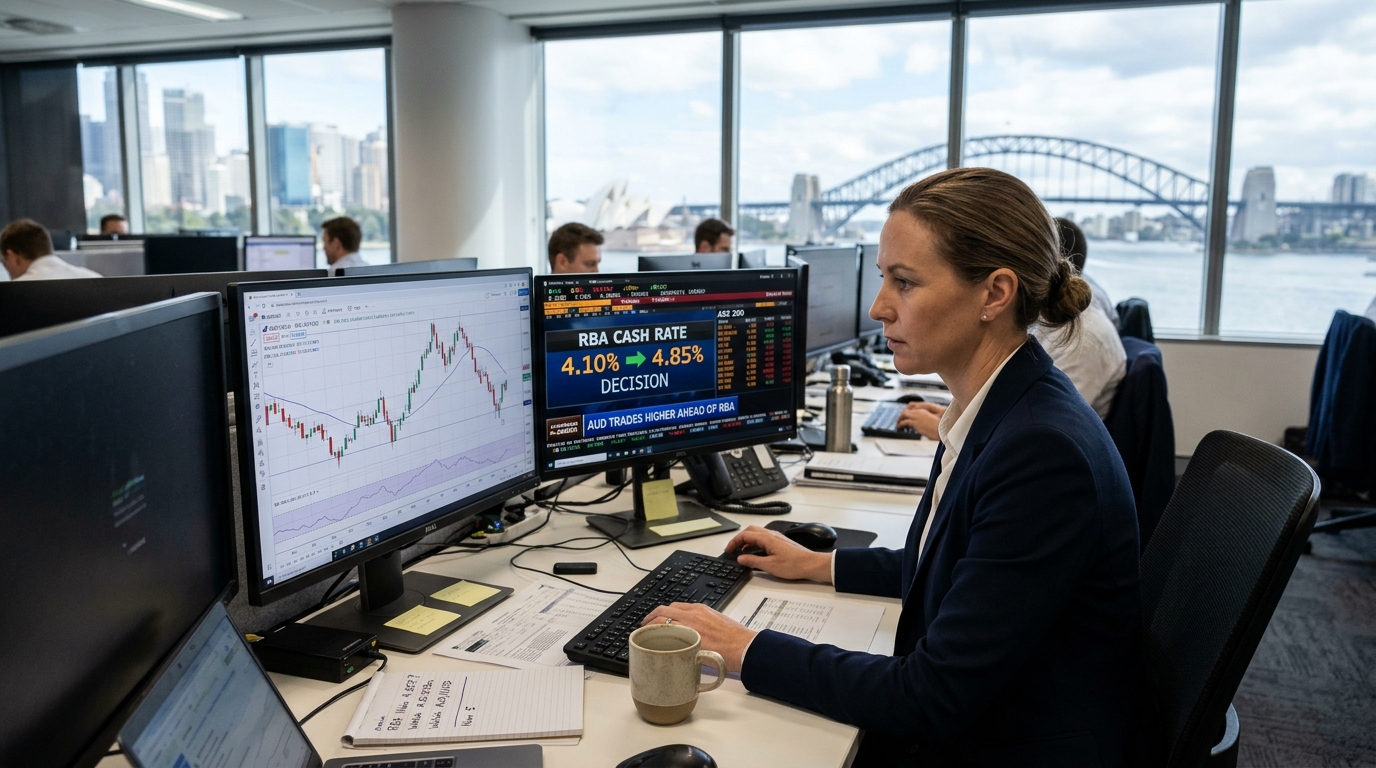
Tuesday’s Reserve Bank of Australia decision is, on paper, already done. With many of the big bank economics teams now leaning toward a November hike, the decision itself looks close to priced. That makes the decision less interesting than what happens around it. The real trade is reading the language, watching the AUD, and figuring out whether this tightening cycle has one more move left in it.
The RBA raised the cash rate to 4.60% on September 29, the fourth hike of 2026, and Commonwealth Bank economists now expect another hike on November 3, taking the cash rate to 4.85%. Another increase would take the cash rate to its highest level in about 15 years, adding further pressure on borrowers already managing higher repayments and living costs.
The inflation data forced the banks’ hands. Australian inflation accelerated to 4.3% in September, boosting expectations of an interest rate hike in November. ANZ said the data cemented the case for a hike, singling out services, where market services inflation posted its strongest annual growth since 2024. CBA’s economists described the expected move as an “insurance hike” to guard against inflation staying higher for longer. CBA also pointed to inflation risks from the Middle East conflict, the AI-driven global investment boom, and tight domestic capacity.
ASX’s RBA Rate Tracker has put market-implied odds for a move to 4.85% around the 80% area in late October. When pricing moves that decisively, the hike itself becomes a non-event. What matters is the statement and press conference that follow.
Experienced traders know this pattern. AUD/USD fell after the September RBA rate hike because the central bank’s hawkish stance was already priced in while the U.S. dollar stayed firm. The Australian dollar’s reaction also highlighted the gap between the written statement and what investors heard as Governor Bullock spoke, with AUD/USD later trading below 0.7000. That sequence is worth remembering heading into the November decision.
The same dynamic played out in the U.S. the same week. The Fed’s 10-2 hold vote showed how dissenter count and a single word change in the statement moved yields more than the decision itself.
The more consequential question is whether this is the last hike or the second-to-last. Westpac does not expect further hikes in its base case but says the risk of another move, most likely in February, has risen. Standard Chartered has pointed to the first rate cut in Q3 2027, with risks of further tightening or delayed easing. If the RBA does go to 4.85%, policy would be firmly restrictive, and the board knows it.
For traders with eyes on the AUD specifically, the contrast with the Fed matters. The Fed lifted rates to a 3.75% to 4.00% target range in September and held them there at its late-October meeting. Australia tightening while the Fed pauses narrows the rate differential in Australia’s favor, which is mechanically supportive of AUD. But that limits policy divergence with the Fed and offers AUD/USD support, while Australia’s strategic exposure to commodities linked to energy, AI, and defense remains an important long-term tailwind for AUD.
On the equity side, the split running through the ASX is worth tracking. Banks and retailers have been sensitive to rising oil prices and growing bets on an RBA rate hike, while energy and mining stocks have tended to hold up better. Materials and energy together make up a meaningful share of ASX 200 sector weight, far more than the comparable resource-linked sectors in the S&P 500. BHP and Rio Tinto carry a disproportionate amount of index weight, and their commodity-linked earnings act as a partial offset to the rate pressure hitting financials and consumer names.
The trader’s lesson: When a decision is 80%-plus priced, the decision itself is rarely the trade. Study the reaction to the forward guidance, not the hike. Tuesday’s real test is whether Governor Bullock’s press conference signals the board is done or leaves February open. One sentence either way will do more for AUD/USD than the 25 basis points themselves.