
The CIA Accidentally Discovered the Rare Earth MOTHERLODE
…And One $5 Stock Sits at the Center of it ALL
Dear Reader,
Inside the CIA’s private museum at Langley sits a strange black rock, sealed in a block of clear plastic.
It looks like a lump of coal… but it’s NOT.
It’s a tiny piece of the biggest discovery of critical resources ever made… a $16 trillion treasure trove that 60 Minutes calls “staggering.”
And one small company you can buy today for about $5 holds the rights to harvest the richest stretch.
Click here for the jaw-dropping TRUE story.
As you’ll see…
The CIA stumbled onto it during one of the boldest secret missions of the Cold War.
To hide what they were really doing, they teamed up with billionaire Howard Hughes and invented a fake mining company.
The whole world bought the story.
But when the mission was over, the CIA came back with something nobody expected… rocks as heavy as gold bricks, packed with rare earths, cobalt, nickel and lithium.
These are the same materials that are driving the 21st-century economy.
America can’t build a fighter jet, an electric car or an AI data center without them.
A $16 Trillion Chess Move that practically nobody sees coming…
At the center of it all is the only company with the technology and track record to harvest this rare earth motherlode.
A publicly traded stock you can buy right now for $5.
The last time Trump backed a mining company like this, its stock shot up 407% in a single week. This time, I believe this stock could hit $50 by the time Trump’s second term is over.
Click here for the details before Trump makes his move.
Regards,
Matt McCall, Head Innovations Strategist
Monument Traders Alliance
P.S. A former CIA insider just sent me Trump’s executive order by OVERNIGHT FedEx, with one section highlighted in yellow. Click here to see why it could be the key to 1,000% gains before Trump leaves the White House.
Microsoft Lost $7 Billion in Productivity. Its Stock Barely Noticed.
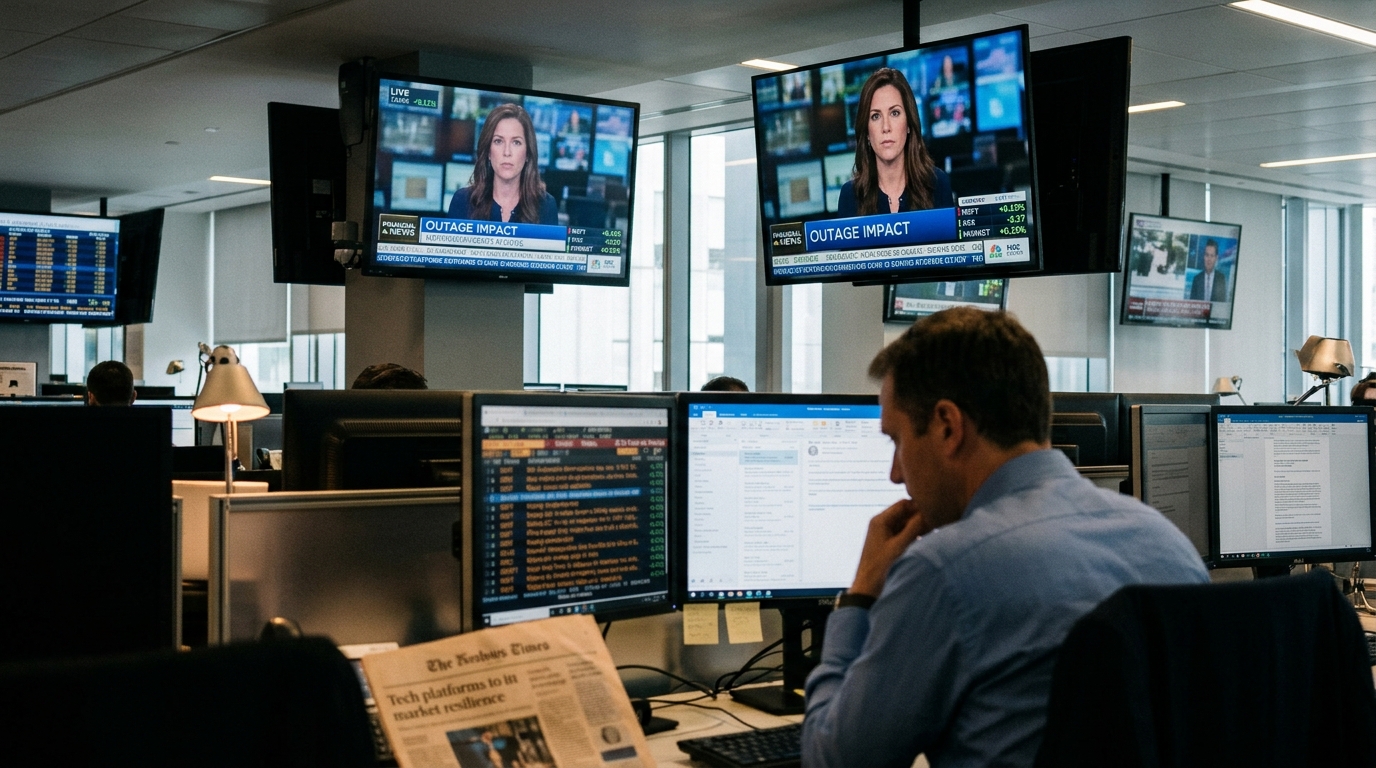
An outage that dragged from Thursday into Friday disrupted Outlook, Teams, Copilot, and other Microsoft 365 services, with reports of wider knock-on effects. Downdetector logged reports from 74 countries and territories within about an hour of problems first emerging midday Thursday in the U.S. CNN, citing the Anderson Economic Group, estimated the productivity loss at $7 billion, and noted the figure could rise as secondary costs are tallied.
Microsoft attributed the disruption to a technical issue tied to earlier network-related work, and said it found that a process on affected servers responsible for establishing secure connections became overwhelmed, causing those servers to stop processing requests. The company also said there was no indication the incident was caused by malicious activity.
Here is the trading lesson: MSFT closed at $523.88, up 0.17%, on Friday. Shares were down about 1.4% in pre-market trading as the outage extended into a second day, then recovered by the closing bell. The market opened with fear and finished with indifference. That gap between pre-market alarm and the regular-session close is worth studying.
Why did it snap back? Microsoft says on its website that more than 430 million people use Microsoft 365 apps, making the suite deeply embedded even when reliability falters. RBC also reiterated Microsoft as its top software pick this week, pointing to 48% Azure growth in constant currency last quarter and expanding Copilot usage, with no change in its overall stance. The analyst community largely treated the outage as an operational accident, not a structural threat. That view, right or wrong, is what drove price action.
Australia’s Home Affairs Minister said Microsoft had likened the incident to the 2024 CrowdStrike outage. That prior CrowdStrike disruption caused an estimated $5.4 billion in direct losses at Fortune 500 companies, roughly $44 million per affected company, according to modeling and insurance services firm Parametrix. CrowdStrike’s stock was hit for months. Microsoft’s recovered in a single session. The difference is market position: when a vendor controls the productivity layer for more than 430 million users, switching costs are so high that an outage reads as inconvenience rather than existential risk.
That dynamic has real implications for how professional traders price cloud-concentration risk. Government agencies in Australia, Japan, and the U.S. reported disruption, and the UK’s NHS was among the affected institutions. Reuters also reported that Euronext flagged email disruption, Aviva activated backup plans, and a firm in Taiwan confirmed trades by fax, while multiple Indian airlines reported problems with email-based customer support. The breadth of impact was extraordinary. The market reaction was minimal.
Traders watching names like Cloudflare (NET) and Amazon Web Services parent (AMZN) through this episode got a reminder that distributed architecture carries a different risk premium than concentrated single-vendor environments. Diversification across cloud providers is a business continuity argument that this week made concrete.
Distributed architecture is not just a business continuity argument — it is increasingly a growth thesis. Cloudflare’s traffic data shows how AI agent workloads are shifting toward multi-vendor network infrastructure at a pace the market had not priced in.
The lesson: Markets do not price operational accidents at dominant platforms the way they price competitive or regulatory threats. When a stock with about a $3.9 trillion market cap dips in pre-market and closes up on the same day a multibillion-dollar productivity hit is being discussed, the market is saying something precise: switching costs matter more than headline damage. Traders who sold the open and bought the indifference were right for the right reason.