
The market’s most important question right now is not whether the Fed hikes in December. That debate is settled. The question is whether traders are positioned for what happens after.
What Happened
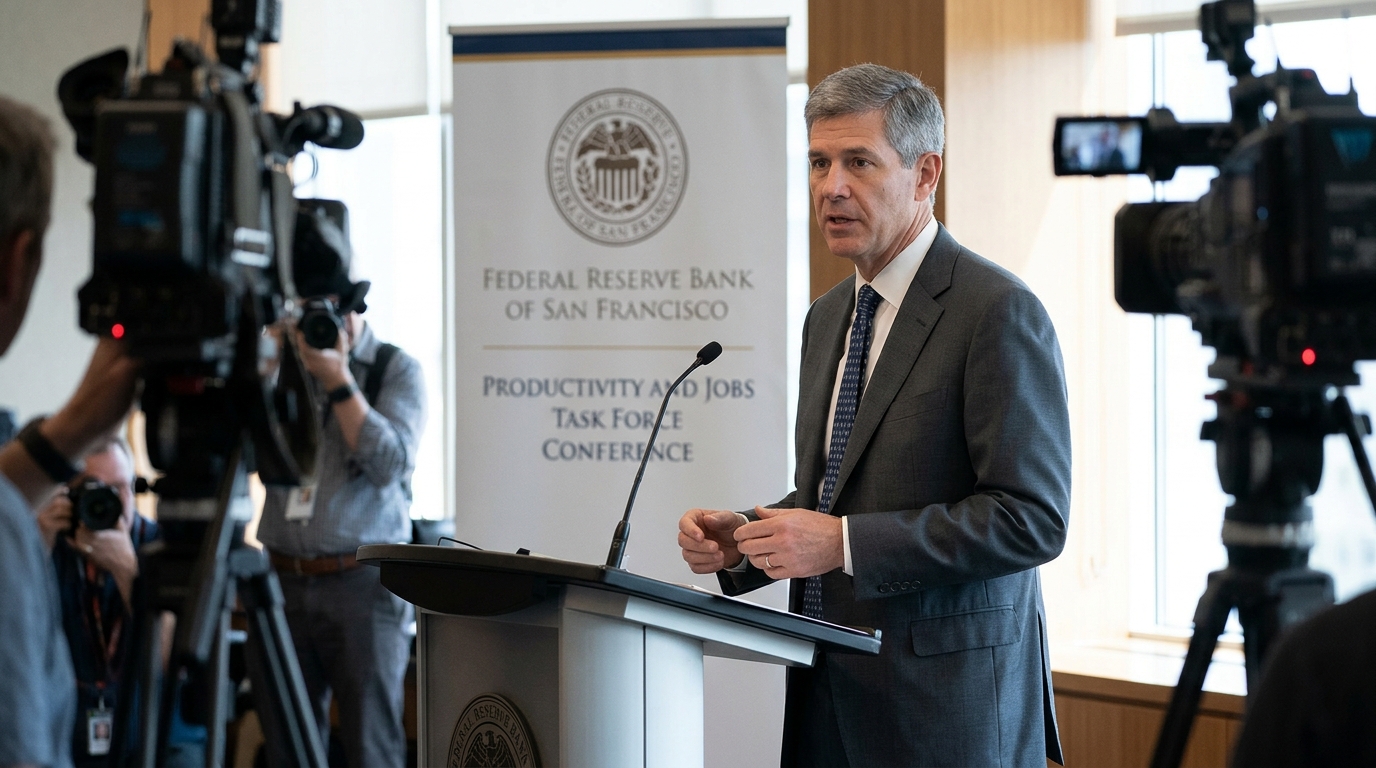
Fed Chair Kevin Warsh gives opening remarks at the Fed’s Productivity and Jobs Task Force Conference at 17:00 GMT (12:00 p.m. ET) on Monday. The conference, held at the San Francisco Fed, looks at whether AI will lower inflation, raise prices, or displace workers. On paper, it is a research forum. In practice, it is the last Chair-level word before two data landmines land this week.
October retail sales arrive Tuesday at 8:30 a.m. ET, followed by the FOMC minutes from the October 27–28 meeting on Wednesday at 2:00 p.m. ET. Since the minutes cover the meeting held before the hotter inflation data, they will provide a detailed look at how much additional tightening policymakers wanted. That framing matters. The minutes will lean hawkish almost by definition. The only open question is by how much.
Why It Happened
The inflation data left little room for doubt. The Producer Price Index rose 0.3% month-over-month in October, with a 6.5% year-over-year increase, the highest since November 2022. That followed a hot CPI reading earlier in the same week.
Schmid, Collins, and Jefferson have all put inflation first in recent remarks. Governor Christopher Waller thrust the possibility of a December hike into the spotlight, arguing that a larger-than-quarter-point move should be on the table if inflation remains hotter than expected. The committee’s hawkish lean is not new. What is new is how completely the market has absorbed it.
The 10-year Treasury yield held at 5.14% on November 16. The yield stood at 4.86% on November 6 and was just under 5.00% on November 11. That is roughly a 28-basis-point move in ten sessions, one of the more compressed episodes in recent years, and it has not finished working through risk assets.
How Professionals Might View It
The S&P 500 dipped 0.4% to 7,562 on Friday, and US equity futures retreated further into the European open, led by a roughly 0.9% drop in Nasdaq 100 contracts. The index sits at a level that has not priced in the possibility of a second consecutive hike early in 2027. The debate is shifting to how big a December move might be and how much further the central bank may need to tighten into 2027.
That repricing has already forced at least one major bank to abandon its easing timeline entirely. Citi’s shift of its first Fed cut forecast to mid-2027 shows how crowded the wrong side of the rate bet became.
Disciplined traders will watch Warsh’s tone carefully for one specific thing: does he validate the AI-productivity thesis as a reason inflation could ease on its own, or does he treat the conference as academic and keep the hawkish posture intact? A chair who leans on AI as a future disinflationary force gives equity bulls a reason to hold. One who ignores the angle and stays on current data tightens the vise. His opening remarks, listed on the Fed calendar simply as “Opening Remarks,” carry outsized weight precisely because he has been careful not to pre-judge meetings.
What Comes Next
October retail sales arrive Tuesday at 8:30 a.m. ET, expected flat at 0.0% after a 0.8% gain in September, with sales excluding autos expected up 0.4%. A gain of 0.5% or more would feed the case for a half-point Fed hike. That scenario currently sits at roughly 10% in market pricing. It would not take much to move that number, and equities have no buffer built in for it.
Wednesday’s FOMC minutes will show how close the October majority came to joining the two dissenters. The Fed held at 3.75%–4.00% by a 10–2 vote, with Cook and Hammack wanting a hike. If three or four others were close to joining them, that changes the December calculus considerably.
The minutes will also land into a bond market that is already under structural pressure beyond rate expectations. Foreign demand at recent Treasury auctions has weakened in ways that compound the yield move independent of Fed guidance.
The Trader’s Lesson
When a central bank chair speaks at an event that is not explicitly about monetary policy, the temptation is to discount the remarks as ceremonial. That is a costly assumption at a moment like this one. Warsh is an experienced communicator who knows exactly what a 5.14% 10-year and near-certain December hike imply for his audience. Any deviation from his recent tone, in either direction, moves markets. The lesson is simpler than it sounds: know the full calendar before you hold a position through a Fed Chair appearance, and understand that silence on a live debate is itself a signal.