
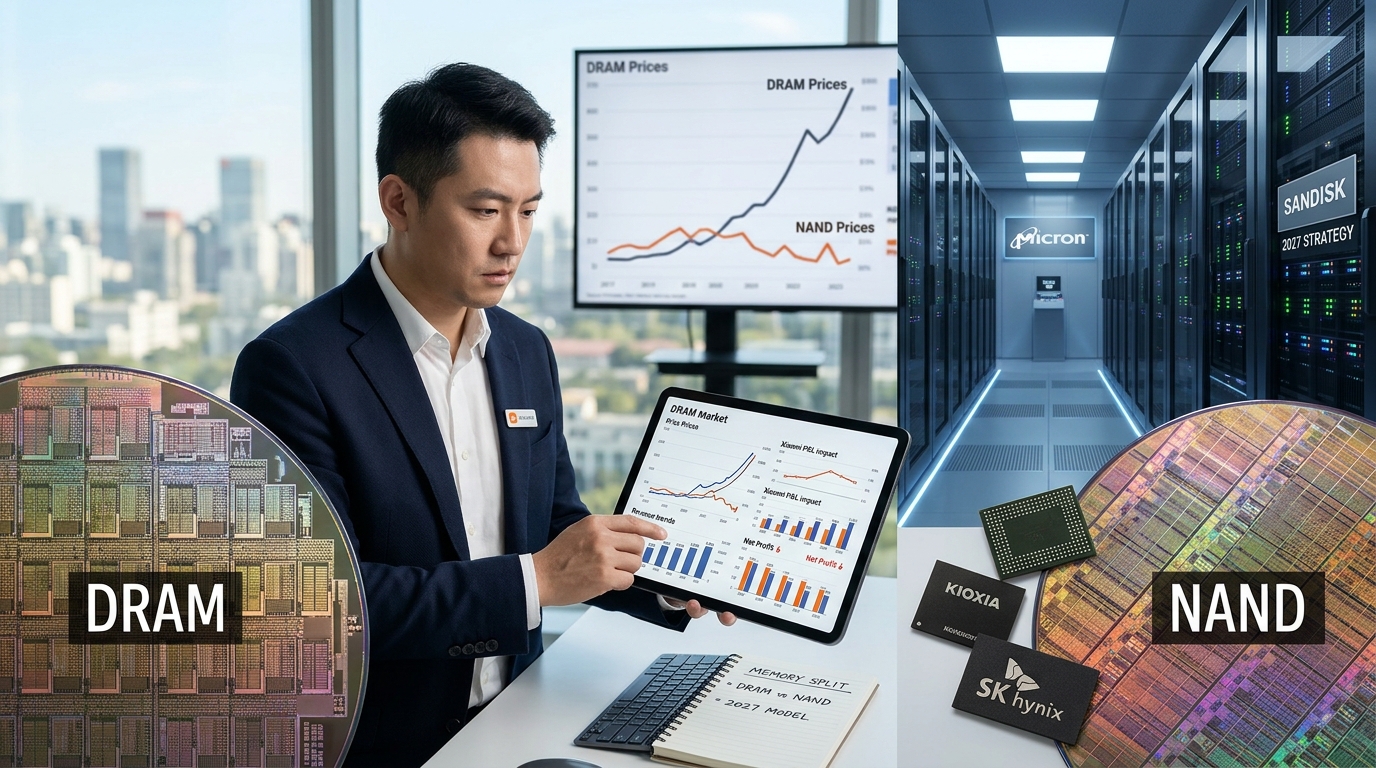
Xiaomi just delivered the clearest P&L evidence yet that the memory market is not one market. Net profit dropped 68.4% to 3.9 billion yuan in the third quarter, with gross margin slipping to 20.2% from 22.9% a year earlier. Management said its smartphone business faced pressure from key component costs, including memory, continuing to rise. Company president Lu Weibing told analysts on the call that memory prices would likely stay elevated into the second quarter of 2027.
The same week, HP guided fiscal 2027 earnings to $3.15 to $3.45 per share and told its own analysts something subtly different. Management expects memory and storage costs to continue rising in FY27, but at a slower rate, with smaller increases in CPU costs, and says all required component supplies have been secured. HP noted that memory and storage represented 15 to 18% of its bill of materials at the start of fiscal 2026 and that by Q4 it had risen to roughly 40%. Both companies see costs rising. What separates them is that HP, with long-term supply agreements locked, is absorbing a known number. Xiaomi, buying on shorter cycles in a smartphone market, is not.
Meanwhile the spot market for NAND is sending a signal that neither earnings call fully addressed. Bank of America flagged that NAND spot prices have fallen about 20% since mid-to-late October 2026, with 512Gb wafers down 32% on the quarter to $14.30. TrendForce said spot and contract prices are now more than 20% apart, with the 512Gb TLC wafer averaging $14.238 in its latest reading, down about 24% from $18.833 on October 5. Bank of America and TrendForce have also pointed to a softer Q1 2027 setup for NAND contract pricing, tied to inventory clearing and demand conditions.
DRAM is not following. Bank of America has still been pointing to rising DRAM pricing into early 2027, and TrendForce has also been expecting DRAM contract prices to keep rising, with smaller increases each quarter. DRAM contract prices are still rising, with HBM production consuming meaningfully more wafer resources, and new DRAM capacity from Samsung and SK Hynix is generally expected to take years to arrive at scale.
This divergence is the crux of what institutional analysts are now rewriting around. The memory sector has effectively split into two businesses with opposite 2027 trajectories, and stock positioning has started to reflect that.
Stocks to Watch
Micron (MU). Micron’s own reporting has recently shown DRAM as roughly three-quarters of its revenue mix, and management said on its September call that more than 75% of its 2027 output is already committed. NAND exposure is real but secondary.
SanDisk (SNDK). SanDisk is essentially a pure NAND player and could get hit hard if flash prices turn. Several sell-side and industry forecasts have been revising Q1 2027 expectations toward flat-to-down NAND pricing versus earlier calls for further increases. SanDisk’s valuation may already reflect substantial NAND price normalization, but a deeper correction or higher manufacturing costs could still impair cash flow, even if longer-term agreements offer some downside protection.
HP (HPQ). The company’s supply-locked posture gives it a defensible 2027 earnings floor, but Q4 Personal Systems operating margin already dropped 2.8 points to 3.0%, with total units down 29% as memory and storage costs rose. The question for 2027 is whether the slower pace of cost increases is enough to rebuild that margin.
Samsung Electronics and SK Hynix. Both are on both sides of the split, supplying DRAM into a tight market and NAND into a softening one. DRAM and high-bandwidth memory exposure should help insulate results versus a pure NAND player, but neither escapes the NAND overhang entirely.