
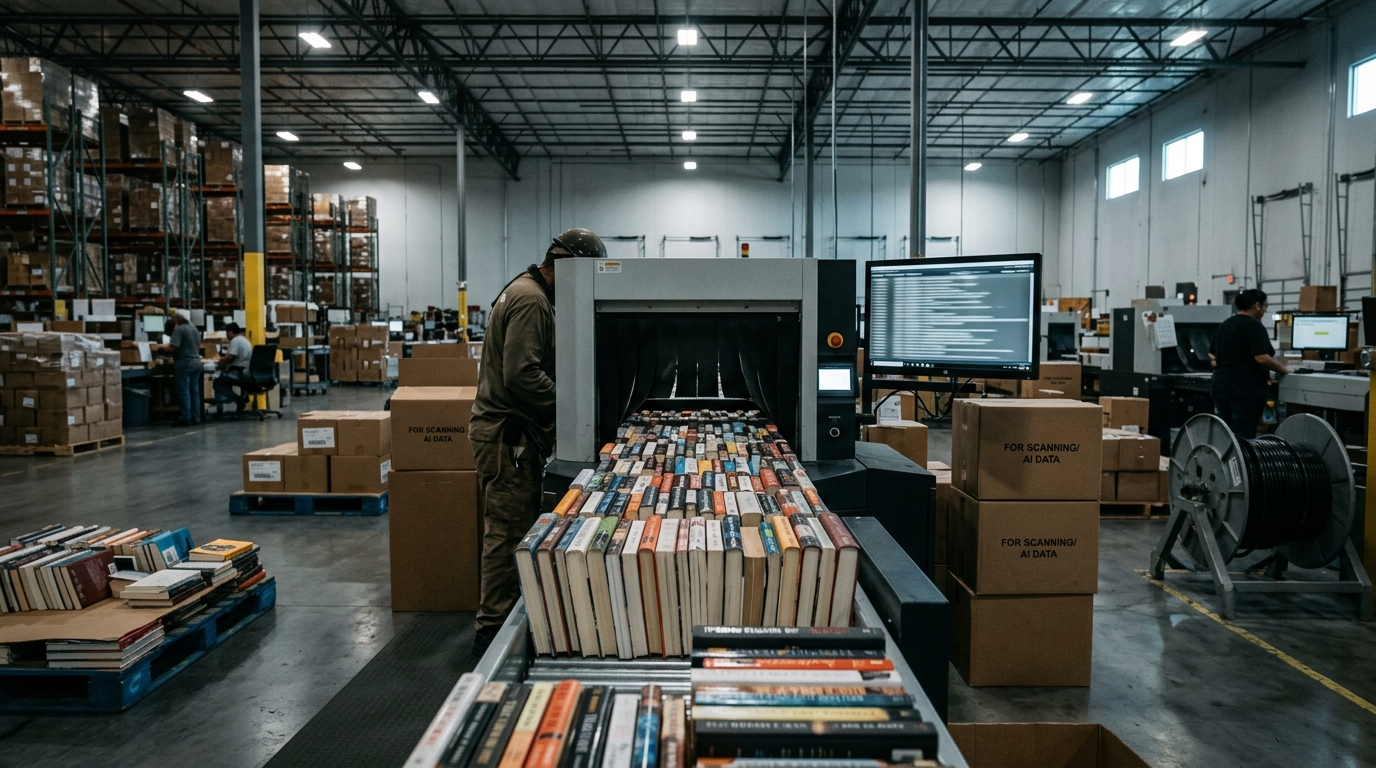
A 404 Media investigation published on August 17, 2026, confirmed something the rare book trade had suspected for months. Amazon is buying large quantities of books, cutting off their spines, and scanning them for AI-related purposes, according to 404 Media, which placed a tracking device in a rare book that ultimately arrived at an Amazon facility in Las Vegas. The method is blunt by design. Workers at the warehouse told 404 Media that their day-to-day duties consist of taking bulk shipments of books, slicing their bindings off to run pages through high-speed scanners, and discarding the destroyed remnants.
Amazon is not embarrassed about the commercial logic. Amazon told 404 Media in a statement that it “purchases books through commercial channels to improve the products and services customers use.” That is the whole story from their end. From an investor’s end, it is something more complicated.
Why This Stock Now
The book destruction story is not primarily a cultural scandal. It is a data economics story, and it lands at a moment when Amazon’s entire AI model strategy is in flux. Reuters reported on July 28, 2026 that Amazon has begun deprecating most of its flagship Nova models and reorganizing its AI teams around a single frontier-model effort, citing a Business Insider report based on people familiar with the matter. That frontier effort is led by researcher Pieter Abbeel, a UC Berkeley professor who joined Amazon after its acquisition of AI robotics startup Covariant. Reporting described the frontier work as a top priority inside Amazon this year, with a new flagship model expected to be unveiled at re:Invent later in 2026.
Building a frontier model from scratch requires training data. And the supply side of that market has a structural problem that the Las Vegas warehouse makes visible.
The Business
The practice highlights a growing push among tech giants to find high-quality text for machine learning datasets. As the open internet becomes saturated with low-quality, AI-generated content, older physical media has become more valuable as a source of human-written text. Older books can offer cleaner prose and niche information that may be harder to reliably source from the modern web.
The technical reason matters. Text published before the modern generative AI boom is less likely to have been authored by a large language model. Researchers have also warned that heavy reliance on AI-generated text in training can degrade model performance, a concern often described as “model collapse.” Even so, 404 Media did not establish that Amazon is scanning books specifically to train its Nova models, and Amazon did not publicly detail which internal systems would use the digitized material.
The scale of the sourcing operation is where the story shifts from anecdote to industry signal. 404 Media reported that booksellers saw unusual demand accelerate in 2026, and that ISBNdb had advertised a concept to help AI companies source large bulk purchases of printed books, including order sizes ranging from 1,000 to 1 million. Since that coverage, ISBNdb has said the service was never launched and that it has never purchased, scanned, or sold books for AI training, describing the webpages as an exploratory concept rather than an active business. Separately, 404 Media reported that workers at the Amazon site appear to be scanning ISBN barcodes as part of processing, which has fueled speculation among booksellers that buyers are working from ISBN-based lists.
Why Wall Street Is Paying Attention
Amazon’s AI spending dwarfs the book budget. In Amazon’s February 2026 earnings materials, Chief Executive Andy Jassy said: “We expect to invest about $200 billion in capital expenditures across Amazon in 2026.” Against that backdrop, buying rare books is a rounding error in cost. The signal is about quality, not quantity.
The pattern Amazon is now exposed following is one Anthropic carved out in court, at least in part. In the Bartz v. Anthropic litigation, a federal judge ruled that Anthropic’s digitization of lawfully purchased print books into internal digital library copies, followed by discarding the paper originals, qualified as fair use under the circumstances described in that case. But the same litigation also turned on separate questions around Anthropic’s alleged use of pirated shadow-library copies, and the ruling was not a blanket endorsement of every way a company might acquire or use copyrighted books.
The broader industry motion is accelerating. Reporting over the last year has described “destructive scanning” as a practice used to create digitized text at scale for AI development. At the same time, ongoing lawsuits involving multiple AI companies continue to test what kinds of acquisition, copying, and training uses will be treated as permissible under copyright law.
What’s Driving the Opportunity
The investment case is not about the books. It is about what the books represent: Amazon’s race to acquire proprietary training material that could differentiate its frontier model from every competitor also scouring the same depleted internet.
Amazon’s AI strategy overhaul compounds this. Reuters’ July 28 report said Amazon is moving away from many specialized in-house models and toward a single frontier-model push intended to compete at the top of the market. A better-trained foundation model built on cleaner, human-authored text could matter in that competition. Pre-2022 books are not a sentimental choice; they are a data provenance argument that some labs are beginning to treat as a potential competitive moat. Even so, claims about pristine “chain of custody” and receipt-based provenance as a defensible legal moat should be treated carefully: the legality still depends on how data is acquired, what is copied, and how it is used.
Amazon’s cloud business provides the financial runway to absorb the cost and the legal exposure. AWS is the engine that funds the model ambitions, and if re:Invent delivers a credible frontier model later in 2026, the data strategy behind it becomes a retroactive asset rather than a liability.
What Could Go Wrong
The legal shelter is thinner than it looks. The Anthropic ruling addressed digitization of print copies that were purchased. Rare books, with only a handful of surviving copies in existence, present a different moral and potentially legal argument. Booksellers have expressed concern that uncommon editions with limited surviving copies are being removed from circulation permanently. A legislative response, a narrower reading of fair use, or adverse rulings in related cases could expose Amazon to liability it currently believes is managed.
The reputational risk is also real, and ISBNdb acknowledged the optics in its marketing language before it removed the page, including the line: “AI company destroys two million books” is not a headline that generates sympathy. Amazon is not an abstract AI lab. It sells books. It started as a bookstore. The symbolic tension is difficult for any communications team to neutralize, and it could become a regulatory lever for legislators already skeptical of Big Tech’s AI practices.
There is also the model quality question. Buying books by ISBN, indiscriminate of subject or quality, is not a curated data strategy. Reporting around the broader buying wave has suggested purchasers were often focused on ISBN-identified inventory without obvious thematic selection. Bulk acquisition of everything is not the same as targeted acquisition of the best. If Amazon’s frontier model underperforms at re:Invent despite the data spend, the book strategy becomes a liability story rather than an asset story.
The Bottom Line
The Las Vegas warehouse is a symptom, not a cause. The cause is a structural data scarcity problem across the entire AI industry, and Amazon is responding in a way that looks similar to what court filings showed at Anthropic. The question for investors is whether this data advantage, combined with a $200 billion capex commitment and a refocused frontier model effort, is enough to close the gap on OpenAI and Google before re:Invent arrives.
The draft’s claim about AMZN being down about 1.6% “today” cannot be verified from the reporting that established the book-scanning story, and market moves also depend on the broader tape. The more durable takeaway is that the immediate price reaction, whatever it was on August 17, 2026, is unlikely to capture the longer-run implications of Amazon’s data strategy. The investment case for AMZN has never rested on its AI models alone, but if the frontier model launches with a credible data-quality argument behind it, today’s headlines may look like noise in hindsight.