
October 7, 2026
Bonus Content: Medical Drone Corridors Are Now Real. Couriers May Not Return.
If you have $25,000 or more in the bank or a retirement account, read this now!
Dedollarize News
October 26: Four Systems. One Deadline.
Click Here to See Why October 26 Matters
Who gets a say in the financial systems handling YOUR money?
On October 26, 2026, public-comment windows close on four federal information collections covering bank deposits, financial customer-data security, securities-market activity and institutional trade settlement.
Four proceedings. One deadline.
Before that deadline, watch what former Goldman Sachs president Gary Cohn said at the public FDIC meeting on November 9, 2022:
“I almost think you’d scare the public if you put this out.”
They were discussing how to explain the resolution of major financial institutions while maintaining public confidence.
The meeting was public. The words are in the transcript.
6,714 matching bank-branch closing records since the day he said it.
That is the result reported in our FDIC BankFind search from November 9, 2022 through September 30, 2026, using data labeled September 29, 2026. These are branch-closing records, not failed banks.
Watch Gary Cohn’s Words and See the Live Branch-Closing Counter.
And when the FDIC recently invited comments on renewing its branch-deposit survey, it received ZERO.
America’s financial infrastructure is changing in plain sight. How closely are you watching?
Watch the exchange, follow the live branch-closing counter and read about the four proceedings before their comment windows close.
Click Here to Watch Before October 26.
Bill Brocius
Author of The Vanishing Dollar and Digital Dollar Exposed
Dedollarize News
Medical Drone Corridors Are Now Real. Couriers May Not Return.
Two events this week clarified something that has been easy to dismiss as perpetual pilot-program theater: FAA-approved medical drone corridors are now operational, and the economics for traditional last-mile couriers are deteriorating faster than most traders following this space have priced in.
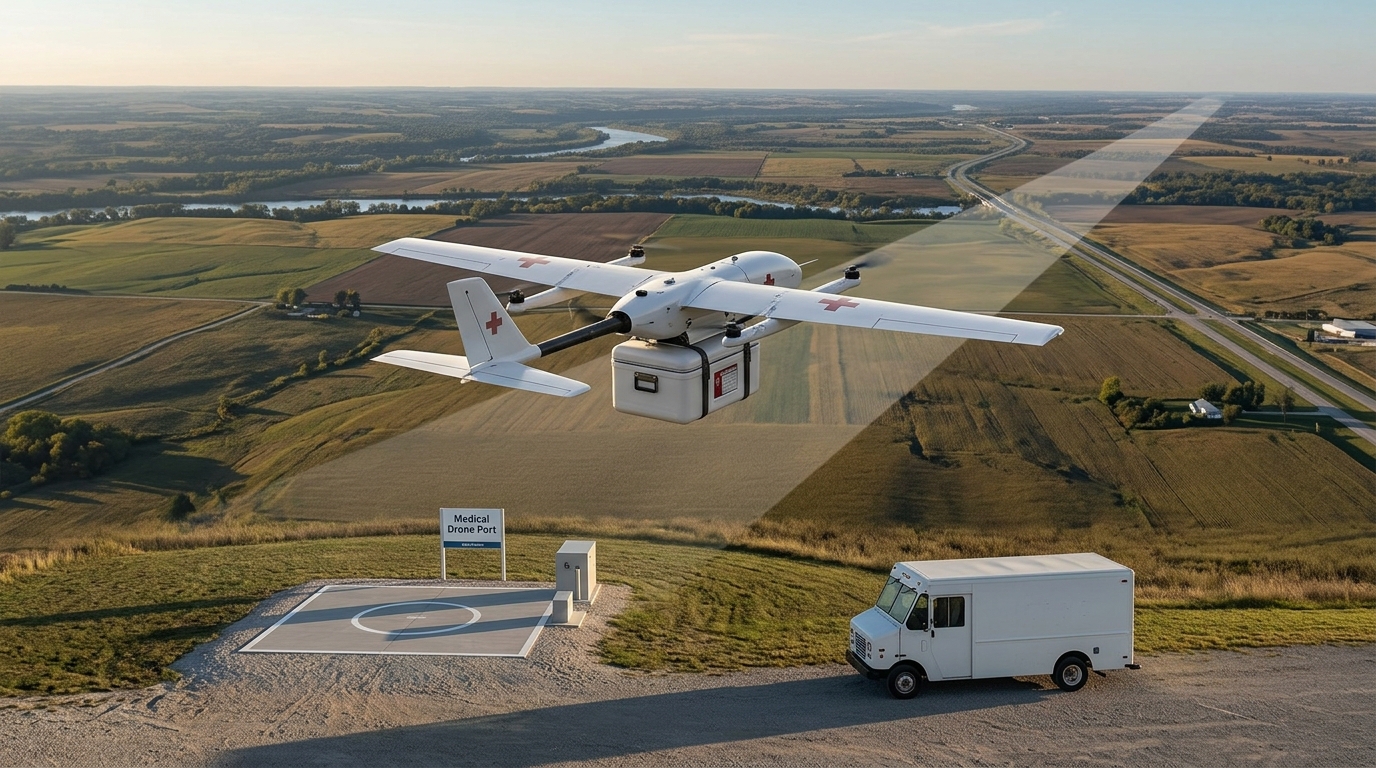
Mid-America Transplant became the first organ procurement organization in the United States to use drones for donor blood sample transport when it opened a dedicated healthcare drone corridor in Missouri on April 1, 2026. The route is not a short hop. The corridor spans approximately 160 miles across three locations, with blood samples loading near Springfield, flying 94 miles to Rolla for a battery swap, then completing the remaining 66 miles to a St. Louis-area drop point for laboratory testing. The speed and cost data are the part that matters for anyone watching logistics incumbents: ground transport from Springfield previously took more than three hours, while the drone completes the route in under two hours and at about one-tenth the cost.
That cost ratio is the structural threat. Traditional medical couriers compete on reliability and compliance, not speed. When a drone corridor offers both at about a tenth of the price, the business case for ground-based last-mile medical logistics narrows to edge cases.
Meanwhile, a medical drone delivery project in northern Michigan began its second phase on October 6, expanding the scope of a pilot first conducted in May 2025. Test flights are running between Munson Medical Center and Crystal Lake Health Center in the Traverse City area through October 30, simulating deliveries of medical supplies, laboratory samples, and medications. Phase one recorded a 91 percent success rate and confirmed that drones maintained payloads at an average of 17.3 degrees Celsius, well within the required range for clinical laboratory specimens.
The regulatory arc is tightening. Upstate University Hospital received an FAA Certificate of Waiver allowing BVLOS operations across a corridor connecting several facilities from its Downtown Campus to Utica, a span of approximately 50 miles. Under that approval, Upstate is authorized to conduct BVLOS drone operations over people, over moving vehicles, and during nighttime hours. At scale, Advocate Health’s partnership with Zipline is expected to handle more than 100,000 deliveries annually across Charlotte, Chicago, and Milwaukee, with the first flights slated to begin in 2027 after required regulatory processes.
The trader’s lesson here is about sequencing. Markets tend to price disruption either too early, when it is still conceptual, or too late, after incumbents have already lost margin. Medical drone corridors crossed from concept to operational approval in 2026. The next step is volume. Watch that inflection, not the headline approvals you have already seen.