
When a presidential promise changes nothing about actual guidance, traders need to know the difference.
There is a moment every active trader recognizes: a headline that sounds bullish, a quick spike at the open, and then a slow bleed back toward unchanged. Wednesday gave Nvidia that exact session, and the lesson embedded in it matters more than the price move itself.
While President Trump was in Shenzhen for the APEC summit, the broader messaging out of Washington has been that U.S. export controls will keep the most advanced AI chips out of China. Earlier reporting has noted that the Trump administration greenlighted exports of Nvidia’s H200 chips to China this year, but Blackwell remains restricted.
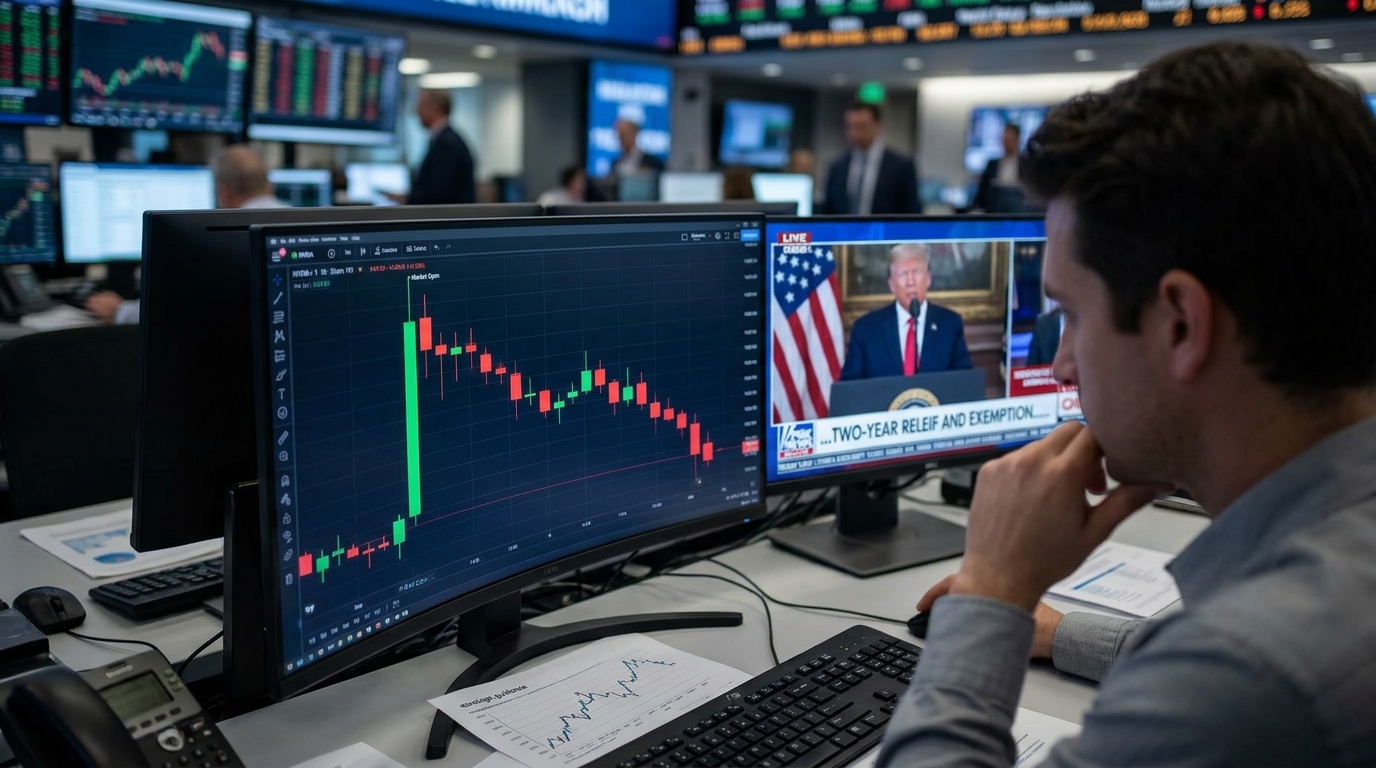
Markets traded the ambiguity anyway, with NVDA gapping higher at the open to $159.70. The stock closed at $150.96, with a session range of $150.40 to $159.70. The gap filled. The enthusiasm faded.
What actually changed? Very little. A forward-looking comment is conditional. It is also not Nvidia guidance. It is not a purchase order.
Meanwhile, the actual policy direction is running the other way. The annual defense policy bill, the National Defense Authorization Act, is still expected to be a key focus in December, and major coverage has described AI-chip provisions in the Senate version that would tighten oversight of licenses and expand tracking and allied coordination. And Nvidia’s leadership crisis remains a real-world overhang. The Associated Press reported this week that Nvidia rejected Jensen Huang’s offer to return as CEO, and that Huang has been summoned by three House committees for a closed-door interview on December 1.
That is the asymmetry traders missed this morning. The legislative calendar is concrete and moving toward December.
This is a recurring pattern in semiconductor stocks. Presidential comments on trade flow move prices intraday because they are unexpected and emotionally resonant. But experienced traders ask a harder question immediately: does this change what the company will ship and bill in the next four quarters? In this case, the answer is still no. Blackwell remains restricted. And if Congress turns more of the export-control framework into statute, it becomes harder for any future administration to unwind quickly.
The trader’s lesson: A politician’s future-tense promise is not a catalyst. It is noise with a time stamp. When a headline moves a stock sharply at the open but cannot point to a change in earnings visibility, the correct instinct is to wait, not to chase. The market told you that today in real time: NVDA opened at $159.19, hit $159.70, and spent the rest of the session giving it back. The close was the honest verdict.