
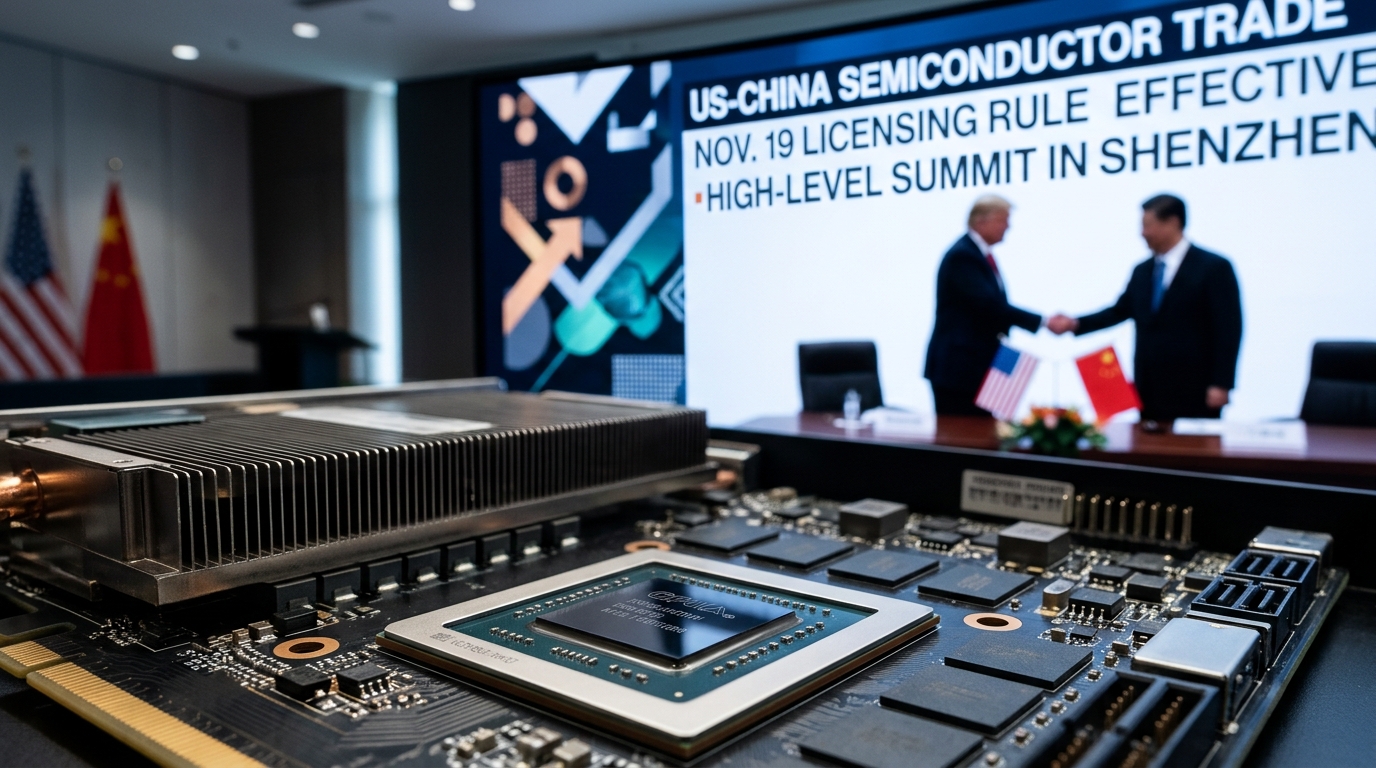
Two dates are on the sheet today. The US Commerce Department’s remote-access compute rule is scheduled to publish in the Federal Register on Thursday, November 19, and take effect upon publication. Hours later, President Trump sits down with Xi Jinping in Shenzhen for a bilateral meeting and working lunch at the APEC summit. Beijing has already told Washington what happens if the rule proceeds.
Market Snapshot
When the rule surfaced Monday, 19 of the largest US-listed technology stocks shed roughly $960 billion in combined market value. Nvidia closed 4.1% lower that session. AMD fell 5.6% and Broadcom 3.9%. Stocks partially recovered Tuesday but the retaliation threat, issued overnight, resets the risk calculation entering Wednesday’s open.
Stocks in Focus
- NVDA: Under the interim final rule, a data center anywhere in the world needs a US license for advanced American chips if it provides more than 12,000,000 in aggregate total processing performance to companies headquartered in China or Macau. Nvidia has also stopped shipping Hopper chips to China. China (including Hong Kong) accounted for about 9.1% of Nvidia’s revenue in fiscal 2026, but the licensing friction in Southeast Asia affects a far larger pool of data-center customers.
- AMD: The rule covers advanced US AI chips regardless of which company designs them, so there is no escape by substituting AMD for Nvidia. Singapore alone accounted for 12.4% of AMD’s 2025 revenue. Watch AMD closely: its Instinct GPUs sit squarely inside the license threshold and its valuation was already stretched heading into this week.
- ASML / AMAT: Chipmaking equipment sits outside the remote-access portion of Monday’s rule, but tighter US restrictions on advanced chips could invite Beijing’s retaliation through stronger rare earth controls, which would raise input costs for fabs that ASML and Applied Materials supply. Any summit outcome that eases tensions would benefit both names; an escalation tightens the vice.
- MP Materials (MP): China has used export controls on rare earth minerals as a lever in trade talks. Beijing could counter by reinstating its currently suspended October 2025 measures, which include controls on certain rare-earth-related technologies and equipment. MP, as the primary US rare earth producer, is the clearest domestic beneficiary if Beijing pulls that trigger.
Sector Watch
Semiconductors carry the most concentrated event risk today. The restriction has forced bankers to review or pause Asian data center deals linked to Chinese customers. That means cloud infrastructure names with Southeast Asian exposure face secondary pressure alongside the chip designers. Rare earth miners move in the opposite direction from chip stocks on any escalation signal out of Shenzhen.
Catalyst Calendar
- Nov 19, Thursday: The rule is scheduled for publication in the Federal Register on November 19, when it takes effect.
- Nov 19, Thursday: Trump holds a bilateral meeting and working lunch with Xi on November 19, then joins the first-ever Trump-Putin-Xi trilateral meeting.
- Jan 10, 2027: The suspension of broader Chinese restrictions runs through January 10, 2027. Any summit breakdown accelerates that deadline.
- 90-day window: Data centers already serving Chinese firms must obtain a license within 90 days of the rule taking effect or face future export restrictions.
Risk Radar
China’s commerce ministry firmly opposes the new rule and will take countermeasures if the US insists on imposing it. The specific form those countermeasures take is unresolved. China has adopted a law restricting purchases from suppliers it deems unreliable, used rare earth export controls as a lever in trade talks, and announced antitrust investigations into US technology companies. Any one of those levers, deployed during or after the summit, would hit different corners of the market. Rare earths pressure materials and defense supply chains; antitrust investigations target revenues directly; an unreliable-entity designation is the most surgical and the most disruptive.
“Trump may be further inclined to make economic and security concessions to maintain a tactical thaw between the United States and China,” according to Ali Wyne at Crisis Group. Markets should not price in a resolution today.
The Cheat Sheet
- Top Theme: A new US licensing regime on rented AI compute goes live the same morning the two leaders most likely to shape its fate sit across a table in Shenzhen.
- Stock to Watch: AMD. It carries direct GPU exposure, a Singapore revenue dependency of 12.4%, and a valuation that was already under pressure before this week began.
- Sector to Watch: Semiconductors, with rare earth miners as the inverse trade if Beijing escalates.
- Biggest Risk: Beijing reinstates suspended October 2025 rare earth measures ahead of the January 10 deadline, particularly if the summit produces no de-escalation signal on chips.
- Biggest Opportunity: MP Materials on any hardening of rare earth export controls out of Beijing. The company is the clearest US-listed beneficiary of a tighter Chinese supply squeeze.
- One Thing to Remember: The rule is interim. The final version could end up tighter or looser, which means the summit conversation today is not the end of this story.