
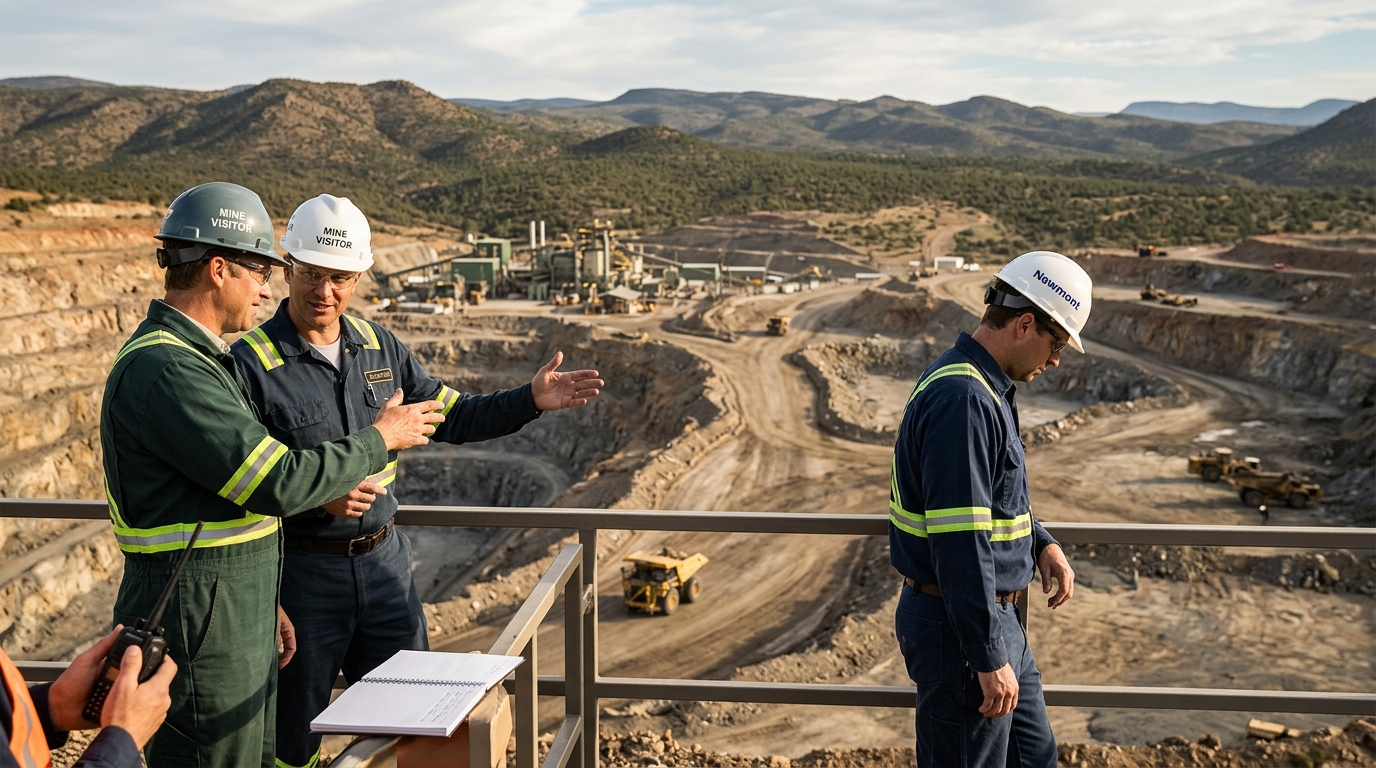
Gold miners are generating cash at a rate the sector has rarely seen. The VanEck Gold Miners ETF is up sharply over the past 52 weeks. At spot prices above $4,400 per ounce, even mediocre operators look flush. The real question for H2 2026 is not who is making money today. It is who has the cost structure, the balance sheet, and the production trajectory to compound that advantage as gold prices stabilize.
Two names pass that test. One does not.
Buy: Agnico Eagle (AEM)
The Q2 results released July 29 were as clean as any major gold producer has delivered this cycle. Agnico Eagle produced 855,816 ounces at an AISC of $1,459 per ounce, with realized gold prices averaging $4,483 per ounce, supporting record quarterly free cash flow of $1,335 million. That $3,024-per-ounce spread is not luck. It reflects a decade of deliberate asset selection in safe, low-cost jurisdictions.
Cash from operating activities hit $2,144 million, lifting the cash balance to $3,464 million and net cash to $3,267 million against total debt of just $197 million. The company returned a record $625 million to shareholders in the quarter, including a $0.45 quarterly dividend and $400 million of share repurchases.
The Barnat pit wall slide at Canadian Malartic is a real disruption. The incident is expected to reduce production at Canadian Malartic in the second half of 2026 by approximately 60,000 to 80,000 ounces and result in reduced production in both 2027 and 2028 of up to approximately 150,000 ounces of gold per year. Full-year output now tracks toward the low end of the 3.3- to 3.5-million-ounce range. That is the honest risk. What matters more is what Agnico is building around it.
Agnico approved the Hope Bay redevelopment, targeting 400,000 to 435,000 ounces of annual gold production over an initial mine life of 11 years, and acquired Central Lapland properties in Finland, consolidating a 2,492 square kilometer land package including the Ikkari project. CEO Ammar Al-Joundi said the company is beginning to look beyond the 20 to 30 percent production growth already expected over the next decade. Total capital expenditures for 2026 rose to between $2.6 billion and $2.8 billion from prior guidance of $2.2 to $2.4 billion, reflecting the approval of Hope Bay construction. That is a deliberate reinvestment at exactly the right moment in the cycle.
Agnico has declared a cash dividend every year since 1983. The balance sheet is essentially debt-free. The growth pipeline is funded from cash flow. That combination is rare in this sector.
Buy: Kinross Gold (KGC)
Kinross does not carry the brand recognition of Newmont or Barrick. That gap is narrowing fast. Q2 2026 production was 492,326 gold equivalent ounces at an AISC of $1,821 per ounce, generating margins of $3,131 per gold equivalent ounce sold. Adjusted EPS was $0.71, and free cash flow reached $726.8 million, contributing to a first-half total exceeding $1.5 billion.
The company ended the quarter with record cash of $2.7 billion and net cash of $1.9 billion, while returning over $275 million to shareholders through buybacks and dividends. The Great Bear catalyst is what separates Kinross from its mid-tier peers. The project is expected to produce about 518,000 ounces annually during its first eight years, with a life-of-mine AISC of $812 per ounce.
Ontario is moving to accelerate Great Bear by cutting permitting timelines in half under its One Project, One Process framework, a streamlined approval system aimed at reducing government review times by 50 percent. Management anticipates that Great Bear and Lobo-Marte will eventually contribute approximately 850,000 high-grade, low-cost ounces per year to the future production profile. That is a 40 percent production increase sitting in the pipeline, mostly already permitted.
The stock is up roughly 178 percent over the past year and still trades at a reasonable free cash flow multiple given the Great Bear optionality. The CEO has been explicit: Kinross does not feel a need for M&A, given its strong organic resource inventory and development projects. Discipline at the top of a cycle is undervalued.
Avoid: Newmont (NEM)
Newmont is the world’s largest gold producer. It is also shrinking, becoming more expensive to operate, and undergoing a simultaneous leadership overhaul at the worst possible moment.
Newmont produced about 1.3 million attributable gold ounces in Q2 2026. Full-year 2026 production guidance stands at approximately 5.3 million attributable gold ounces. Lower production is expected to drive higher unit costs in 2026. Newmont’s AISC is guided at $1,680 per ounce.
That cost trajectory matters. At $4,400 gold, $1,680 AISC still produces strong margins. But the direction is wrong while Agnico and Kinross are moving the other way. On June 15, Newmont announced key executive appointments effective July 1, naming a new CFO, COO, and CTO. That simultaneous transition of top operating, financial, and technical executives during a period of market volatility introduces near-term execution and integration risk.
In June, investors went from pricing in record cash flows to panicking over cooling gold prices amid falling production and rising costs. The rebound since then has been real, but the underlying issues have not been resolved.
Risks to Monitor
Gold at $4,400 is not guaranteed. A durable Fed hold, a dollar recovery, or further easing of geopolitical tension could pressure spot prices and compress the margins that are currently flattering every name in the sector. Gold mining equities have delivered strong gains but have often lagged the metal. When gold consolidates, miners absorb the multiple compression and the operating leverage simultaneously.
For Agnico, the Barnat redesign and the ramp in Hope Bay capital expenditure are real near-term variables. For Kinross, Great Bear execution risk is a multi-year story that deserves continued monitoring. Kinross plans to provide a comprehensive capital update for Great Bear in the first half of 2027, following the completion of detailed engineering to account for inflation and scope optimizations. The final number could move.
Bottom Line
The gold price is doing the heavy lifting for every miner right now. What separates the sector’s best ideas from its worst is cost structure, balance sheet cleanliness, and a production pipeline that extends the opportunity beyond today’s spot price. Agnico Eagle and Kinross both clear that bar. Newmont, despite its scale, is moving in the wrong direction on all three. In a market where production growth and cost discipline are the actual edge, size alone is not a strategy.