
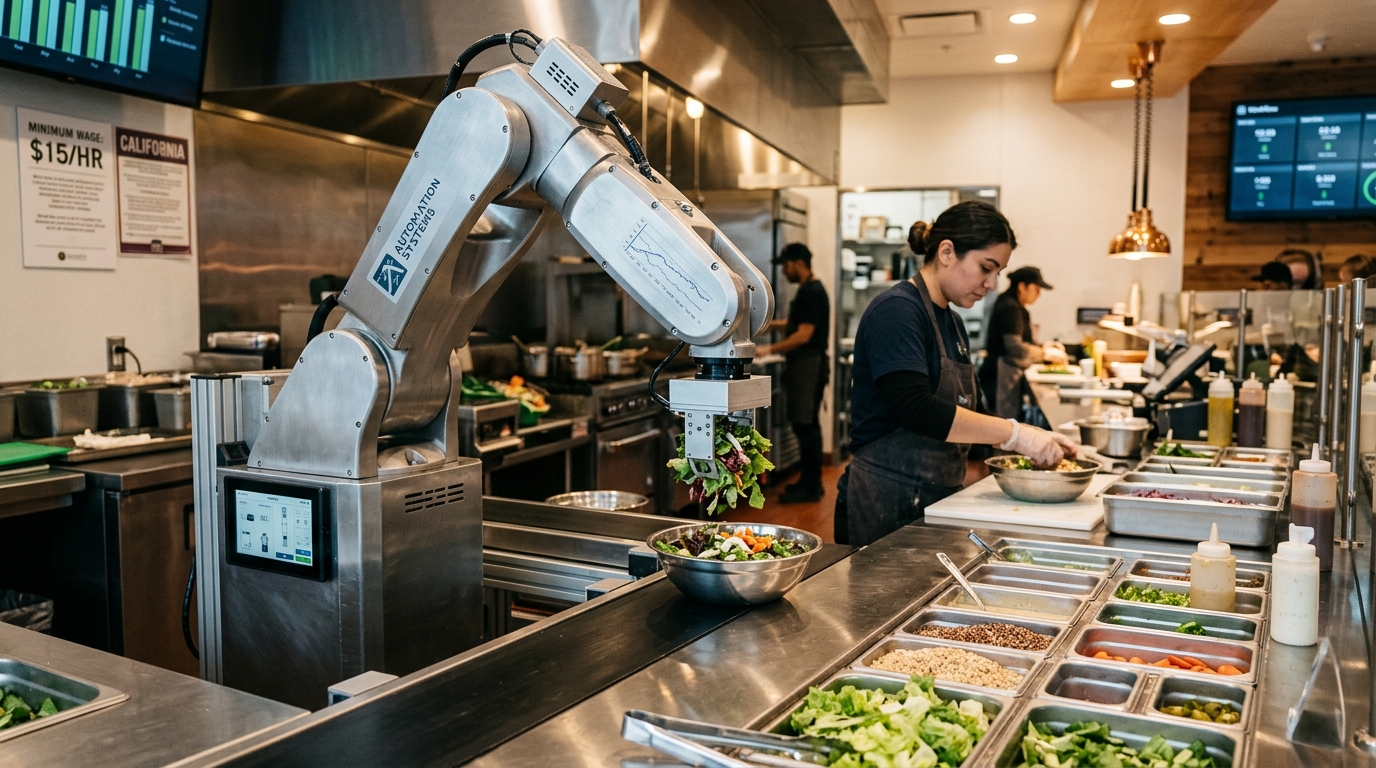
The question fast-casual chains have been asking for three years is finally getting a concrete answer. Not whether kitchen robots work, but where they work well enough to justify the capital outlay. The answer is turning out to be highly zip-code dependent, and that has direct implications for which publicly traded restaurant operators can realistically use automation as a margin defense.
The Wage Floor Is the Key Variable
A total of 19 states increased their minimums in 2026, each landing between $10 and $18 an hour. California’s statewide minimum for covered fast-food workers is $20 per hour. Under AB 1228, California’s Fast Food Council can approve annual increases, capped at the lesser of 3.5% or the change in CPI-W, and those increases cannot take effect before January 1, 2025. At that level, automation equipment that looks marginal in Alabama becomes financially obvious in Burbank.
Payback periods in high-labor-cost markets are often discussed in the 18 to 36 month range for mature deployments. In California, that window can compress, but it still depends on throughput and utilization. At low volume, many systems never pay back. The ROI is a function of volume and wage floor, not just technology quality.
Two Chains, Two Approaches
Sweetgreen offers the clearest public dataset. Its Infinite Kitchen has been described by the company as having the potential to reach 500 bowls an hour and costing $450,000 to $550,000 per unit, with an expected minimum of seven points of margin improvement. Locations running the system have delivered about 7 percentage points in labor savings and about one point of improved cost of goods sold compared to stores of similar age and volume. The Infinite Kitchen model also operates with meaningfully fewer on-site labor hours than a traditional restaurant.
The secondary benefit is proving equally valuable. Sweetgreen has said Infinite Kitchen pilot stores saw turnover run about 45% lower than comparable traditional locations. The average cost to train a new employee is about $3,034, according to TouchBistro’s 2026 American State of Restaurants Report. Multiply that by restaurant-level turnover and the math for robotics gets more compelling before a single bowl rolls off the line.
Chipotle is playing a different game. Rather than a full kitchen overhaul, it is targeting the highest-labor tasks in its prep line. Its Autocado prototype can cut, core, and peel an avocado in about 26 seconds on average, and Chipotle has said the goal is to reduce guacamole prep time by 50%. Chipotle has backed Autocado’s developer Vebu and the automated makeline company Hyphen through its $100 million Cultivate Next venture fund. Chipotle has also said it expects to use roughly 5.2 million cases of avocados, about 129.5 million pounds, in a year. Any labor-dollar impact from Autocado depends on how broadly it is deployed, how much time it reliably removes from the process in live operations, and what tasks that time is reallocated to.
Where This Leaves the Rest of the Industry
Roughly one in four operators in the limited-service segment say they plan to invest in kitchen automation and AI-driven inventory tracking in 2026. Most will run into the same constraint: capital. Robotics-as-a-service has become a common procurement model in the mid-2020s, and outright purchases are often the exception rather than the rule. That shift lowers the barrier to entry but converts a capital expense into a recurring operating cost, which carries its own margin implications.
A high-volume restaurant that ran eight full-time equivalents per shift in 2022 might run 7 to 7.5 FTE in 2026 after adding automation. That is a 6 to 10% labor reduction, not 50%. Automation is changing job mix, not just headcount.
The honest read for traders: robotics has moved from a nice-to-have to a necessity in the highest-wage markets, and the question is no longer if restaurants will adopt it but how quickly they can scale it where the unit economics work. Chains with dense California and Northeast footprints have the strongest economic case right now. Those concentrated in low-wage states are still running the same labor math they were three years ago, robots or not.