
October 3, 2026
Bonus Content: The Industrial Plumbers Holding AI Data Centers Hostage
Below is an important message from one of our highly valued sponsors. Please read it carefully as they have some special information to share with you.
Dear reader,
A few years ago, every expert swore Elon Musk would never build a car that could drive itself.
A top federal safety adviser said, “you are never getting real self-driving.”
Ford called the whole effort “vaporware.”
But they were dead wrong. Today, Tesla’s robotaxis pick up paying passengers, with no one in the driver’s seat, in cities across America.
I have ridden in one myself.
Here’s why that matters to you, today:
Elon cracked self-driving by putting eyes on the car and letting it watch and learn from countless hours of footage. And he is about to unleash the exact same playbook on his next breakthrough.
He calls it his “infinite money glitch,” and he predicts it will be the biggest product launch in history. I expect it will enter production as soon as October 21.
I have spent almost forty years investing in technology, and this is easily the biggest breakthrough I have covered yet.
I put the whole story into a short presentation. Watch it before October 21.
â¶️ Watch the presentation here.
Regards,
James Altucher
The Industrial Plumbers Holding AI Data Centers Hostage
Everyone is watching Nvidia’s shipment schedule and GPU allocation queues. The real constraint on the next wave of high-density AI data center construction may be sitting in a valve catalog from an industrial supplier most traders have never heard of.
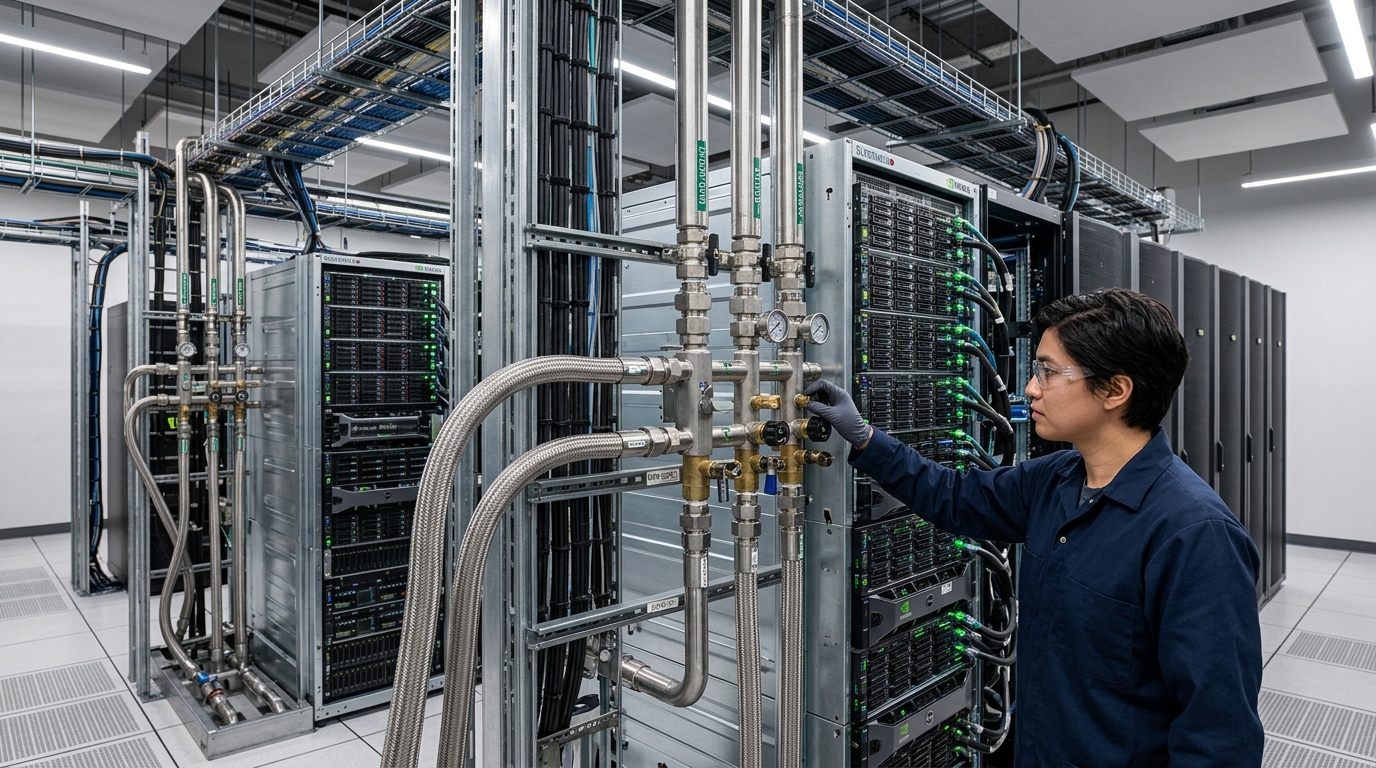
Here is why that matters. Rack power densities can now hit 80 to 120 kilowatts, a level at which air cooling stops working economically. Liquid has to run to the chip. That requires manifolds, quick-disconnect fittings, pressure-independent control valves, check valves, hose assemblies, and specialty tubing, all engineered to leak-free standards and rated for continuous uptime. The companies that make those components quietly sit between the GPU and every dollar of hyperscaler capex.
The Consolidation Wave Signals Where the Money Is
Eaton acquired Boyd’s Thermal business on March 12, 2026 for $9.5 billion. Boyd had forecast 2026 sales of $1.7 billion, of which $1.5 billion sits in liquid cooling. Eaton did not pay that multiple for the brand. It paid for the engineering depth and manufacturing capacity to move coolant precisely at chip level, at scale, globally.
Ecolab agreed to acquire CoolIT Systems in March 2026 for about $4.75 billion, and Schneider Electric signed a deal for a controlling stake in Motivair in October 2024. The pattern is clear: every major industrial infrastructure company wants a seat in the fluid path between the coolant distribution unit and the server.
The market they are rushing into is projected to grow from $0.94 billion in 2026 to $6.33 billion by 2033, a CAGR of 31.2%, according to MarketsandMarkets.
The Overlooked Names Below the Headline
The trade most discussed around liquid cooling centers on Vertiv, Eaton, and Schneider. Look one layer deeper at who supplies the flow-control hardware inside the system. Parker Hannifin, GF Industry and Infrastructure Flow Solutions, Valex, Hanley Controls, and Steel and O’Brien Manufacturing compete through fittings, tubing, valves, stainless steel assemblies, and custom engineered manifolds. These are not household names in equities. Parker is the closest to tradeable.
Parker-Hannifin is positioning itself as a key supplier to AI data centers through liquid cooling components including couplings and fluid-control valves. On its April 30, 2026 earnings release for the quarter ended March 31, 2026, Parker reported quarterly sales of about $5.5 billion. Management has said data center is still roughly 1% of sales. At $5.5 billion in quarterly revenue, 1% is about $55 million per quarter and rising.
The Trader’s Lesson
As AI clusters evolve toward higher-density direct-to-chip architectures, demand for high-precision valve systems is surging, and value per watt has experienced structural growth. Manifold and valve makers are not running at Vertiv’s valuation multiples. That gap exists because the market has not yet priced how deeply the AI data center depends on fluid infrastructure that only a handful of qualified suppliers can deliver.
When hyperscaler timelines compress further, lead times on precision flow hardware will be the number project managers call about first. Watch which industrial names start showing up on Nvidia’s and Eaton’s preferred supplier disclosures. That list is the trade.