
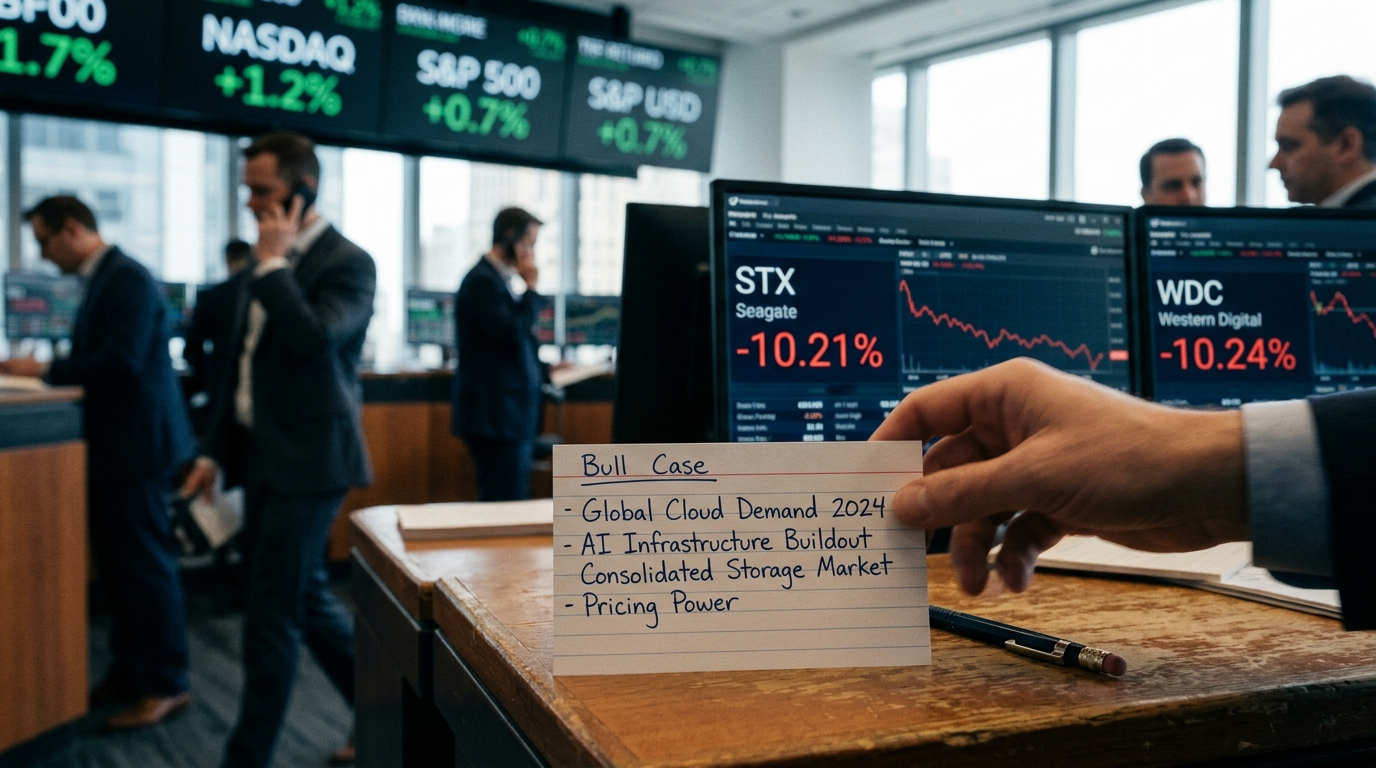
Friday was a good day to own almost anything in technology. The Nasdaq Composite gained 1.2%, the S&P 500 added 0.7%, and large-cap tech broadly held its ground. Seagate closed October 2 at $848.99, down 10.21%, while Western Digital finished at $415.31, down 10.24%. Two of the year’s best-performing stocks moved violently in the wrong direction while the market celebrated around them.
The catalyst was a single report from Nikkei Asia. Toshiba plans to spend about 60 billion yen, roughly $380 million, doubling hard-disk-drive production capacity at its plant in the Philippines by fiscal 2027. Toshiba is targeting 30% of the HDD market, measured by storage capacity, up from about 10% today. That gap between ambition and current reality matters, but the market didn’t pause long enough to calculate it.
What the Trade Actually Was
Seagate and Western Digital, along with Toshiba, are the only three companies left making hard drives at scale, and the entire bull case for owning either stock has rested on a simple idea: demand for storage is outrunning supply, pricing power sits with the sellers, and nobody new is coming to break that up. That is a clean thesis. It is also the kind of thesis that becomes dangerously crowded when the stocks have already priced in every good outcome.
Seagate shares had risen roughly 240% in 2026 prior to the decline. Western Digital shares had climbed about 170% over the same period. When a stock has tripled on a single thesis, the position sizing in that trade is enormous across the industry. The moment that thesis wobbles, the exits get narrow fast.
How Professionals Would Read Friday’s Session
Disciplined traders would separate two questions: is the thesis broken, and was the selling rational? The answer to the first is probably no. Morgan Stanley noted the supply-demand gap in hard disk drives through calendar year 2028 is expected to be wider than Toshiba’s potential capacity expansion, and also pointed out that Toshiba does not have leading-edge capacities or heat-assisted magnetic recording technology. Citi analyst Asiya Merchant said the market may be overstating the impact, noting that unlike Seagate and Western Digital, Toshiba relies on outside suppliers for key components such as media and heads, and those suppliers would also need to significantly increase production for Toshiba to double its output.
The answer to the second question is more instructive. The Roundhill Memory ETF slipped modestly on the day, while the Invesco QQQ Trust advanced, so large-cap technology stocks traded stronger overall. Damage was confined precisely to the names that shared one thesis. That is not random panic. That is a crowded trade unwinding.
Rosenblatt pointed out that hyperscalers are now negotiating long-term agreements extending into 2029-2031, and Toshiba’s expansion introduces a credible medium-term supply risk, giving customers incremental negotiating leverage. That is the part worth watching. The near-term supply picture may be fine. The longer-term pricing power argument just got more complicated.
What Comes Next
Western Digital reports earnings later in October. That becomes the first real opportunity to hear management address Toshiba’s plans directly and to see whether nearline pricing held through the quarter. Seagate said in January that its nearline capacity for 2026 was already sold out, so the near-term financial damage is likely limited. The question is what happens to contract conversations for 2027 and beyond.
Traders watching for re-entry should note that options volume in Western Digital split almost evenly between calls and puts on Friday, suggesting two-way hedging and repositioning rather than one-sided panic. That is not the signature of a market that has fully made up its mind.
The Trader’s Lesson
The most dangerous position in markets is not a bad thesis. It is a correct thesis that everyone already owns at a full valuation. When that happens, the trade stops being about whether the thesis is right and starts being about who sells first. Seagate and Western Digital were not wrong about AI storage demand. They were just priced for perfection, and perfection requires that nothing new ever shows up. Toshiba showed up. That is all it took.