
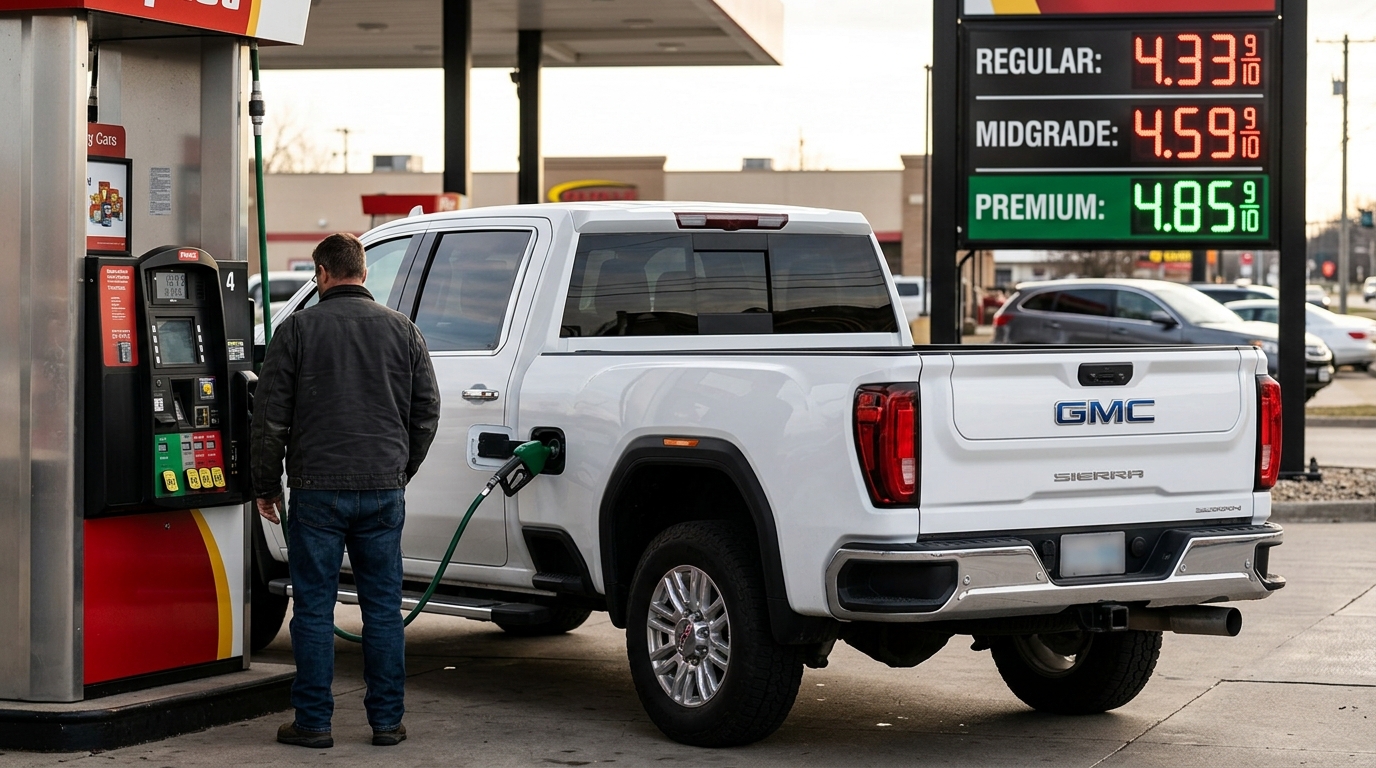
General Motors has a problem it cannot paper over with accounting: crude oil at about $101 a barrel, a national gasoline average around $4.33, and a consumer who is already voting with their feet against the company’s most profitable products.
GM releases its Q3 2026 results before the market opens on Tuesday, October 20. Estimates vary by source, but the broad consensus is roughly $3.68 to $3.69 per share on about $48.8 billion in revenue. That headline number will look familiar. It should also invite scrutiny, because the first question worth asking is how much of it is genuinely earned.
The Tariff Windfall Problem
GM booked a roughly $500 million benefit tied to the Supreme Court decision on IEEPA tariffs, a one-time gain that helped lift first-quarter results. The company did not change its free cash flow guidance in response, because CFO Paul Jacobson acknowledged at the time that the timing of actual cash receipt remained unclear: “All we’ve done here is taken the IEEPA direct tariff that we paid last year…and credited that back as a receivable,” he said. That receivable has not yet become cash. What flowed into Q1 profit was an accounting adjustment. Tuesday’s report will tell investors whether any additional IEEPA benefit has been recognized in Q3, and whether the underlying business can stand without it.
The company reported a 10.1% North American margin in Q1 2026, boosted by the tariff adjustment. By Q2, North America’s EBIT-adjusted margin was 8.6%, still credited partly to disciplined incentives and a strong product mix, with GM citing about a $52,000 transaction price and dealer inventory of roughly 511,000 vehicles. The Q3 number, arriving Tuesday, is the first without that Q1 cushion and the first that fully reflects what $100-plus crude does to buyer behavior.
What the Sales Data Already Shows
GM sold 670,974 vehicles in Q3, a 5.5% year-over-year decline, with high fuel prices expected to weigh on big trucks and SUVs. Full-size pickups were relatively flat. Flat is not collapse, but the detail underneath is worth reading carefully. EV sales fell roughly 62% to about 25,500 units, shrinking to under 4% of GM’s U.S. volume from more than 9% a year earlier. Excluding EVs, GM’s sales were essentially flat, up 0.3%.
Light-duty pickup sales rose 9.3%, led by a 13.3% jump in the Silverado light-duty, while heavy-duty models were softer, with the Silverado HD down 10.1% and Sierra HD off 6.9%. That split matters: heavy-duty trucks carry the fattest margins, and they are softening.
GM North America President Duncan Aldred acknowledged in June that demand for full-size trucks and other fuel-thirsty vehicles was softening as consumers reacted to elevated fuel prices, with the shift in buyer preferences arriving earlier than executives had anticipated. Hybrids compound the pressure: GM sells just a single hybrid nameplate, the Corvette, while gas prices remain elevated and shoppers are increasingly choosing hybrid alternatives.
Bull and Bear
The bull case rests on pricing discipline. GM has kept its incentive spend below the industry average for twelve consecutive quarters. That restraint protects margin even when volume dips. The company has also beaten Wall Street’s earnings estimates in each of the last four quarters, which argues for giving management the benefit of the doubt on execution.
The bear case is simpler: GM’s business model is a leveraged bet on large, fuel-thirsty vehicles at a moment when crude is back above $100. WTI touched $101.84 per barrel on October 16, but it was not 78% higher than a year ago. CFO Jacobson’s own prior guidance was that sustained high prices need about six months to redirect consumer choices toward smaller vehicles. That clock started running in the spring.
What to Watch Tuesday
Three numbers will tell the real story: North American EBIT-adjusted margin excluding any further IEEPA recognition, full-size truck average transaction prices, and whether management narrows or widens its full-year EBIT guidance range of $13.5 billion to $15.5 billion. Jacobson said after Q2 that “margins have returned to our 8% to 10% target range” driven by trucks and SUVs with disciplined pricing. Whether that holds at $101 crude, with heavy-duty demand easing, is the only question that matters Tuesday morning.