
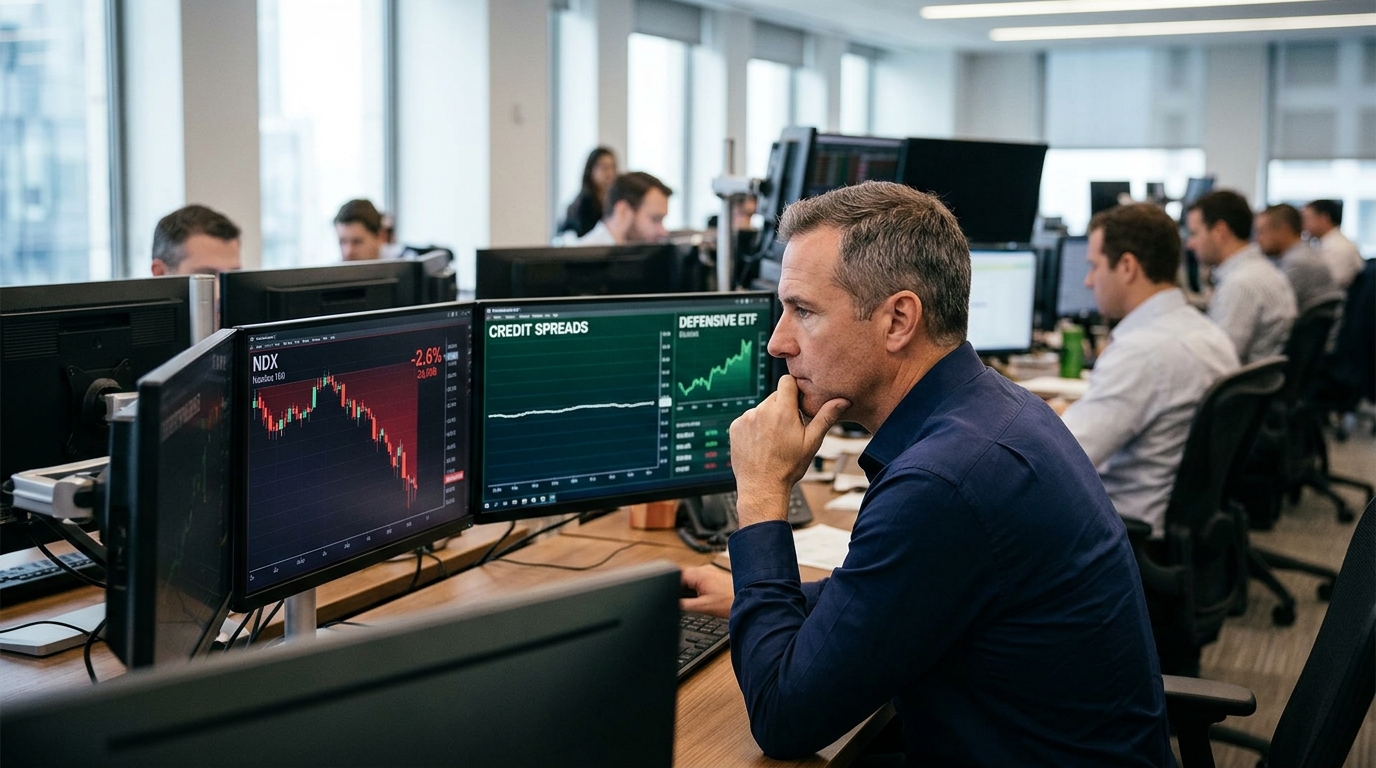
Thursday’s close looked ugly on the surface. The Nasdaq fell 2.60% to 26,008.86, its worst session since June. The S&P 500 dropped 1.21%, its worst day since July. Meta sank nearly 7%. Lam Research fell almost 12%. AMD, Marvell, and Intel each lost more than 8%. The Philadelphia Semiconductor Index cratered 6.72%, with all 30 members finishing in the red.
But here is what disciplined traders noticed: the equal-weight S&P 500 rose 0.73% on the same day. High-yield credit was roughly unchanged. Ten-year Treasury yields fell about 19 to 20 basis points. Those three data points, read together, tell a completely different story than the Nasdaq headline does.
What Actually Happened
Two catalysts landed simultaneously and hit the same corner of the market hard. First, Meta guided 2026 capital spending to $135 billion to $145 billion, raising the floor of its range by $5 billion from its prior outlook. Quarterly capex hit $34.91 billion, and free cash flow turned negative at minus $2.12 billion. The market’s reaction was not to the revenue beat, which was real: $64.6 billion, up 26% year over year. It was to what comes next.
Second, Lam Research’s CFO said during the earnings call that quarterly guidance “would have been a bit higher if not for some near-term supply chain constraints,” with delayed shipments pushing into March. That single phrase, buried inside a record quarter, erased tens of billions of dollars in semiconductor market value by the close.
The result: two separate but reinforcing reasons to sell AI infrastructure exposure in a single session. Nvidia fell 4.4%. AMD dropped 8.1%. Marvell fell 8.7%. Lam itself closed down 11.76%.
The semiconductor sector’s vulnerability to sentiment shocks runs deeper than any single earnings call. A single revenue clarification from a private company with no public filings shaved roughly 3.4% off the entire Philadelphia Semiconductor Index in one session.
Why Credit Not Moving Changes Everything
When genuine risk appetite collapses, credit markets say so. Spreads widen, investment-grade and high-yield bonds sell off, and capital heads for the exit across asset classes. That is not what happened Thursday. High-yield credit mostly sat still. Yields on Treasuries fell, which reflects demand for bonds, not a rush out of all risk assets.
What the data shows instead is rotation: money leaving mega-cap tech and moving into staples, utilities, and health care. The Dow Jones Industrial Average finished nearly flat. The average stock in the S&P 500 rose. This is the market’s internal structure doing exactly what it should do when one sector becomes the source of concern rather than the entire market.
Experienced traders read this distinction carefully. A session where breadth is negative and credit widens is one type of problem. A session where the Nasdaq falls 2.6% while most stocks rise is a completely different type, and it calls for a completely different response.
What Comes Next
The calendar is about to force the issue. Microsoft and Alphabet report on October 28. Amazon reports October 29. Each carries its own version of the same question the market is currently asking Meta: does the AI infrastructure spending justify its cost?
The capex-versus-returns question is not new to this earnings cycle. Alphabet’s prior quarter showed how quickly the market can punish a cash flow statement even when revenue growth is exceptional.
Alphabet heads into its report with Google Cloud having grown 82% in the second quarter. AWS and Azure growth rates will define the competitive read. If any of the three companies signal that cloud demand is softening, Thursday’s rotation could deepen quickly. If they show the spend is converting into revenue acceleration, the pressure on the semiconductor sector may ease.
Watch how the equal-weight index responds relative to QQQ on each of those evenings. The ratio between the two is telling you, in real time, whether the market is rotating or liquidating.
The Trader’s Lesson
A falling index and a falling market are not the same thing. Thursday’s session is a clean illustration of why. The Nasdaq’s 2.6% loss was real, but it was concentrated in roughly a dozen names that share one common characteristic: heavy exposure to AI infrastructure spending at a moment when the market is questioning the return on that spending. Every other sector mostly rose.
Before reacting to an index move, check breadth and credit. Those two filters will tell you whether you are looking at a sector problem or a market problem. The correct response to each is very different.