
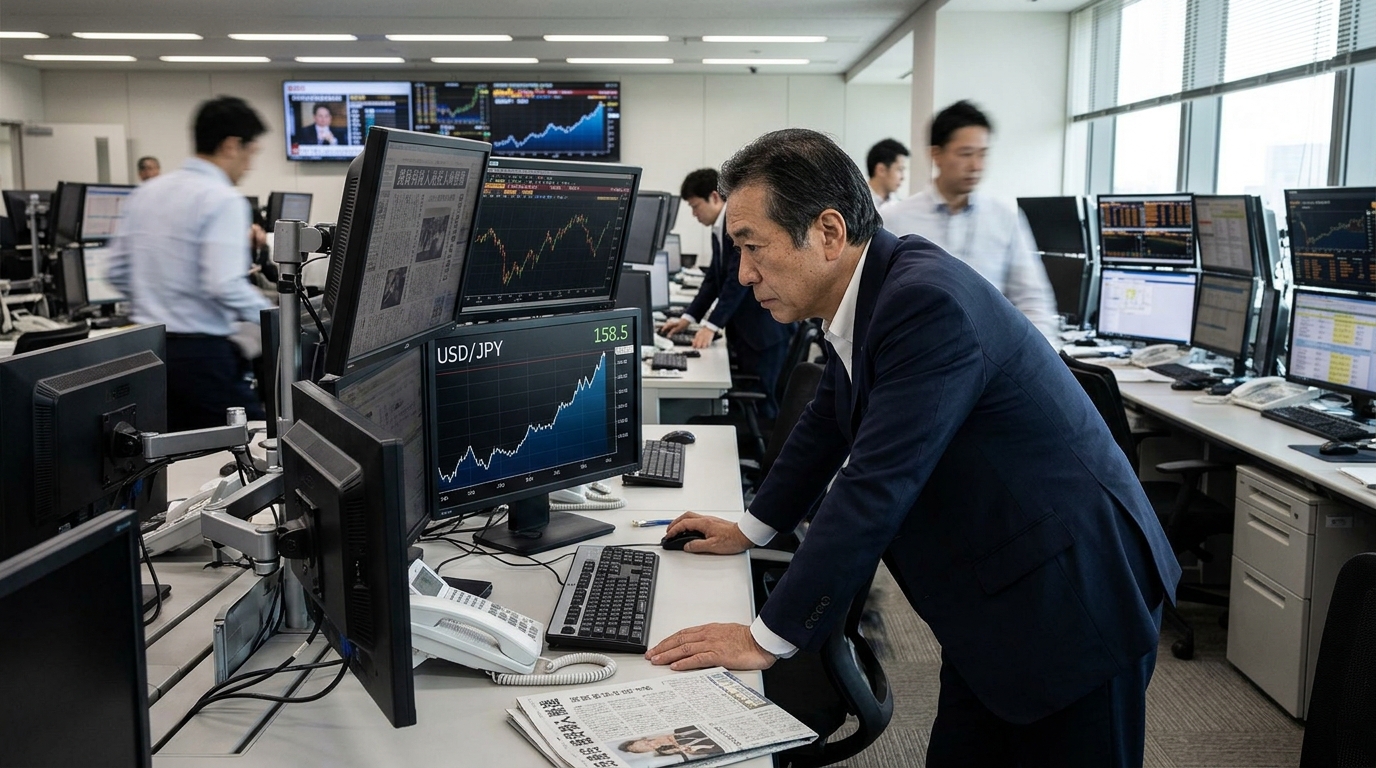
One data release undid weeks of yen recovery. Friday’s October payrolls report landed at 165,000 new jobs, well above the roughly 59,000-65,000 range many forecasters expected, and the currency market’s reaction was immediate and blunt.
Reuters reported the dollar index jumped on Friday and was on track for its biggest daily percentage gain since mid-June, rising about 0.77% to roughly 102.26, as traders adjusted Fed expectations in real time. The unemployment rate dipped to 4.1%.
USD/JPY rose to about 158.53 on November 6, up roughly 0.52% from the previous session. That is not just a round number. It is territory Tokyo has already spent real money defending.
What Tokyo Spent, and What It Bought
On the night of July 30, with USD/JPY near 164 and the yen at its weakest in roughly four decades, Japan’s Ministry of Finance began selling dollars and buying yen during New York trading. U.S. officials later described a rare coordinated intervention with Japan on July 31. Ministry of Finance data later showed Japan spent a record ¥15.39 trillion supporting the yen from July 30 through August 26, a sum that works out to roughly $96.5 billion depending on the exchange rate used.
It knocked USD/JPY from around 164 to the mid-155 area in short order. Three months later, the pair has retraced a meaningful part of that move.
The Ministry of Finance has been vocal throughout. Japan’s Finance Minister Satsuki Katayama has said the joint FX stance with the United States remains in place and that the government stands ready to counter excessive or disorderly JPY weakness. On October 15, she warned speculators she was prepared to act again if needed, stressing that the stance of Washington and Tokyo had not changed since the late-July action. The yen strengthened after that warning.
That was three weeks ago. Now the pair is back above 158.5.
How to Read the Warnings
Verbal intervention does two things: it costs nothing, and it works until it doesn’t. Japan’s officials have signaled they care about speed as much as level, and market participants tend to treat the 160 area as a line that raises the odds of more forceful rhetoric. Historically, gradual moves tend to prompt warnings, while disorderly ones are more likely to trigger actual action.
Warnings of potential intervention from Japan’s Finance Minister increase the risk of holding short-yen positions; however, uncertainty over the timing of a Bank of Japan rate hike, combined with positive US economic data and elevated expectations for tighter Fed policy, continue to support the USD/JPY spread.
The rate differential is not a static backdrop — it is actively widening as major banks reprice the Fed’s path. Citigroup pushing its first Fed cut forecast to mid-2027 shows how far the easing timeline has shifted for crowded rate-sensitive trades.
The issue for traders is that the fundamental driver of yen weakness has not changed: the US-Japan rate and yield gap remains wide. That spread is why intervention keeps fading. Japan demonstrated this in July: massive intervention produced a powerful initial move, but USD/JPY subsequently gave back a substantial part of it.
The Fed’s own posture is the other half of that spread equation. Two FOMC dissenters pushing for an immediate hike signal the Fed is not done tightening, which keeps the rate differential that drives yen weakness firmly in place.
The BOJ Factor Changes the Equation
There is one potential structural shift worth watching. A Bloomberg survey in late October found 83% of economists expected the Bank of Japan to raise its policy rate in December from 1.25%. Separately, Reuters reported BOJ former top economist Seisaku Kameda said the central bank’s policy shifted gear around June and July toward a hike roughly once every quarter, making December the most likely timing.
A BOJ move higher in December, combined with a possible Fed move of its own, would still leave a wide spread. But if the Fed signals it is done and the BOJ keeps going, the structural case for yen weakness weakens considerably. That is a December story, not today’s.
The Trader’s Lesson
The core dynamic in USD/JPY right now is a tug-of-war between bullish support from the US-Japan yield spread and upward risk constraints from Japan’s verbal intervention. Economic resilience underpins expectations of tighter Fed policy, which favors the pair; however, warnings of Japanese intervention could trigger a swift pullback at any time, making this a textbook high-risk long position.
That framing captures the lesson precisely. When a government has already spent the equivalent of roughly $96 billion defending a currency level and publicly pledged to do it again, every dollar-long position above 158 carries tail risk that the profit-and-loss statement does not capture in normal market conditions. Size positions accordingly. The Ministry of Finance does not send a calendar invite before acting.