
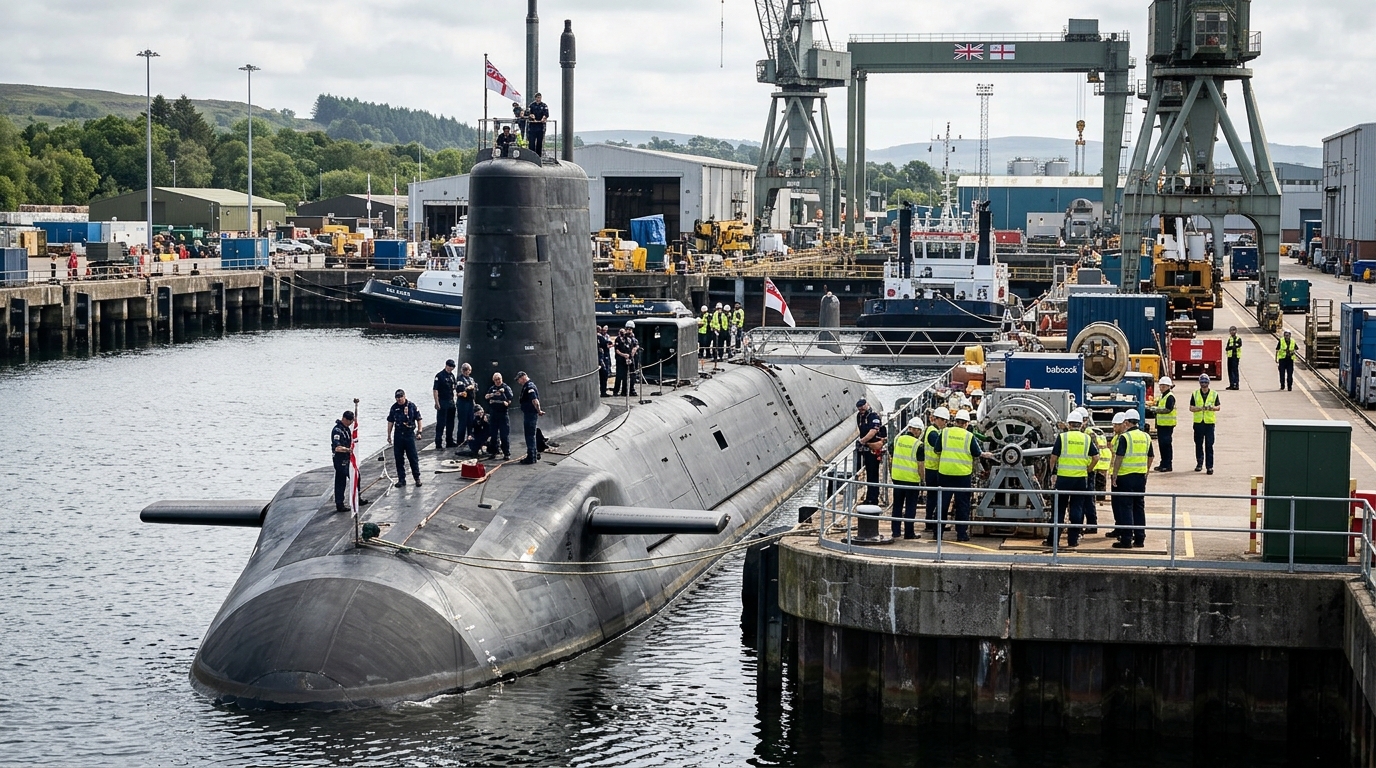
There is a category of business that elite investors find irresistible: one so deeply embedded in its customer’s critical infrastructure that displacing it would cost more than it is worth. Babcock International stepped firmly into that category this morning.
The five-year Gateway Agreement is valued at £8.7 billion and covers submarine maintenance, engineering, naval base operations and other essential support services at HMNB Devonport, Devonport Dockyard and HMNB Clyde. It is the largest contract award in Babcock’s history and takes effect on 1 December 2026. The agreement has the potential to extend to an aggregate term of up to 15 years, supported by a separate Memorandum of Understanding setting out the strategic framework for the long-term relationship between the Ministry of Defence and Babcock.
Babcock said the new contract reinforces support of the UK’s sovereign submarine programme and Continuous At Sea Deterrent, including the transition from the Vanguard class nuclear submarine to the Dreadnought class. That transition alone ensures demand does not fade when the current fleet ages out. It intensifies it.
Why This Business Is Hard to Displace
Running nuclear submarine maintenance at two of Britain’s most sensitive naval bases is not a capability a competitor builds over a weekend. The skills, security clearances, infrastructure relationships and institutional knowledge accumulated at Devonport and Clyde represent years of investment. Peel Hunt noted that the agreement primarily reflects the continuation of existing business alongside growth from higher fleet volumes and availability requirements, and views the award as strengthening Babcock’s position within the UK’s priority nuclear submarine programme while reducing risks surrounding its existing growth outlook.
Alongside major government programmes such as Project Royal Oak and the Clyde Transformation Programme, Babcock is investing in the infrastructure, skills and operational capacity needed to support the long-term growth of the UK Submarine Enterprise. Co-investing with the Ministry of Defence in base infrastructure raises switching costs further. The deeper those roots go, the less rational it becomes for any government to contemplate a change of operator mid-programme.
The Financial Picture
With around 90% of expected FY27 revenue already under contract as of 1 October 2026, management had reconfirmed its medium-term guidance of average mid-single-digit organic revenue growth. The Gateway Agreement does not change that guidance, but it does remove the single largest uncertainty hanging over it. The reason it matters is the backlog. A temporary extension left it at £8.9 billion, down from £9.9 billion a year earlier. Gateway restores a long-term contract.
Goldman Sachs started Babcock coverage last month, seeing civil nuclear as a key upside driver. The company’s ongoing share buyback programme has been active since 1 July 2026, but the totals in this paragraph can change frequently with ongoing purchases. Peel Hunt maintained its 1,409p price target, implying potential upside of around 29% from the share price quoted at the time of that note.
What Could Go Wrong
Entrenchment cuts both ways. A business this dependent on a single government customer carries real concentration risk. If UK defence budgets contract sharply, or if political priorities shift away from nuclear deterrence, Babcock has limited places to redirect capacity quickly. Execution risk matters too: submarine maintenance programmes are technically complex, and cost overruns in this environment attract scrutiny. The shares’ 52-week range runs from about 871p to 1,527p, a spread that reflects how sensitive the market remains to any sign of contract or operational trouble.
The Long-Term Verdict
What disciplined long-term investors look for is a business that becomes more valuable to its customer over time, not less. Babcock’s submarine work fits that description. Britain is not stepping back from its nuclear deterrent. The Dreadnought programme is decades long, AUKUS is expanding the Royal Navy’s submarine ambitions, and no credible alternative operator exists at Devonport or Clyde. Beyond securing its existing nuclear defence operations, the agreement is expected to support the retention of around 8,500 current roles and create an additional 3,000 full-time positions over five years. Scale and workforce depth only reinforce the competitive position further.
Fifteen years of potential contract life. A customer for whom switching is not a realistic option. That is the type of economic position worth studying carefully.