
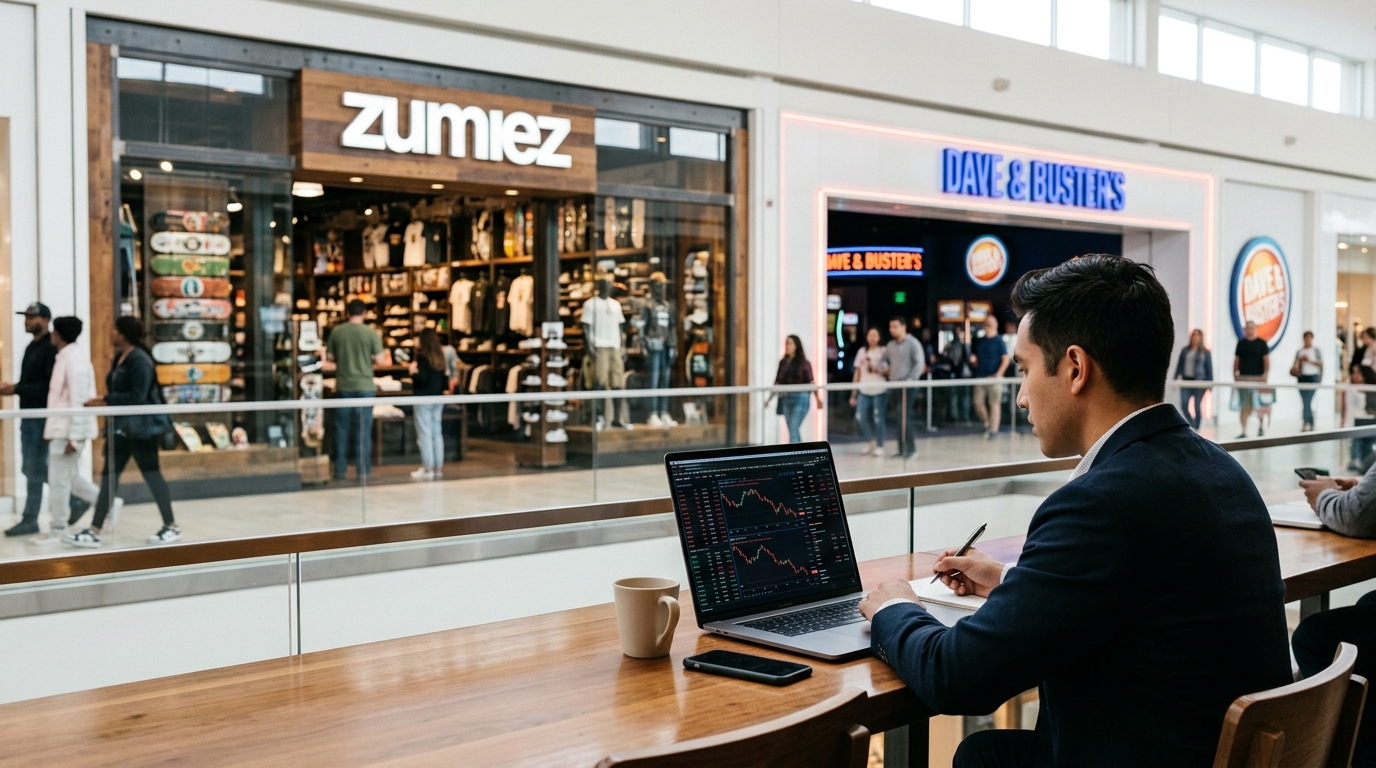
Friday morning, Zumiez opened 16.8% lower at a fresh 52-week low. That kind of gap-down gets traders’ attention. The more important question is whether it deserves yours heading into tonight.
What Happened
Zumiez reported Q2 fiscal 2026 results that missed on both lines, posting a loss of $0.17 per share, wider than the year-ago loss of $0.06 and the consensus estimate of a loss of $0.14. Net sales declined 2.5% year over year to $209 million, missing the consensus of $212 million by about 1.4%. The number that matters most, though, is not the EPS gap.
Weak footwear sales drove 70% of the domestic sales decline. That is a category signal, not just a merchandising stumble. Footwear is one of the most price-sensitive categories in specialty retail, and when traffic softens first in shoes, it tends to precede broader pullbacks in discretionary spending.
Third quarter-to-date net sales are already running down 4.3%, and Zumiez guided Q3 net sales to $222–$226 million with projected EPS between $0.00 and $0.10. That compares with earnings of $0.55 per share in Q3 fiscal 2025, reflecting management’s cautious stance following weaker back-to-school trends. Back-to-school is supposed to be the easiest quarter Zumiez has. That it is already struggling tells you something.
Why It Matters Beyond ZUMZ
The reflex trade after a gap-down like this is to hunt for contagion or look for a bounce. Neither is useful before you answer a simpler question: is this a Zumiez problem or a consumer problem?
Here is how to run that test. Look for corroboration across categories and price points. This year has provided plenty. Reuters reported in late May that shares of Gap and American Eagle tumbled more than 12% after both retailers issued weak forecasts, signaling pressure on consumer discretionary spending. Meanwhile, the University of Michigan’s Surveys of Consumers showed its consumer sentiment index fell to 44.8 in May 2026, which the University of Michigan and the Associated Press described as a record low. American Eagle’s peer Abercrombie and Urban Outfitters, by contrast, moved only modestly when AEO gapped down, suggesting the earlier AEO decline was more company-specific than sector-wide.
That context is what makes tonight meaningful. Dave & Buster’s will report financial results for its second quarter ended August 4, 2026, after the market closes today (September 14, 2026). Entertainment spending and specialty apparel footwear are different animals, but both are purely discretionary. If Dave & Buster’s confirms weakness, the category signal from Zumiez gets heavier.
Dave & Buster’s was already in trouble entering tonight. The company reported a 5.4% comparable store sales decline for Q1, citing both internal and external challenges. Management also acknowledged continued pressure on lower-income consumers, noting that it was seeing more pressure on the low end. Executives said Q2 trends entering the quarter were running at roughly negative 4% comparable sales, with management forecasting a return to positive comps for the rest of the year driven by new games, World Cup activations and a revitalized loyalty program. Tonight is the moment of truth on that claim.
How Professionals Are Reading This
Disciplined traders do not chase gap-downs and they do not fade them reflexively either. They use the gap as a forced question: what does this close confirm or deny about something you already thought was true?
Zumiez’s Q2 miss confirms that the lower-income consumer is cutting purchases that feel optional, and that footwear is an early indicator of that pressure. It does not, by itself, confirm that the entire consumer discretionary space is in trouble. When AEO dropped sharply earlier this year, peers Abercrombie and Urban Outfitters slipped far less, suggesting single-name issues rather than a broad sector shift at that moment. That distinction is exactly what Dave & Buster’s results tonight will help clarify.
Watch PLAY’s comparable sales figure and any commentary on traffic trends from lower-income guests. If Dave & Buster’s echoes the same language Zumiez’s CEO used about softness in domestic traffic, the category signal hardens. If PLAY shows stabilization or improvement in line with what management guided in June, the Zumiez result stays more isolated.
The Trader’s Lesson
A 16.8% gap-down is noise until you decide what question it is answering. Zumiez is asking whether the consumer has stopped buying things they want but do not need. Dave & Buster’s tonight is the next data point in that answer. Read one close in isolation and you are guessing. Read two in the same week, across categories, and you are building a position with evidence behind it. That is the difference between reacting to a stock and understanding a market.