

Every American Should Unlock Their IRA/401k In 2026
Most Americans have no idea their Retirement Plan is locked down.

Let’s say you’re at a restaurant – you can order anything you want, as long as it’s on the menu.
But what if you found out you have a fish allergy, and you’re at a seafood restaurant?
Because if you’ve had an employer 401(k), then you remember seeing the options:
You can invest in anything you want, as long as it’s on the menu. Same thing with many IRA plans.
But what happens if everything on the menu can make you sick?
That’s what many Americans are facing right now. Because whether you order the S&P Index Fund, the 60/40 Stocks and Bonds mix, or any other combination on the menu…
All the ingredients come from the same kitchen – the stock market.
And you already know the stock market has made people sick.
The ups and downs can be nauseating.
Now that’s not a problem if you’re a few decades away from retirement, because you can ride out the storm, and things could likely turn in your favor.
But when you’re already retired, or about to retire, then the game changes.
Because it’s not about growing your assets anymore, it’s about preserving your assets, right?
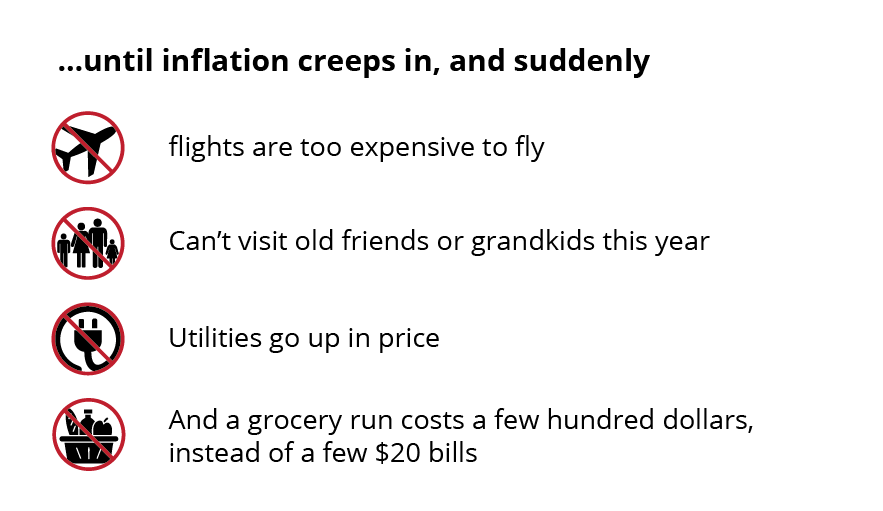
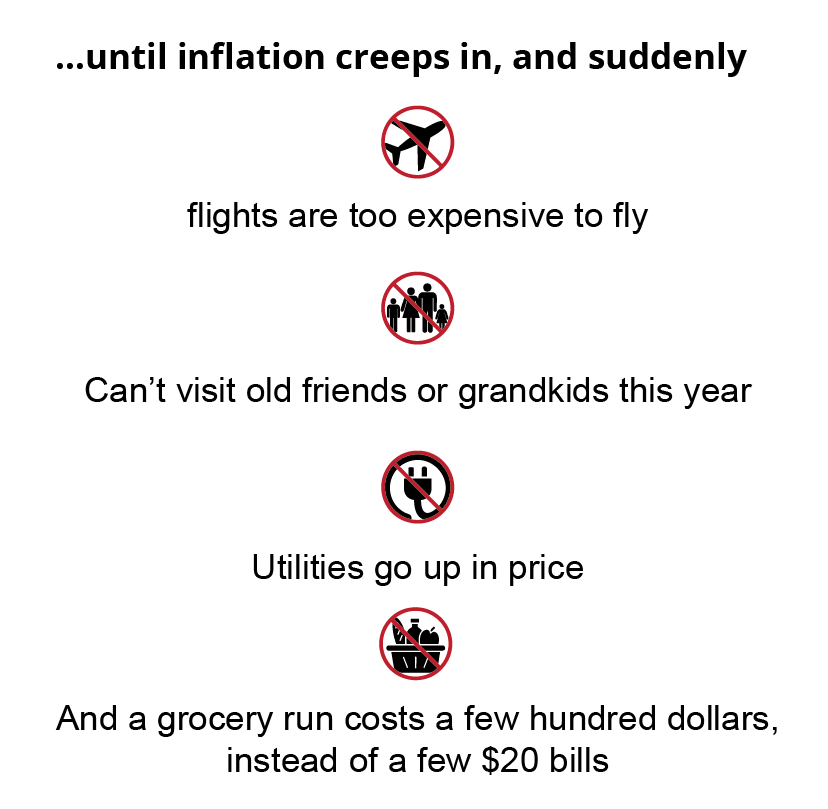
That means if you have $1 million saved for retirement…
Then you expect that million to pay for your travel, gifts, visits to family and grandkids…
For the rest of your life. Literally! And that’s a great plan.
So how do you tackle the problem?
You could hope the stock market rockets up again, and grows your retirement…
Or you could look at assets that help defend against inflation.
Except the problem is, many IRAs and 401(k)s can be locked out of inflation-defending assets.
But it doesn’t have to be that way.
Because right now, thousands of Americans have figured out how to UNLOCK their IRA/401(k) so they can diversify a portion of their retirement savings into assets that help defend against inflation.
That’s why we put together this free guide.
It’s a brief, to-the-point handbook that shows you:
- The IRS Rule That Lets You Access Locked Retirement Funds
- Who Really Controls Your Retirement Savings
- How To Transition To An Unlocked IRA

And it’s completely free to get a copy.
So what you do with your retirement savings is your business, but at the very least, you should be educated about your options.
But of course, the choice is yours.
Small Caps in Correction, Dow Up, Three Different Markets

Three major indexes finished the week of October 12 to 16 pointing in three different directions. That alone is worth studying. The Nasdaq Composite fell 4.48% for the week. The S&P 500 dropped 1.95%. The Dow Jones Industrial Average rose 0.67%, marking its second consecutive week of gains. The gap between the Nasdaq’s weekly loss and the Dow’s gain was the widest since July 2002.
And then there is the Russell 2000, which told its own story entirely.
The Russell 2000 entered correction territory with Wednesday’s plunge as rising inflation and interest rates pushed the riskiest stocks below key averages. The small-caps gauge has now fallen more than 10% from its most recent peak, marking its first technical correction since March. Since its August high, the index has fallen about 11%, and the October 14 sell-off was broad: for every stock in the index that rose, roughly five fell.
Why Small Caps Are Bearing the Brunt
The mechanism is not complicated, but it is worth being precise about. The core driver behind the small-cap selloff is the relentless climb in long-term Treasury yields. The 10-year briefly touched about 5.36% intraday on October 7 before easing back toward the low 5.3% range. Rising yields directly compress valuations of risk assets while simultaneously driving up corporate borrowing costs. Smaller companies carry far more floating-rate debt than their large-cap counterparts, which means every basis point of yield increase hits their income statements faster and harder.
Higher inflation and rates are causing investors to prefer large-cap firms with strong free cash flow, reducing investment in small-cap and cyclical stocks. The Dow, by contrast, benefited from stronger performance in energy, consumer staples and other non-technology sectors, exactly the kind of cash-generative, rate-tolerant businesses that hold up when the cost of capital rises.
BCA Research has argued that the economic impact of rising rates can show up with a lag. That is the part traders should take seriously. The correction may be reflecting damage that has not yet fully appeared in earnings reports.
How Professionals Read a Divergence This Wide
Experienced traders treat index divergence as information about where money is actually moving, not just where it is leaving. When the Dow rises while small caps correct and tech collapses, capital is rotating toward earnings certainty. On Thursday alone, the Dow jumped 556 points, and Home Depot was among the session’s notable leaders. It was a rotation so clean it looked deliberate.
The Russell 2000’s breadth reading reinforces this. Five stocks falling for every one rising is not a sector story. It is a risk-appetite story.
What the FOMC Adds to the Picture
All of this lands ten days before the October 27 to 28 FOMC meeting. Markets are leaning toward a hold, but they still assign meaningful odds to at least one more hike later in 2026, with December very much in play. The base case among many economists and strategists is a hawkish hold: the Fed keeps rates where they are in October and leaves the door open for December.
Rising long-term yields do not stop at equity valuations. The same 10-year Treasury climb driving small-cap borrowing costs higher has frozen the mortgage market and reshuffled which sectors absorb the damage.
That is the context small-cap investors are sitting inside. A hold on October 28 does not resolve the pressure; it defers it. If December remains live, floating-rate borrowing costs for Russell 2000 companies are not coming down anytime soon.
The Trader’s Lesson
This week illustrated one of the most useful skills in active trading: reading what indexes tell you about each other. The Dow’s gain was not a sign that everything is fine. It was a sign that money moved somewhere specific for a reason. When breadth collapses inside a correction while one index rises, the market is communicating a preference, and that preference deserves more attention than any single price move does. Watch where relative strength is being built, not just where losses are accumulating.